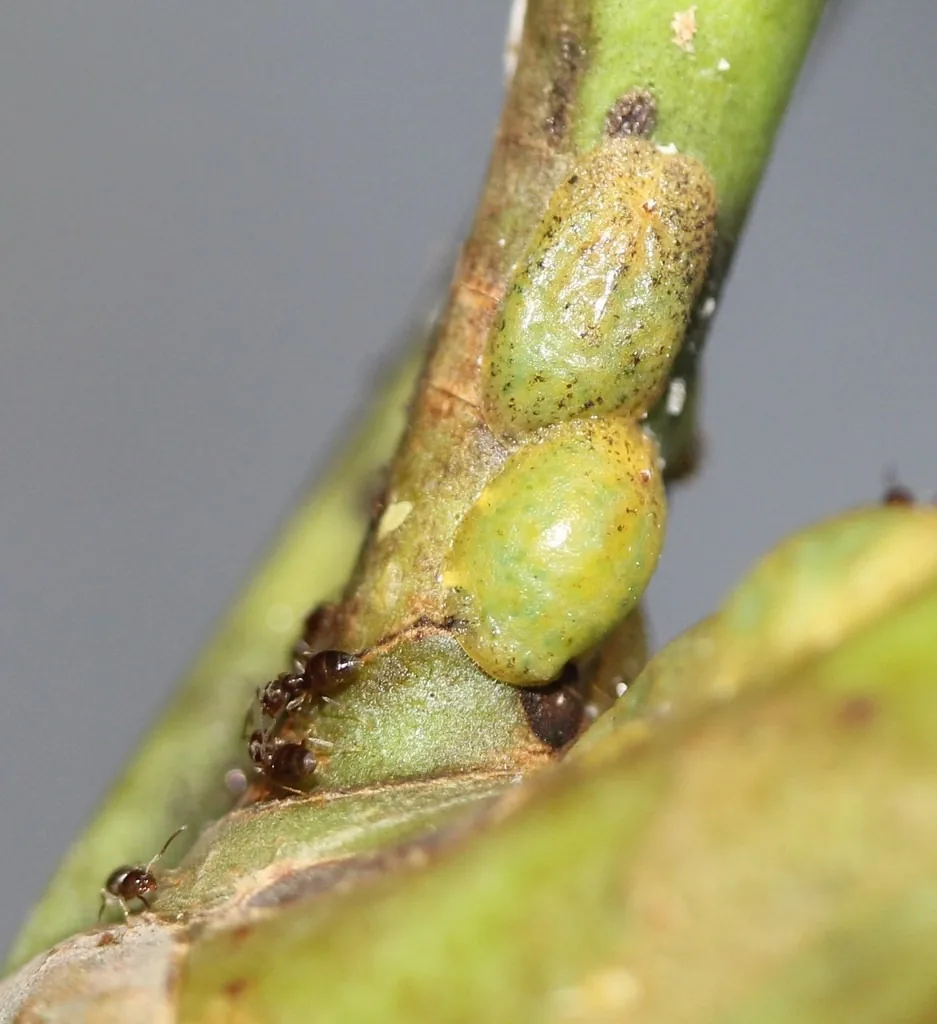
How to identify it
Look-alikes
| Look-alike | How to tell them apart |
|---|---|
| Other scale insects | Croton scale was different enough to be placed in a new genus.[1] |
Where it lives
It has been found in 21 Florida counties, plus Guatemala, Barbados, Guadeloupe and Hawaii; its native home is unknown.[1]
Biology and life cycle
Females gather densely on the undersides of leaves.[1]
Some 72 host plants have been recorded in Florida, including guava, mango and croton.[1]
Damage and signs
- Females produce lots of honeydew, which grows sooty mold that blocks sunlight and leads to plant decline.[1]
Health risk
It feeds on plants; UF/IFAS mentions no risk to people.[1]
Control
Prevention
Watch for ants: follow their trails on the plant to find scale infestations.[1]
Biological control
A lady beetle preys on croton scale and has been recommended for release a few days after an insecticide application.[1]
Common questions
Sources
- University of Florida IFAS Extension (Featured Creatures), “Croton Scale, Phalacrococcus howertoni (EENY-768).” edis.ifas.ufl.edu/publication/IN1335 (accessed 2026-10-06)
- iNaturalist, “Phalacrococcus howertoni taxon page (order and family).” www.inaturalist.org/taxa/804291 (accessed 2026-10-06)