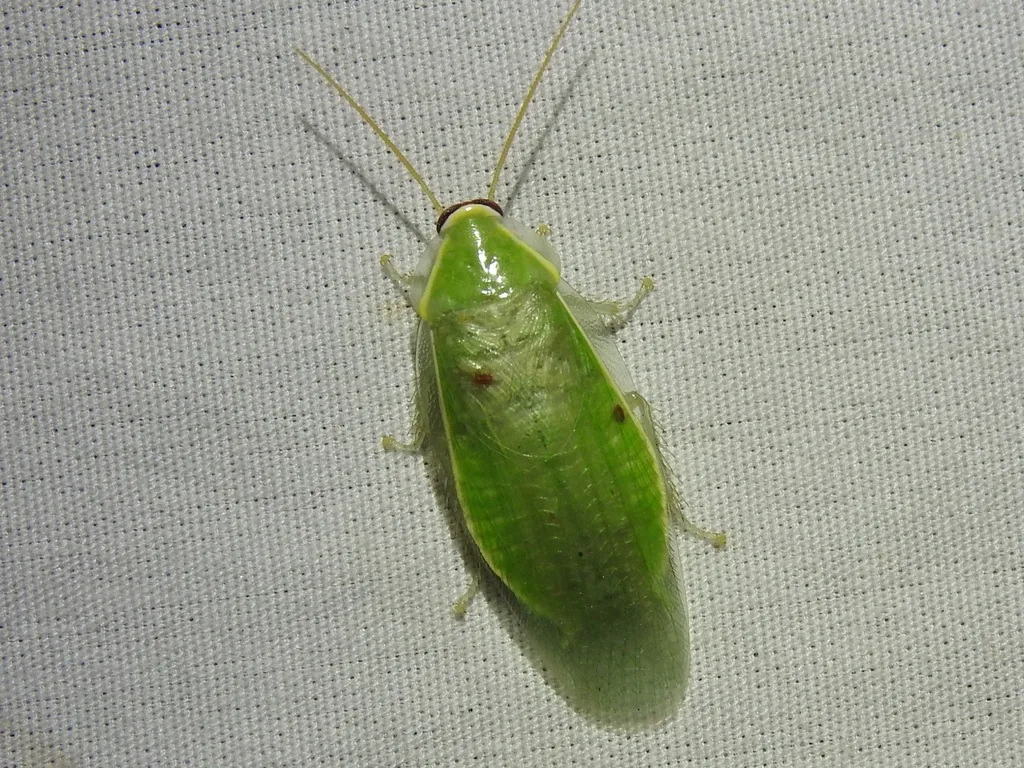
How to identify it
- Adults are pale to bright green and about 7/8 to 1 inch (20 to 25 mm) long.[1][2]
- There's a thin yellow margin along the front edge of the shield behind the head and the front of the wing covers.[1][2]
- Nymphs look nothing like the adults: they are dark brown to black until their final molt.[1][2]
- Adults are strong fliers and are drawn to lights, including ultraviolet light, at night.[1][3]
Where it lives
A tropical species native to Cuba and common in Central and northern South America. In the U.S. it lives near the Gulf Coast: mainly peninsular Florida, coastal Louisiana and eastern Texas from the coast to Central Texas.[1][2][3]
Biology and life cycle
Eggs develop inside the female's body for about two months, and she gives birth to an average of about 30 live nymphs at a time.[1][2]
Development from egg to adult averages about 144 days for males and 181 days for females, and adults may live about 150 days.[1]
Outdoors it lives in trees, shrubs and other plants, and in piles of lumber, leaves and mulch.[2]
It likely reached the U.S. in banana shipments, and it is also sold as a pet, which has led to escapes.[2]
Damage and signs
Health risk
It is not considered an indoor pest and usually isn't found inside unless kept as a pet.[2]
Control
Prevention
Turn off outdoor lights when you can, since adults are active at night and fly toward light.[2][1]
Sanitation
Scatter woodpiles and get rid of leaf piles to remove the shelter this roach prefers.[2]
Common questions
- What is the bright green cockroach I found?
- In Florida and along the Gulf Coast, it's most likely the Cuban, or green banana, cockroach, a pale green outdoor species attracted to lights.[1][2]
- Will green banana cockroaches infest my home?
- No. They can't develop and reproduce indoors, so ones that fly in are accidental visitors.[2]
- Why are the babies brown if the adults are green?
- Nymphs are dark brown to black and only take on the green adult color after their final molt.[1][2]
Sources
- University of Florida, Department of Entomology and Nematology, “Cuban cockroach, Panchlora nivea (Cockroach image gallery).” entnemdept.ufl.edu/projex/gallery/dl/cockroaches/text/cuban_cockroach.htm (accessed 2026-10-06)
- Texas Invasive Species Institute, “Green Banana Cockroach / Cuban Cockroach, Panchlora nivea (invasive species database).” tsusinvasives.org/home/database/panchlora-nivea (accessed 2026-10-06). University-based invasive species institute database entry.
- Texas A&M AgriLife Extension Service, Cooperative Extension Program, “Blattodea-Blaberidae-Panchlora nivea-Green Banana Cockroach (insect image record, June 9, 2018).” elp.tamu.edu/ipm/bugs/blattodea-termites-cockroaches/blattodea-blaberidae-panchlora-nivea-green-banana-cockroach-a-2/ (accessed 2026-10-06)
- iNaturalist, “Panchlora nivea taxon page (order and family).” www.inaturalist.org/taxa/244906 (accessed 2026-10-06)