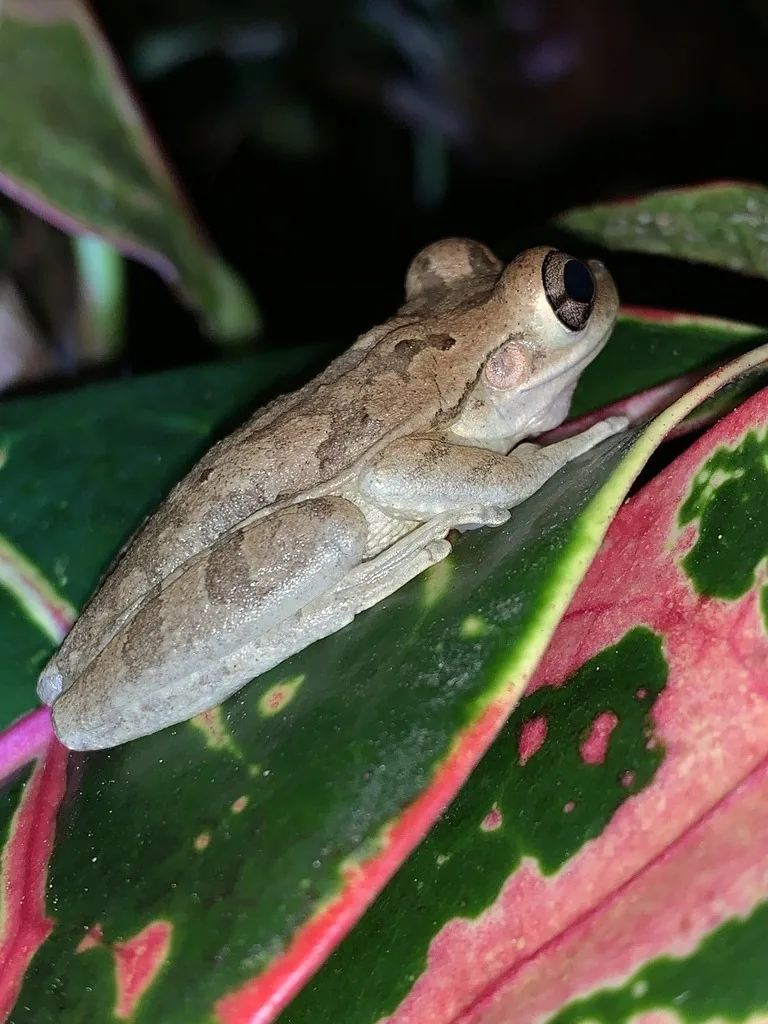
How to identify it
- It is Florida's largest treefrog: most are 1.5 to 2.5 inches long, but females can top 6 inches, and any Florida treefrog over 3 inches is almost certainly this species.[1]
- Look for large bulging eyes, unusually big round toe pads, and warts of different sizes scattered over the back but not on top of the head.[1]
- Color varies from creamy white or light brown to green, gray or dark brown, often with wavy blotches on the back and bands on the hind legs.[1]
- A yellow wash often shows where the legs meet the body, and once a frog passes about an inch long, the skin on top of its head is fused to the skull.[1]
- Young frogs have a light, jagged line from the eye to the hind leg and bluish bones that show through the leg muscles.[1]
Look-alikes
| Look-alike | How to tell them apart |
|---|---|
| Barking treefrog and Cope's gray treefrog (native) | These native frogs can look similar but are generally smaller, with smaller eyes and toe pads; confirm the identification before removing any frog.[1] |
| Squirrel and green treefrogs (native) | Native treefrogs rarely enter homes and are smaller, which makes them easy prey for Cuban treefrogs.[1] |
Where it lives
Native to Cuba, the Bahamas and the Cayman Islands. It is established throughout peninsular Florida and parts of the Panhandle, with breeding populations documented in Georgia and Louisiana.[1]
Biology and life cycle
It first appeared in the Florida Keys in the 1920s and spreads by hitching rides on ornamental plants, cars, trucks, campers and boats.[1]
By day it hides in tight spaces such as tree cavities, behind storm shutters and vinyl siding, and in other crevices around buildings.[1]
At night it sits near lights and waits for insects, and it also eats snails, spiders, lizards, small snakes and other frogs, including its own kind.[1]
Breeding peaks in spring and summer after warm rains; females lay eggs as a floating film of evenly spaced black dots on the water surface.[1]
Tadpoles develop in very small amounts of water, such as buckets, bird baths, ornamental ponds, wading pools and swimming pools.[1]
Males make a raspy call that sounds like a squeaking door, often loudest in the hours before dawn.[1]
Damage and signs
- It preys on native treefrogs and appears responsible for their decline around homes, and its tadpoles outcompete some native tadpoles.[1]
- Frogs can enter roof vent pipes and end up in toilets, and they have clogged sink drains.[1]
- They get into transformer boxes and electrical switches and can cause short circuits and power outages; they may also enter pump housings and A/C units.[1]
- Droppings build up on walls and windows near lights, and frogs may jump onto people or in through open doors at night.[1]
Health risk
Its sticky skin secretion causes burning and itching of the eyes and nose that can last over an hour, so handle frogs with gloves. Pets that bite one may drool heavily, and some have had seizures.[1]
Control
Prevention
Turn off unneeded lights at night and use yellow bug lights to attract fewer of the insects the frogs eat.[1]
Check boats, kayaks and camper awnings for hiding frogs before leaving an area where they live, so you don't spread them.[1]
Keep them out
Cover roof plumbing vents with screen or hardware cloth to keep frogs out of toilets and drains.[1]
Sanitation
Dump standing water from buckets, coolers and toys, keep pools properly maintained, and empty bird baths where tadpoles are found.[1]
Traps and physical control
Capture frogs with a plastic bag used as a glove, or set 3-foot lengths of thin PVC pipe upright in the ground near plants as hiding spots you can check.[1]
Skim egg films from ornamental ponds with a fine aquarium net, ideally the morning after rain, and remove Cuban treefrog tadpoles.[1]
UF/IFAS recommends humane euthanasia after confirming the species: chill the bagged frog in a refrigerator for 3 to 4 hours, then freeze it for 24 hours, or apply benzocaine ointment before freezing.[1]
What not to do
UF/IFAS warns against killing the frogs with bug spray, insecticide, bleach, sunscreen or other household chemicals.[1]
Never put a live frog in the trash, and put any native frogs you catch back where you found them.[1]
Don't rescue tadpoles from buckets and bird baths in Cuban treefrog areas; they are probably Cuban treefrogs, and dumping the water is the recommended approach.[1]
Common questions
- Why is there a frog in my toilet?
- In Florida it is very likely a Cuban treefrog that came in through a roof vent pipe; screening the vents prevents it.[1]
- Can Cuban treefrogs carry rat lungworm?
- A rat lungworm parasite was found in one Cuban treefrog in 2022. People are infected by eating raw or undercooked infected animals such as frogs, not by handling them.[1][2]
- Are Cuban treefrogs poisonous to dogs?
- Their secretions are far less toxic than a cane toad's and are not considered lethal, but they irritate a pet's mouth and some pets have had seizures, so keep dogs and cats away from them.[1]
Sources
- University of Florida IFAS Extension (EDIS), “The Cuban Treefrog in Florida (EDIS publication UW259).” edis.ifas.ufl.edu/publication/UW259 (accessed 2026-10-06)
- Centers for Disease Control and Prevention, “About Rat Lungworm Disease (June 24, 2024).” www.cdc.gov/angiostrongylus/about/index.html (accessed 2026-10-06)
- iNaturalist, “Osteopilus septentrionalis taxon page (order and family).” www.inaturalist.org/taxa/24382 (accessed 2026-10-06)