How to identify it
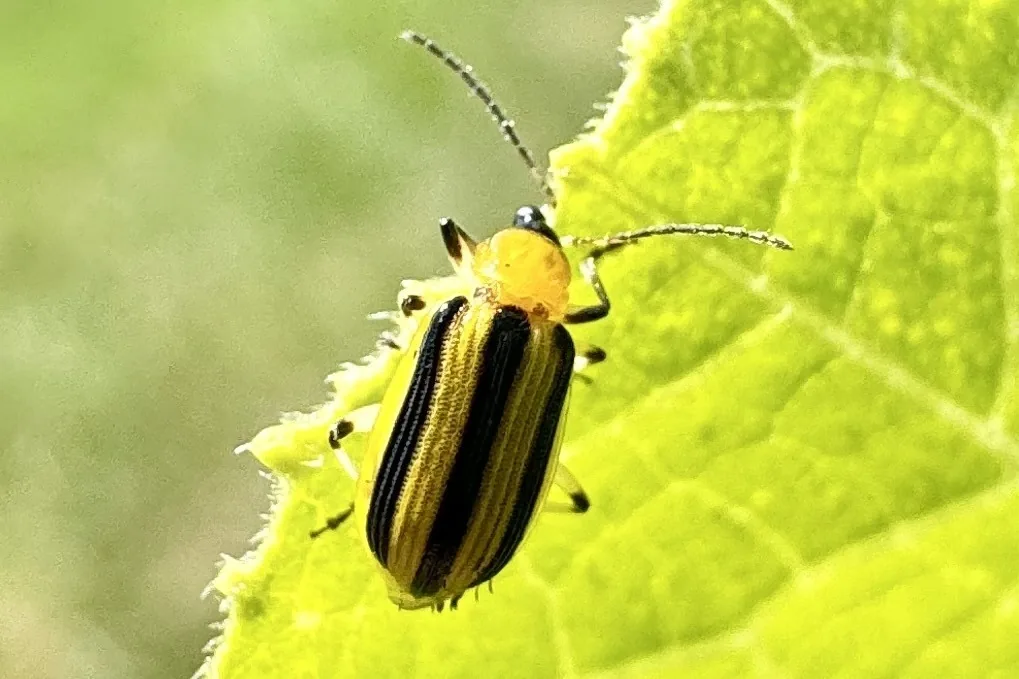
- This page centers on the striped cucumber beetle, Acalymma vittatum, a beetle about 1/5 to 1/4 inch long with yellow wing covers and three black stripes.[1][2]
- Its head and antennae are black and the area just behind the head is orange; the antennae are long and threadlike.[1][3]
- The spotted cucumber beetle, also called the southern corn rootworm, is about the same size but yellow-green with 12 black spots instead of stripes.[2][1]
- Larvae are slender, creamy white grubs about 3/8 inch long that live in the soil, and eggs are pale orange-yellow, laid at the base of plants.[1][3]
Look-alikes
| Look-alike | How to tell them apart |
|---|---|
| Western corn rootworm | The striped cucumber beetle has straighter stripes than the western corn rootworm, and the middle segment of its hind leg is yellow rather than black.[2] |
| Lady beetles | Cucumber beetles are sometimes mistaken for predatory lady beetles, but lady beetles have short, stubby antennae, not long threadlike ones.[3] |
| Western striped and western spotted cucumber beetles | In California the most common species is the western spotted cucumber beetle; the western striped cucumber beetle, a separate species, is yellowish orange with three black stripes.[3] |
Where it lives
Striped cucumber beetles are pests from Minnesota to Kentucky; spotted cucumber beetles do not survive Minnesota winters and fly in from the South in early summer, while California has its own western species.[1][2][3]
Biology and life cycle
Adults spend the winter in leaf litter and sheltered spots near buildings, fence rows and wood lots, and find host plants quickly in spring.[2][1]
Females lay eggs in soil cracks at the base of cucurbits; the larvae feed on roots and underground stems, then pupate in the soil.[2][1]
Going from egg to adult takes about 40 to 60 days, and Minnesota usually sees one generation a year.[1]
Kentucky growers typically see a spring peak in beetle activity lasting two to four weeks, the most important time to protect plants.[2]
Damage and signs
- Adults chew leaves, stems and blossoms and can strip small plants completely; feeding hurts most up to about the third true leaf.[1][2]
- Striped beetles can carry the bacteria that cause bacterial wilt, which plugs the plant's water-conducting tissue so vines wilt and die.[2][1]
- Cucumbers and muskmelons are very susceptible to bacterial wilt, while watermelon is not, and pumpkins and winter squash tolerate heavy leaf loss once past the third leaf.[1][2]
- To check for wilt, cut a wilted stem and slowly pull the cut ends apart; sticky sap that strings out like rope points to bacteria.[2]
- Late-season feeding on fruit rinds and pollen is mostly cosmetic, and larval root feeding is usually minor compared with wilt losses.[1][2][3]
Health risk
Cucumber beetles harm plants, not people; the concern is crop loss from feeding and from bacterial wilt and other cucurbit diseases they spread.[2][3]
Control
Prevention
Plant a trap crop such as Blue Hubbard squash a week or two ahead of your main cucurbits to draw early beetles away.[1]
Keep them out
Cover seedlings with row cover, screens or cones as they emerge, and remove the cover when plants start flowering so bees can pollinate.[2][1][3]
Sanitation
Pull weeds around the garden, remove plants showing bacterial wilt promptly, and clear debris and leaf litter after the season.[1]
Traps and physical control
In small gardens, knock beetles into a bucket of soapy water, and spread thick straw around established plants to hinder egg-laying.[1]
Biological control
Various general predators attack cucumber beetles, though older plants can usually carry substantial numbers without serious harm.[3]
Pesticides
Minnesota Extension suggests treating seedlings when a quarter of plants have two or more beetles, or older plants when they are about 25 percent defoliated.[1]
Infected plants cannot be saved, so any control must stop beetles feeding early; spray before 8 a.m. or after 6 p.m. to protect bees.[2][1]
Common questions
- Why did my cucumber vine suddenly wilt and die?
- Bacterial wilt spread by striped cucumber beetles is a common cause; a wilted leaf spreads to the whole vine, and sticky, stringy sap in a cut stem confirms it.[2]
- Do I need to worry about cucumber beetles on pumpkins and squash?
- Mainly while plants are small. Once squash and pumpkins have four or more leaves they tolerate feeding, while cucumbers and melons stay at risk all season.[1]
- Are the beetles in my squash flowers hurting the crop?
- Usually not. Beetles feeding on pollen and blossoms after flowering begins do not reduce yield, and late-season fruit feeding is cosmetic.[1]
Sources
- University of Minnesota Extension, “Cucumber Beetles (reviewed 2026).” extension.umn.edu/garden-and-home/yard-and-garden/yard-and-garden-insects/cucumber-beetles (accessed 2026-10-06)
- University of Kentucky Entomology, “ENTFACT-311: Cucumber Beetles (revised January 2026).” entomology.ca.uky.edu/ef311 (accessed 2026-10-06)
- University of California Statewide IPM Program, “Cucumber Beetles (Pest Notes, Home and Landscape).” ipm.ucanr.edu/home-and-landscape/cucumber-beetles/ (accessed 2026-10-06)
- iNaturalist, “Acalymma vittatum taxon page (order and family).” www.inaturalist.org/taxa/154287 (accessed 2026-10-06)