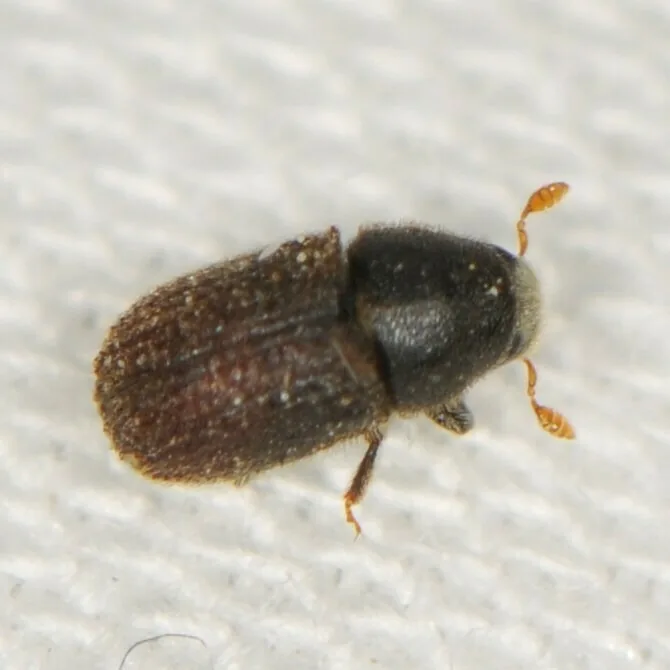
How to identify it
Where it lives
Utah State reports them on Utah and Rocky Mountain juniper, eastern red cedar and cypresses, and Arizona Extension on ornamental Arizona and Leyland cypress.[1][2]
Biology and life cycle
They overwinter as larvae under the bark and usually have one generation a year, sometimes two.[1]
Adults can attack from spring to fall depending on location, mostly mid to late summer in Utah.[1]
Damage and signs
Health risk
Control
Prevention
Keep trees vigorous with deep, infrequent irrigation during drought, and don't overwater.[1][2]
Sanitation
Prune dead or dying branches in winter and remove them from the site.[1]
Pesticides
Where beetles are active, susceptible trees can be protected with a labeled bark spray (carbamate or pyrethroid) on the main stem and branches.[1]
Common questions
- Why are branches on my Arizona cypress dying?
- Cypress bark beetles girdling branches of drought-stressed trees are a common cause.[1][2]
- How do I protect cypress trees from bark beetles?
- Water deeply and infrequently during drought; healthy trees can usually withstand the beetles.[1][2]
- When should infested branches be removed?
- Prune dead or dying material in winter and remove it from the site.[1]
Sources
- Utah State University Extension, “Cedar/Cypress Bark Beetles (Ornamental Pest Guide).” extension.usu.edu/planthealth/ipm/ornamental-pest-guide/arthopods/bark-beetles/cedar-cypress-bark-beetles.php (accessed 2026-10-15)
- University of Arizona Cooperative Extension, “Cypress Bark Beetles (AZ1316, December 2011).” extension.arizona.edu/publication/cypress-bark-beetles (accessed 2026-10-15)
- iNaturalist, “Phloeosinus taxon page (order and family).” www.inaturalist.org/taxa/178452 (accessed 2026-10-06)