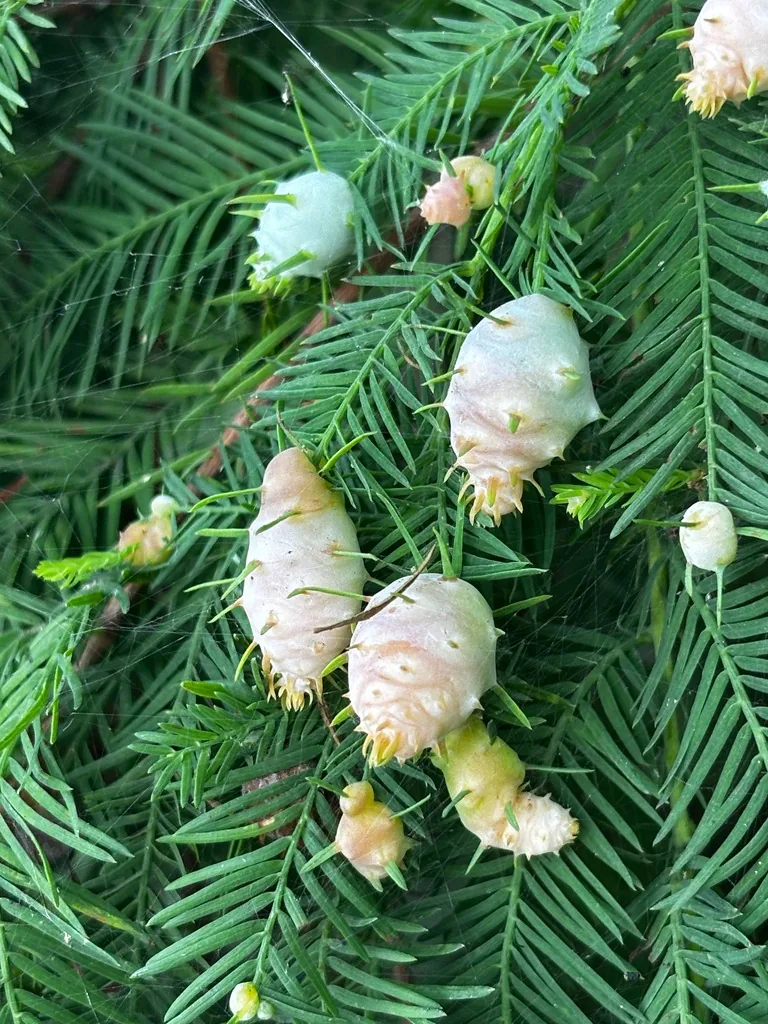
How to identify it
- Galls are oval, 3/4 to 1 1/4 inches long, and look like miniature pineapples; they start pink, turn light green and often look white from a powdery coating, then brown after the adults leave.[1][2]
- Adults are tiny gnat-like flies under 1/8 inch, tan with clear wings and an orange-red (female) or tan-orange (male) abdomen.[1][2]
- Maggots are light orange when young, becoming yellow to orange-red.[1][2]
Where it lives
It attacks bald cypress and pond cypress; NC State and UF/IFAS both cover it.[1][2]
Biology and life cycle
Adults emerge from mid May over an extended period, mate the same day and live only one to two days.[2]
Females lay eggs in clusters on young, succulent foliage, and the maggots cause the gall to form.[1][2]
Damage and signs
Health risk
Control
Sanitation
Collect and destroy fallen galls in autumn or early spring, before the midges become active.[1]
Biological control
At least four species of tiny parasitic wasps attack it and help keep it in check.[1]
Pesticides
Insecticides aren't recommended: the galls don't really harm the tree and there is no good practical treatment.[1]
Common questions
- What are the little pineapple-shaped balls on my bald cypress?
- Galls caused by cypress twig gall midge maggots.[1][2]
- Do cypress galls hurt the tree?
- Not really; they are unsightly, and the leaf dies beyond the gall.[1]
- How do I reduce cypress galls?
- Collect and destroy fallen galls in fall or early spring.[1]
Sources
- NC State Extension, “Cypress Twig Gall Midge.” content.ces.ncsu.edu/cypress-twig-gall-midge (accessed 2026-10-15)
- University of Florida IFAS Extension (Featured Creatures), “Cypress Twig Gall Midge, Taxodiomyia cupressiananassa (EENY-430).” ask.ifas.ufl.edu/publication/IN806 (accessed 2026-10-15)
- iNaturalist, “Taxodiomyia cupressiananassa taxon page (order and family).” www.inaturalist.org/taxa/133713 (accessed 2026-10-06)