How to identify it
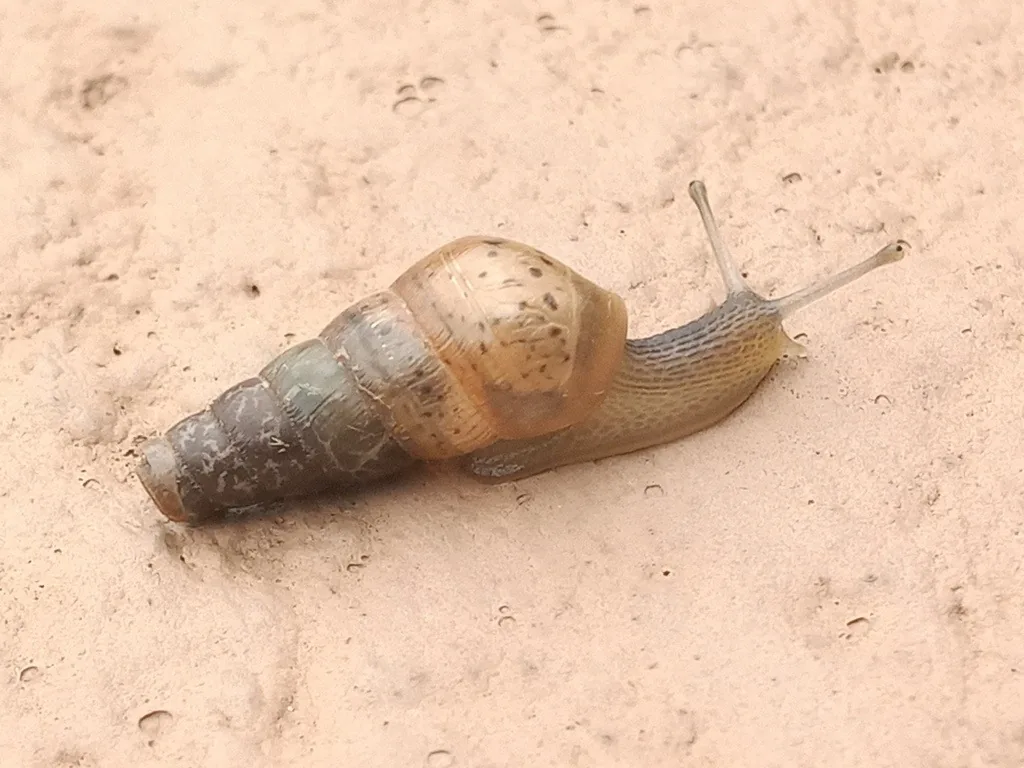
- The shell is pinkish brown, long and tapered, up to about 1-3/5 inches long.[1]
- As it grows the tip breaks off, so older snails keep only four to seven whorls and look blunt-ended.[1]
- The head, antennae and foot are blackish to dark olive-gray.[1]
- Eggs are round, whitish and about 1/12 inch across, laid in topsoil.[1]
Look-alikes
| Look-alike | How to tell them apart |
|---|---|
| Brown garden snail | The pest snail climbs trees and other objects; the decollate stays on soil and litter and climbs only to escape heavy water.[1] |
Where it lives
Native to North Africa and the Mediterranean, it reached Southern California in the 1960s and lives at irrigated sites in Central and Southern California.[1]
Biology and life cycle
Each snail is both male and female; it can self-fertilize but usually mates first.[1]
It matures about 10 months after hatching and lays about 200 eggs a year, up to 500 in a lifetime.[1]
It's active mostly at night and in wet or overcast weather, hiding by day in litter and the top inch of soil.[1]
Damage and signs
Health risk
UC IPM discusses it only as a snail predator and does not mention any risk to people.[1]
Control
Prevention
Don't use snail baits where decollates live, because the baits kill both kinds of snail.[1]
Keep them out
Pruning low tree skirts and using copper trunk barriers stop climbing pest snails without affecting decollates, which rarely climb.[1]
Biological control
Release is legal only in Fresno, Imperial, Kern, Los Angeles, Madera, Orange, Riverside, Santa Barbara, San Bernardino, San Diego, Ventura and Tulare counties; check with the county agricultural commissioner first.[1]
Results aren't consistent, but releases can cut brown garden snails to insignificant levels in four to 10 years.[1]
Common questions
- Can I buy decollate snails anywhere?
- They're sold commercially, but release is legal only in certain California counties; never release them outside those areas.[1]
- Why does the shell look broken?
- The tip naturally breaks off as the snail grows, which is how it gets its name.[1]
- How fast do decollates work?
- Slowly. Expect four to 10 years, and results vary.[1]
Sources
- University of California Statewide IPM Program, “Decollate Snail (Natural Enemies Gallery).” ipm.ucanr.edu/natural-enemies/decollate-snail/ (accessed 2026-10-06)
- iNaturalist, “Rumina decollata taxon page (order and family).” www.inaturalist.org/taxa/125669 (accessed 2026-10-06)