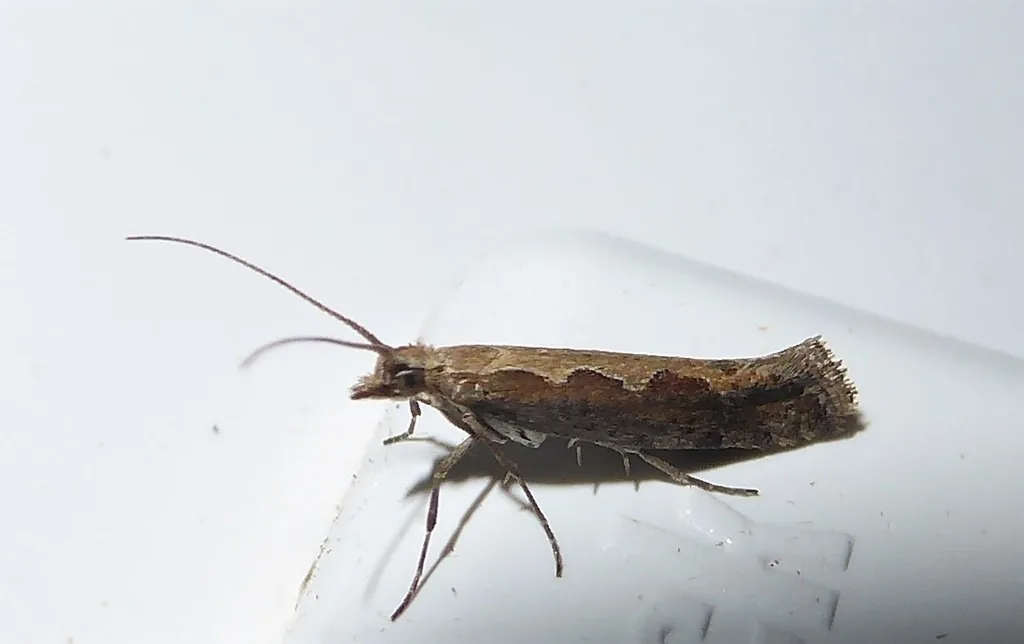
How to identify it
Where it lives
It may be found year round in California and is often abundant in spring and early summer, rising again in fall.[1]
Biology and life cycle
Adults lay tiny eggs singly or in twos and threes under leaves.[1]
Larvae mature in about 10 to 14 days, and there are four to six generations a year.[1]
Damage and signs
Health risk
It feeds on cole crops; UC IPM mentions no risk to people.[1]
Control
Sanitation
Destroy crop culls and mustard-type weeds several weeks before planting.[1]
Biological control
Natural enemies often control it; Diadegma insularis wasps parasitize larvae, and Trichogramma pretiosum may attack eggs.[1]
Bacillus thuringiensis or spinosad sprays are very effective.[1]
Common questions
Sources
- University of California Statewide IPM Program, “Diamondback Moth (Pests in Gardens and Landscapes).” ipm.ucanr.edu/PMG/GARDEN/VEGES/PESTS/diabackmth.html (accessed 2026-10-06)
- iNaturalist, “Plutella xylostella taxon page (order and family).” www.inaturalist.org/taxa/911325 (accessed 2026-10-06)