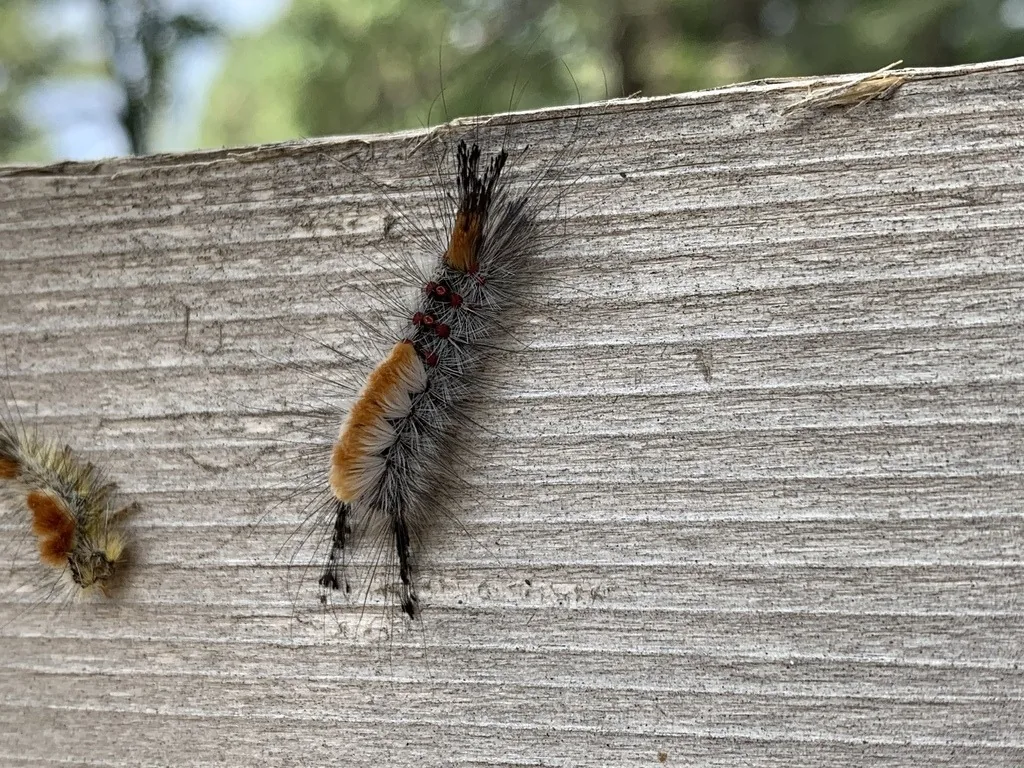
How to identify it
- Mature caterpillars are 1.2 to 1.4 inches, gray to brown with a shiny black head, two long black tufts pointing forward and one backward.[1]
- They carry dense light brown hair patches with red spots and an orange stripe along each side.[1]
- Females are wingless and lay egg masses covered with gray hairs on their cocoons; males have rusty forewings.[1]
Where it lives
CSU Extension covers outbreaks in Colorado landscapes, often near forests, where windblown young caterpillars start infestations.[1]
Biology and life cycle
Eggs overwinter and hatch around bud break, often in late May; tiny caterpillars balloon on the wind to new trees.[1]
Larvae are full grown by mid-July or August, pupate nearby, and moths emerge late July to mid-August; one generation a year.[1]
Damage and signs
- Feeding starts at the top of the tree on new growth; tops can die after a single season of severe defoliation.[1]
Health risk
The caterpillars' hairs can irritate skin and cause a painful rash, though reactions vary widely between people.[1]
Control
Prevention
Survey host trees for egg masses in winter or early spring; few egg masses mean little risk next year.[1]
Biological control
Parasitoids, predators and especially a virus that causes wilt disease usually end outbreaks within a season or two.[1]
Pesticides
If needed, spray the treetop new growth soon after egg hatch, when young larvae are easiest to kill.[1]
Common questions
Sources
- Colorado State University Extension, “Douglas-fir Tussock Moths (Fact Sheet 5.542).” extension.colostate.edu/resource/douglas-fir-tussock-moths/ (accessed 2026-10-06)
- iNaturalist, “Orgyia pseudotsugata taxon page (order and family).” www.inaturalist.org/taxa/48907 (accessed 2026-10-06)