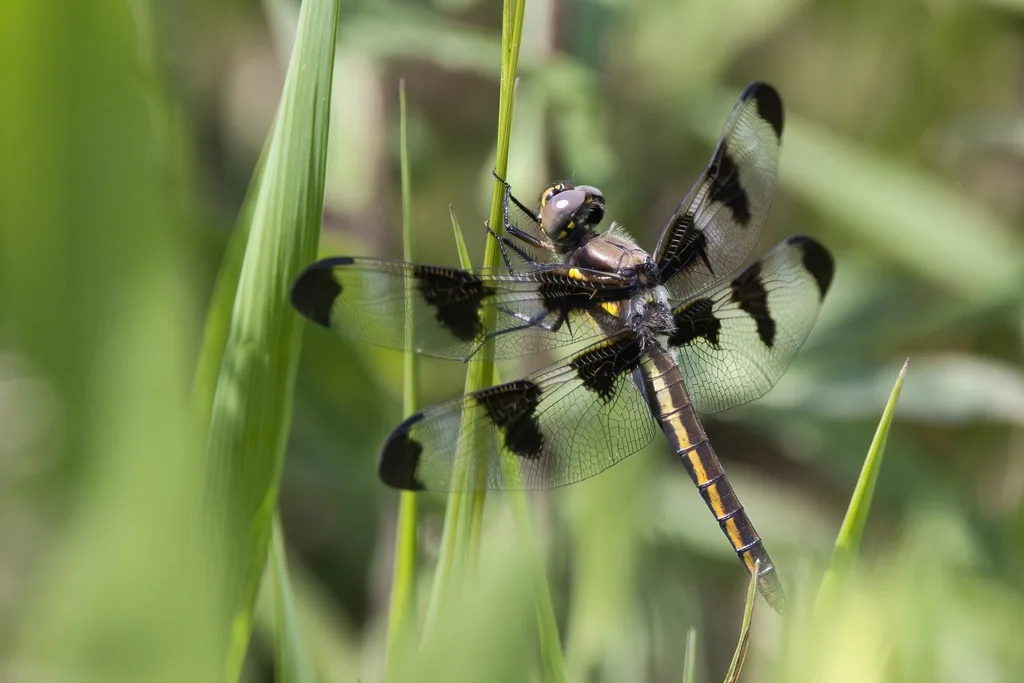
How to identify it
Look-alikes
Where it lives
Adults are most common near water because the young are aquatic. Maine has recorded at least 158 dragonfly species, and Texas 147.[2][3]
Biology and life cycle
Eggs are laid on or near water and hatch in three to five weeks into aquatic nymphs called naiads.[1]
Naiads live in mud or on submerged plants for months to three years, catching prey with a hinged lower lip that shoots out.[1]
Grown naiads climb out on a plant stem, and the adult emerges and expands its wings; adults live up to about six weeks.[1]
Damage and signs
Health risk
Dragonflies can't sting or bite and do no harm to people, pets, plants or houses.[1][3]
Control
Prevention
No control is ever needed; Iowa State calls them entirely beneficial.[1]
Biological control
Don't count on them for mosquito control: many fly by day, when most mosquitoes are less active, and none are sold for release.[3]
A water garden attracts aquatic insects, dragonflies and damselflies among them, if there's no water nearby.[3]
Common questions
- Do dragonflies sting or bite?
- No. They're harmless and can't sting or bite, despite nicknames like horse stinger.[1][3]
- Will dragonflies get rid of my mosquitoes?
- Not on their own. They do eat mosquitoes, but most fly by day, when mosquitoes are less active.[3]
- How do I tell a dragonfly from a damselfly?
- Watch it land: dragonflies rest with wings spread flat, damselflies with wings folded together.[1][2]
Sources
- Iowa State University Extension and Outreach, “Dragonflies and Damselflies (Yard and Garden).” hortnews.extension.iastate.edu/dragonflies-and-damselflies (accessed 2026-10-06)
- University of Maine Cooperative Extension, “Dragonflies (Home and Garden IPM).” extension.umaine.edu/home-and-garden-ipm/fact-sheets/common-name-listing/dragonflies/ (accessed 2026-10-06)
- Texas A&M AgriLife Research, “Questions from our Readers (Dragonflies of Texas).” agrilife.org/dragonfly/questions-from-our-readers/ (accessed 2026-10-06)
- iNaturalist, “Libellula pulchella taxon page (order and family).” www.inaturalist.org/taxa/81495 (accessed 2026-10-06)