❓ Common Questions About Bathroom Drain Fly
How do I confirm I actually have this pest (not something similar)?
The most reliable confirmation is a physical specimen — capture one and compare to reference images on this page. For cryptic pests (bed bugs, termites), look for secondary signs: frass, shed skins, mud tubes, or bites with a specific pattern. When uncertain, a professional inspection is faster than months of misidentification.
Can I treat this myself or do I need a professional?
DIY is effective for small, accessible infestations caught early. Professionals are worth the cost when: the infestation is inside wall voids or structural elements, multiple rooms are affected, you have health-risk pests (hantavirus, venomous species), or DIY has already failed twice.
How long until the infestation is completely gone?
Expect 3–8 weeks for most infestations with proper treatment. Insects with dormant life stages (pupae, eggs) extend the timeline because those stages are impervious to most insecticides. Follow-up treatments at 2 and 4 weeks catch each new cohort as they emerge.
What's the most common mistake people make treating this pest?
Treating only the visible pest population while ignoring the harborage site, entry point, or breeding location. Killing adults provides temporary relief but the population rebuilds from hidden egg cases, pupae, or new arrivals through unaddressed entry points.
Fly identification determines treatment approach
Different fly species require very different treatment because their breeding sites are different. House flies and bottle flies breed in decaying organic matter — garbage, animal waste, dead animals — and adult control without addressing the breeding site produces continuous reinfestation. Fruit flies breed in fermenting fruit and accumulated organic matter in drains. Drain flies (Psychodidae, often called moth flies) breed in slime accumulation inside drains and sewer lines. Phorid flies (humpbacked flies) breed in moist organic matter and indicate broken sewer lines, dead rodents in walls, or accumulated organic debris. Cluster flies enter homes seeking overwintering shelter in fall and don't breed indoors. Treatment that works for one usually doesn't address the others — diagnosis precedes effective treatment.
Common DIY mistakes that defeat otherwise correct treatments
Most DIY pest control failures aren't product failures — they're application failures. The recurring patterns we see across reader emails and field experience: treating only where pests are visible rather than where they live (the active surface is rarely the harborage), spraying repellents over residual products and breaking the residual film, applying baits in already-treated areas (the residual kills foragers before they return with bait), overdiluting product because 'less chemical is safer' (it's not — it accelerates resistance), expecting overnight results when the kill curve is two to four weeks for most products, and stopping treatment at the first sign of improvement rather than completing the protocol. Each of these failure modes is independently preventable with attention to the product label and the pest's biology, and avoiding them improves outcomes more than upgrading to a more expensive product.
Fruit fly elimination protocol
Fruit flies appear suddenly during warm months and persist as long as breeding sites are available. Find and eliminate all sources: overripe fruit on counters, fruit residue in compost bins (especially indoor bins), drain residue (run hot water and drain cleaner monthly), recycling containers with sugary residue, mops and cleaning supplies stored damp, plant pot saucers with stagnant water, and rotting onions or potatoes in storage. Adult fly control: apple cider vinegar traps (vinegar in a jar with plastic wrap over the top, several pinholes; flies enter but can't exit) reduce visible adults while breeding sites are being eliminated. Treatment without source elimination produces temporary results; thorough source elimination usually resolves fruit fly problems within a week or two.
Drain fly diagnosis and treatment
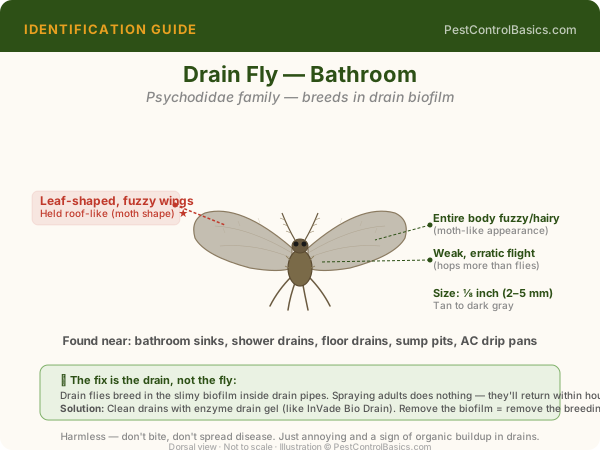
Drain flies appear in bathrooms, kitchens, and basements, usually near floor drains or seldom-used sinks. They breed in the biofilm slime accumulated inside drain pipes, garbage disposals, and sewer p-traps that aren't getting regular use. Diagnosis: tape a piece of clear tape over a suspected drain overnight (sticky side down, not sealing the drain completely) — adult flies emerging from the drain stick to the tape and confirm the source. Treatment: physical cleaning of the drain interior (a stiff drain brush or bottle brush, drain cleaner, then enzymatic drain treatment for ongoing biofilm reduction) is more effective than insecticide. Seldom-used floor drains in basements often dry out and lose their water seal, allowing flies from sewer lines; pouring water down them weekly maintains the trap and prevents fly migration.
When to escalate from DIY to professional
DIY pest control is appropriate for most common household pests when caught early and treated correctly. Escalation to a licensed professional makes sense in specific situations, not just when frustration builds. Wall-void and structural infestations — termites, carpenter ants, rodents nesting inside walls — usually require equipment and access homeowners don't have. Bedbugs at moderate-to-heavy infestation levels almost always require professional treatment; DIY rarely succeeds past the first few isolated bugs. Multi-unit dwellings (apartments, condos) need building-wide coordination that individual unit treatments can't replicate. Health-sensitive households — anaphylaxis risk to stings, immunocompromised individuals, pregnancy, infants — should default to professional because professionals can use the lowest-toxicity option that solves the problem rather than what's available at retail. The financial break-point is roughly when DIY material costs approach one professional visit; below that, DIY is usually fine.
Drain fly elimination: physical cleaning over chemicals
Drain flies (Psychodidae, also called moth flies) breed in the biofilm that accumulates in drain p-traps, garbage disposals, and overflow drains; they appear as small fuzzy flies near sinks, particularly in bathrooms and basement utility sinks. The diagnostic is taping a clear bag over a suspected drain overnight; emerging adults inside the bag the next morning confirm the source. Treatment focuses on physical removal of the biofilm rather than chemical intervention. The effective protocol: pour boiling water down the drain to loosen biofilm, scrub the inside of the drain pipe with a stiff drain brush (available for a few dollars at hardware stores), apply an enzymatic drain cleaner (not bleach or chemical drain opener, which doesn't address biofilm), repeat for several consecutive days, and address any rarely-used drains that may have lost their water seal and become breeding sites. Bleach treatments and pesticide pour-downs typically don't reach the breeding biofilm and produce poor results. Once treatment is complete, periodic monthly drain maintenance with enzymatic cleaner prevents biofilm rebuild.
The cost of doing nothing: implicit pest tolerance and its hidden expenses
Pest control discussions usually frame the costs of treatment without quantifying the costs of non-treatment, but the latter are often larger and almost always less visible. Cockroach allergens add measurable healthcare costs in homes with asthma. Rodent activity in attics damages insulation (reducing R-value and adding seasonal heating and cooling costs) and creates fire risk through wire chewing that doesn't show up until something fails. Termite damage in unmonitored properties produces structural repair bills in the five-figure range, often discovered during unrelated renovation. Stored-product pests destroy food inventory at rates that aren't tracked because items are discarded individually rather than tallied. The cumulative cost of doing nothing isn't a single line item but a sum of small chronic losses across years. The framing that helps: pest control isn't a luxury expense layered onto a working baseline; it's a maintenance expense that competes with the slow accumulating cost of allowing a problem to continue. Households running the comparison honestly almost always find that modest preventive spending is the cheaper path.
Fruit fly source diagnostics: where they're actually coming from
Fruit fly outbreaks have specific sources that range beyond the obvious ripe fruit, and identifying the actual breeding source is more useful than general home cleaning. The most common sources: ripening or damaged fruit (the well-known case), rotting potatoes and onions in storage (often overlooked because they don't smell strongly until well into decay), poorly-cleaned garbage disposals with food residue in the housing, recycling bins with residual liquid from beverage containers, mop heads stored damp, sponges holding food residue, drains in floor traps (rarely used but breeding sites if the seal has dried out), and damp newspaper or cardboard recycling stacks. Apple cider vinegar traps with dish soap surface tension breaker catch adult fruit flies and help confirm elimination — declining trap catches over days indicate the breeding source has been removed. Treatment that addresses only adults (sprays, traps alone) without finding and eliminating the breeding source fails to produce durable results.
Drain fly biofilm: the actual treatment target
Drain fly larvae feed on the biofilm — the layer of microbial growth and organic debris — that accumulates inside drain pipes, particularly in floor drains, infrequently-used sinks, and shower drains. Adult drain flies emerging from a drain are a downstream symptom; the population is sustained by the biofilm in the pipe, and treatment that doesn't address the biofilm reliably fails. Pouring boiling water down the drain provides momentary effect but doesn't remove the biofilm on the pipe walls above the water line. Bleach and commercial drain cleaners have similar limits. Effective drain fly elimination requires mechanical biofilm removal, which means brushing the inside of the drain with a long stiff brush, ideally combined with an enzymatic drain treatment that digests the organic film over time. For floor drains that are infrequently used and have lost their water seal, restoring regular water flow and using the drain at least monthly prevents both the biofilm buildup and the dry-trap conditions that allow sewer gases and drain fly access in the first place. The combination of mechanical cleaning, enzymatic treatment, and regular use is what resolves drain fly problems durably.
Pest control warranties: reading the fine print before signing
Pest control warranties are not standardized, and the differences between contracts that look superficially similar can be enormous. Termite warranties in particular vary across at least three significant dimensions: whether they cover retreatment only or also include damage repair, whether the damage coverage is capped or unlimited, and whether the warranty is transferable to subsequent owners. A retreatment-only warranty on a property with significant termite pressure is much weaker than a damage-inclusive warranty, and the difference matters most precisely in the situations where the warranty is most likely to be needed. General pest control service agreements often have similar gradations — some include unlimited callbacks during the service period, some include a fixed number, and some charge for any visit outside the regular schedule. Before signing, the question to ask is not whether the contract has a warranty, but exactly what the warranty covers, what triggers a callback at no charge, and what the renewal terms are. Companies rarely volunteer this clearly; reading the document carefully and asking specific questions is on the homeowner.
Cluster flies and the overwintering pattern that drives them indoors
Cluster flies are sometimes mistaken for house flies but represent a distinct seasonal pest tied specifically to overwintering behavior. Adult cluster flies seek protected indoor spaces in late summer and fall, gathering in attics, wall voids, and unused upper rooms to overwinter in aggregations that can number in the thousands. They re-emerge on warm winter and spring days, often appearing in living spaces and accumulating against windows in numbers that homeowners find startling. The treatment challenge is that by the time flies are visible inside, they're already established in voids that are difficult to reach. Effective management is preventive: identifying and sealing exterior entry points — gaps around eaves, ventilation openings, fascia, and roof penetrations — in midsummer before flies begin seeking harborage, combined with exterior perimeter treatment of the upper structure with appropriate insecticide. Treatment of the interior aggregations once established is limited; vacuuming is often the most practical response. The species is mostly nuisance rather than health-relevant, but the volume can be significant enough that prevention is worth the investment in properties that have experienced previous cluster fly infestations.