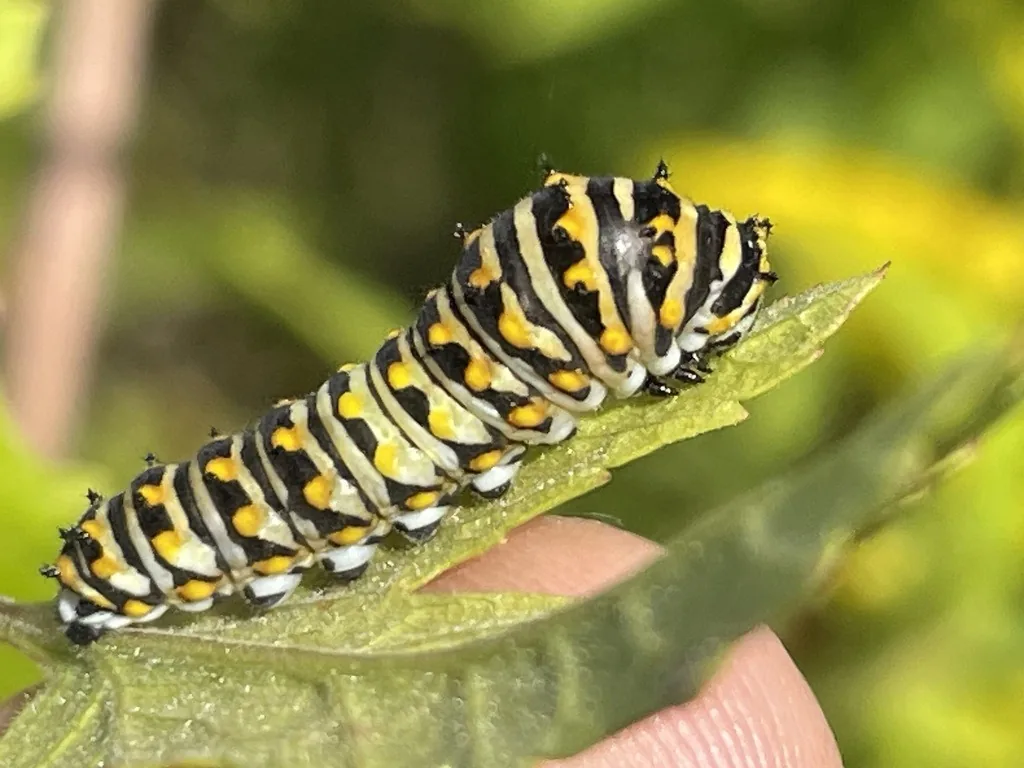
How to identify it
- Young caterpillars are mostly black with a white saddle; older ones are green with black crossbands containing yellow spots.[1]
- Threatened caterpillars rear up and push out a bright yellow-orange, horn-like osmeterium that smears a repellent on predators.[1]
- Adults are black with two rows of yellow spots, spanning 6.9 to 8.4 cm; females have more blue on the hind wings than males.[1]
Where it lives
It's found across southern Canada and most of the eastern and midwestern US west to the Rockies, and southwest into Arizona and northern Mexico.[1]
Biology and life cycle
Eggs are pale yellow and laid singly on host plants, usually on new foliage.[1]
Eggs take 4 to 9 days, larvae 10 to 30 and pupae 9 to 18, except pupae that overwinter; there are two generations in the North.[1]
Hosts are carrot-family herbs such as dill, parsley, fennel, caraway, celery and Queen Anne's lace, plus common rue.[1]
Damage and signs
- Caterpillars chew the foliage of garden herbs but are never common enough to be a problem in commercial agriculture.[1]
Health risk
Caterpillars aren't harmful, but some of their wild hosts, such as poison hemlock and spotted water hemlock, are extremely poisonous and can irritate skin.[1]
Control
Traps and physical control
If control is needed in a home garden, UF/IFAS recommends hand-picking.[1]
Biological control
At least three tachinid flies and five wasp parasitoids attack the caterpillars, along with general predators.[1]
Pesticides
If hand-picking isn't practical, a foliar insecticide or Bacillus thuringiensis (Bt) gives effective control.[1]
Common questions
- What are the green and black striped caterpillars eating my dill?
- Probably eastern black swallowtail caterpillars, which feed on dill, parsley, fennel and related herbs.[1]
- Should I kill black swallowtail caterpillars?
- Rarely necessary; UF/IFAS suggests hand-picking only if control is needed in a home garden.[1]
Sources
- University of Florida IFAS Extension (Featured Creatures), “Eastern Black Swallowtail, Papilio polyxenes asterius (EENY-504).” edis.ifas.ufl.edu/publication/IN906 (accessed 2026-10-06)
- iNaturalist, “Papilio polyxenes taxon page (order and family).” www.inaturalist.org/taxa/58523 (accessed 2026-10-06)