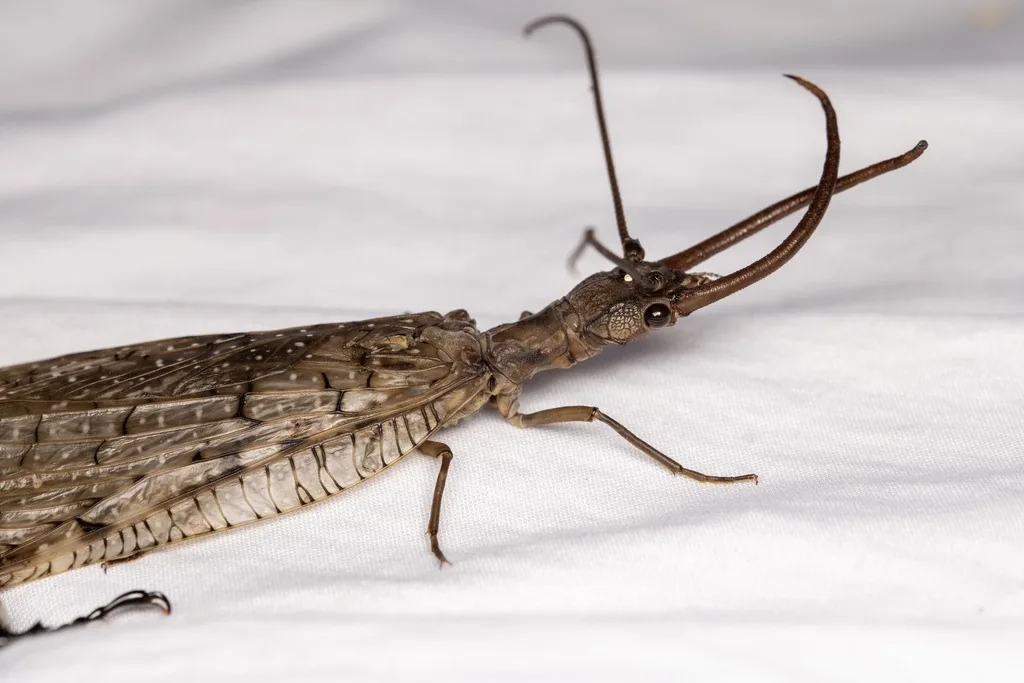
How to identify it
Where it lives
It's found through most of eastern North America east of the Continental Divide, near flowing streams where the larvae live.[1]
Biology and life cycle
Females lay clusters of about 1,000 eggs; eggs hatch in one to two weeks, always at night.[1]
Larvae, called hellgrammites, live under stones in swift, rocky streams and eat soft-bodied insects.[1]
Damage and signs
- They cause no damage to homes or plants.[1]
Health risk
The female can draw blood with her bite; males can't inflict a painful bite despite their long jaws.[1]
Control
Prevention
No control is needed; they come from nearby streams.[1]
Common questions
Sources
- University of Florida IFAS Extension (Featured Creatures), “Eastern Dobsonfly, Corydalus cornutus (EENY-414).” edis.ifas.ufl.edu/publication/IN987 (accessed 2026-10-06)
- iNaturalist, “Corydalus cornutus taxon page (order and family).” www.inaturalist.org/taxa/126712 (accessed 2026-10-06)