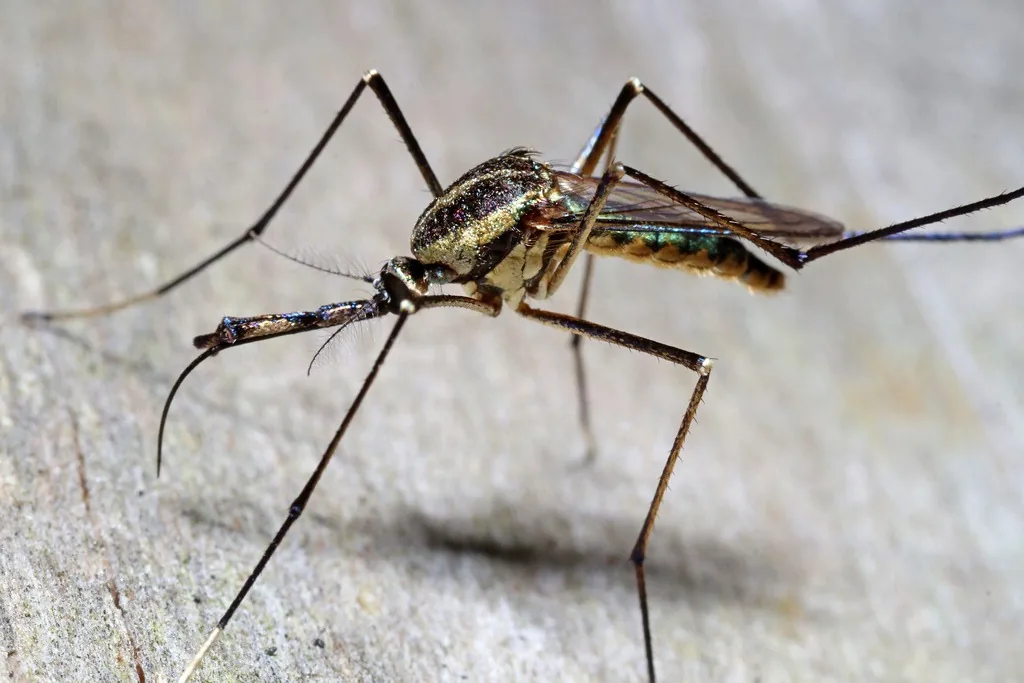
How to identify it
Look-alikes
| Look-alike | How to tell them apart |
|---|---|
| Biting mosquitoes | Its sharply down-curved proboscis sets it apart.[1] |
Where it lives
It's widely distributed in the eastern half of the U.S.[1]
Biology and life cycle
Larvae grow in tree holes and in containers such as cans, flowerpot saucers and tires.[1]
Larvae can survive weeks without prey.[1]
Health risk
Adults feed on nectar, honeydew and fruit, not blood, so they can't transmit pathogens.[1]
Control
Biological control
Its larvae are voracious predators that can eat thousands of mosquito larvae, making it a potential biological control.[1]
Common questions
Sources
- University of Florida IFAS Extension (Featured Creatures), “Elephant Mosquito, Toxorhynchites rutilus (Featured Creatures).” edis.ifas.ufl.edu/publication/IN1380 (accessed 2026-10-06)
- iNaturalist, “Toxorhynchites rutilus taxon page (order and family).” www.inaturalist.org/taxa/232765 (accessed 2026-10-06)