Dutch elm disease has killed over 100 million American elms since 1928 — all transmitted by elm bark beetles. Understanding the beetle-disease relationship is essential for protecting remaining elms.
BeetleDutch Elm DiseaseDisease VectorElmScolytusTree Protection
🪲
Risk Level
Tree Disease Vector
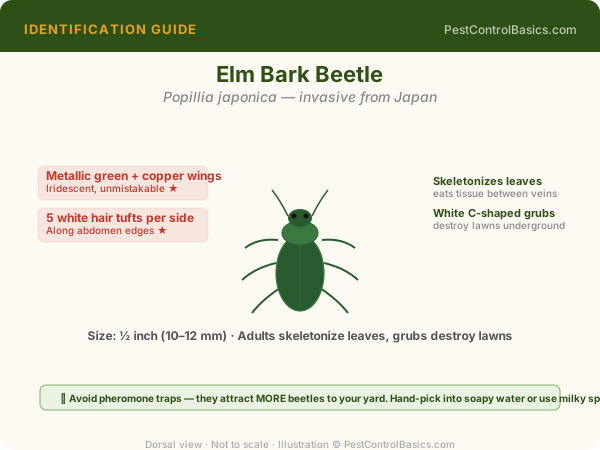
📐 FIELD GUIDE ILLUSTRATION
Original illustration by PestControlBasics.com. Use anatomical labels above to confirm your identification.
🔬
PestControlBasics Editorial Team
Reviewed by Derek Giordano · Updated 2026
🔍 Identification
Adults: 2-3mm; brown-black; cylindrical; found feeding in crotches of elm twigs (feeding produces distinctive small branch dieback). Egg galleries: S-shaped or H-shaped galleries under elm bark — different species produce different gallery patterns. The disease: Ophiostoma ulmi fungus is carried on the beetle's body and transmitted to healthy elms as adults feed in twig crotches.
🧬 Biology & Behavior
Two species vector Dutch elm disease in the US: European elm bark beetle (introduced) and native elm bark beetle. Both adults feed on healthy elm twigs in spring — this feeding transmits Ophiostoma fungal spores to the tree's vascular system. The fungus then spreads through the water-conducting vessels, causing wilting and death. Removing diseased wood promptly is the most critical disease management action — diseased elms breed new beetles that carry higher fungal loads.
⚠️ Damage & Health Risk
Dutch elm disease kills individual trees and entire elm populations; loss of irreplaceable mature urban tree canopy; historical economic and aesthetic losses to American cities (most pre-1950 elm-lined streets are gone); ongoing losses of American elm in rural areas.
🔧 DIY Treatment
For individual high-value elms: injected fungicide (propiconazole/Arbotect or thiabendazole/Mauget) prevents new infections for 2-3 years. Remove and destroy (chip or burn) all dead or dying elm wood before adult beetle emergence in spring. Avoid pruning elms April-August when adults are flying. Sanitation logging is the most impactful community-level management.
👷 When to Call a Pro
Certified arborist injection with propiconazole (Arbotect 20-S) is the only effective treatment for preventing DED in high-value elms — must be applied before infection and repeated every 3 years.
❓ FAQ
Is Dutch elm disease still active?
Yes — Dutch elm disease is still actively killing elms throughout North America. Millions of elms still exist and are at risk. American elm (Ulmus americana) is highly susceptible; some Asian elm species (Siberian elm, lacebark elm) have resistance. Disease-resistant American elm cultivars are now available for replanting.
How do I know if my elm has Dutch elm disease?
Wilting of one or more branches in summer ('flagging') followed by yellowing and leaf drop is the primary sign. Cut a wilted branch: if you see brown discoloration in the outer wood ring (sapwood), DED is likely. Contact a certified arborist immediately — prompt removal of infected wood can save the rest of the tree if caught early enough.
DG
Derek Giordano
Certified Pest Control Operator · Former Business Owner
Derek ran his own pest control company in Florida for several years, servicing thousands of regular customers. All content is based on hands-on field experience and current EPA & university extension guidelines.
Prevention strategies that actually reduce Elm Bark Beetle pressure
Most pest pressure traces back to one or two environmental conditions that are easier to fix than the infestation itself is to spray. For Elm Bark Beetle, the highest-leverage changes typically involve moisture management, food access, and exclusion at structural entry points. Reducing standing water within 20 feet of the foundation eliminates more pest problems than any single chemical application, and the effect persists year over year rather than requiring a rebuy every quarter.
Exclusion work is unglamorous but durable. A common entry-point audit covers door sweeps, weep holes, utility penetrations, dryer vents, soffit gaps, and the base of siding. Most homes have between five and fifteen openings larger than the minimum required for the target pest to enter, and sealing even half of them measurably reduces indoor sightings within one season. Stainless steel mesh, copper wool, and exterior-grade sealant cover most situations; expanding foam alone is not sufficient because rodents and some insects chew through it.
Storage practices matter too. Pantry pests, fabric pests, and overwintering insects all exploit cardboard, paper, and natural-fiber storage in basements and garages. Switching to sealed plastic bins for seasonal storage removes a significant amount of harborage that is otherwise impossible to spray effectively.
When to escalate Elm Bark Beetle control beyond DIY
Most Elm Bark Beetle situations are within the range of a careful homeowner, but a handful of scenarios genuinely warrant a licensed applicator. Multi-unit buildings are at the top of that list — shared walls, plumbing, and ductwork mean a localized treatment in one unit often just relocates the population to a neighbor. Any infestation that involves wall voids, attic insulation, or sub-slab plumbing is also harder to reach with consumer products and benefits from professional equipment and labeled product concentrations.
Health-sensitive situations are the second escalation trigger. Pregnancy, infants, immunocompromised residents, and pets with known sensitivities all narrow the available product list considerably. A licensed professional can apply restricted-use products and reduced-risk reformulations that achieve control with lower household exposure than over-the-counter alternatives. The cost difference is usually less than two seasons of DIY spending once the time investment is factored in.
The third escalation point is recurrence. If the same pest returns within six weeks of an apparently successful treatment, the source is usually structural or environmental rather than chemical, and a professional inspection often finds the cause faster than a second round of self-treatment.
Confirming a Elm Bark Beetle infestation in the field
Misidentification is the most common reason home treatment fails for Elm Bark Beetle. Look-alike species often respond to completely different active ingredients, so a 30-second confirmation step before any spraying or baiting saves the most time over a season. The practical workflow begins with where you found the specimen — kitchen, bathroom, garden, attic — because habitat narrows the candidate list faster than morphology alone.
Specific cues for Elm Bark Beetle include body proportions, leg count, antenna shape, and any wing structure if present. Adults are usually the easiest stage to identify, but most real-world infestations show juveniles or evidence (frass, shed skins, webbing, damage patterns) more often than adults themselves. Photograph the specimen against a ruler or coin for scale, then compare against a regional reference rather than a global one — range maps from state Extension services beat generic online identification sites.
When two species look genuinely similar, the deciding factor is often where they congregate at dusk versus dawn, or whether they leave a visible trail. A test of three common DIY treatments — one bait, one residual spray, one mechanical barrier — applied in different areas can also confirm identity by which works.
Why timing changes everything with Elm Bark Beetle
The same product applied two weeks apart can produce a complete kill or near-zero effect depending on where the Elm Bark Beetle population sits in its life cycle. Egg-stage pests are nearly immune to contact sprays, so a perfectly applied treatment during a major hatch event will leave the next generation completely unaffected. The professional standard is two applications spaced 10 to 14 days apart for most household pests — the first kills the active adults, the second catches anything that emerges from eggs in the interim.
Temperature also drives treatment success. Most residual sprays lose efficacy above 90°F or below 50°F, and pyrethroid products in particular can repel rather than kill when applied during high heat. The best window is early morning when surface temperatures are still moderate and target pests are moving but not yet at peak activity. Indoor treatment is less weather-dependent but still benefits from being applied when household air movement is low — running ceiling fans during application redistributes droplets away from the intended surface.
Seasonal pressure for Elm Bark Beetle usually has two or three predictable peaks per year. A treatment calendar built around those peaks costs less and works better than reactive spraying after a problem is already established.
Published: Jan 1, 2025 · Updated: Apr 7, 2026
Wasp nest removal: timing and the case for waiting
When a wasp nest appears on a property, the instinct is immediate removal, but timing and species considerations often justify a different approach. Paper wasps and many other social wasp species in temperate climates have annual colonies that die naturally at first hard frost; the queen overwinters separately and starts a new nest the following spring. A nest in a location that isn't a direct human conflict point (eave of a shed, branches of a far tree, post in a fence corner) can often simply be left until natural die-off, with the nest removed cosmetically in late fall after the colony has died. Nests in or near high-traffic areas — doorways, mailboxes, play structures, frequently-used outdoor seating — warrant removal for safety. Treatment timing within the season matters: evening application (when most workers have returned to the nest) maximizes effect, while daytime treatment leaves foragers that return to the nest later and produces incomplete results. Aerosol products labeled for wasp nests that produce a long-distance stream (rather than a foaming application) allow treatment from a safer distance.
Trap and bait psychology: why placement beats product choice
Across pest categories, placement is more important than the specific brand or formulation chosen, and the diagnostic data backs this up. A mediocre bait placed in the correct location outperforms a premium bait placed wrong; a basic snap trap on a runway outperforms a designer electronic trap in the middle of a room. The underlying reason is pest behavior: most pests follow predictable physical patterns — walls, edges, vertical surfaces, harborage-to-food routes — and traps or baits intersecting those patterns get encountered, while traps placed for human convenience often don't. Practical placement principles that apply across pest types: along walls rather than in open spaces, between harborage and food/water sources, near observed activity rather than in 'symmetric' patterns, and in higher density (more units, closer together) than feels intuitively right. Cockroach gels go in corners and crevices, not on open surfaces; rodent traps go perpendicular to walls with trigger toward the wall; pheromone traps for moths go where moth flight has been observed, not centrally; ant baits go on observed trails, not where ants are 'expected.' Spending time observing pest behavior before deploying traps almost always pays back.
Yellow jackets vs. paper wasps vs. hornets: what you're dealing with
Three commonly-confused wasp groups have meaningfully different behavior and require different management approaches. Paper wasps build open umbrella-shaped nests with visible cells, typically under eaves, in soffit corners, in shrubs, or under deck railings; colonies are smaller (typically 20-50 wasps), workers are less aggressive, and stings are typically defensive rather than offensive. Yellow jackets build enclosed papery nests, often underground in old rodent burrows or in wall voids, soffit cavities, and similar concealed locations; colonies are larger (often several hundred to several thousand), workers are aggressive particularly in late summer when populations peak and food sources change, and ground-nest disturbance produces serious sting events. Hornets (including bald-faced hornets, technically a yellow jacket species in the Vespidae family, and European hornets) build large enclosed aerial nests on tree branches or building exteriors. The identification matters because paper wasp nests can often be treated and removed by homeowners with caution, while yellow jacket and hornet nests are more dangerous and often warrant professional removal, particularly when nests are concealed in wall voids.
Paper wasp tolerance: when not to treat
Paper wasps are widely treated reflexively, but the cost-benefit assessment for treatment is often less favorable than homeowners assume. Paper wasps are valuable predators of caterpillars and other garden pests, they're typically non-aggressive unless the nest is disturbed within a few feet, and most nests in residential settings are in locations where they pose minimal risk to occupants. A nest under an eave on the unused side of the house is qualitatively different from a nest at the front door or near a children's play area. The right question to ask before treatment is whether anyone is actually going to be within the nest's defensive range during the rest of the season, and what the cost of accidental disturbance would be. For nests in low-traffic areas, leaving them alone often produces fewer wasp encounters across the season than treatment does, because the resident colony actively excludes other wasps and the natural cycle leads to nest abandonment by fall. For nests in genuinely high-conflict locations, prompt treatment is warranted, but the default of treating every visible nest underestimates the ecological role and overestimates the actual risk in most situations.
How regional pest pressure should shape what you buy
The retail pest control aisle is largely undifferentiated by region, but pest pressure is enormously regional, and the disconnect leads to predictable purchasing mistakes. A homeowner in the Gulf Coast facing year-round subterranean termite pressure and large peridomestic cockroach populations has dramatically different needs from a homeowner in the upper Midwest facing rodent invasion in October and bed bugs in apartments. The product mix that makes sense for each is different, the level of investment that's justified is different, and the cadence of application is different. Generic shopping advice and product reviews tend to wash out these regional patterns by averaging across users. The better approach is to identify the two or three pests that actually drive pressure in your specific area, then build a product and treatment plan around those rather than around the broad category. Local cooperative extension publications, state agricultural department pest fact sheets, and regional pest control company blog content tend to be more useful sources of guidance than national review sites, precisely because they're calibrated to the conditions you're actually treating.
Ground-nesting yellowjackets: a distinct problem requiring different handling
Yellowjacket species that nest in the ground present a substantially different management challenge from species that nest above ground. The nest entrance is often inconspicuous — a single small hole in turf, in a soil bank, or at the base of a retaining wall — and the nest itself can be quite large, with thousands of workers. The first sign of the nest is frequently a sting incident during mowing, landscape work, or recreational activity, because the nest is invisible until disturbed. Treatment of ground nests requires direct application of insecticide into the entrance, ideally at dusk or after dark when workers are inside, and follow-up to confirm activity has ceased. Pyrethroid dusts applied to the entrance are typically more effective than sprays, because the dust persists and is tracked into the nest by returning foragers. Sealing the entrance after dusting is sometimes recommended but should only be done after activity has confirmed ceased, because sealing a still-active nest can cause workers to emerge through alternate exits. For homeowners without experience, professional treatment of ground nests is often the right call given the population size and the consequences of incomplete treatment.
🗺️ US Distribution — Elm Bark Beetle
Common Occasional Not Present
States Present
49
Occasional
2
Primary Region
All agricultural regions
📊 Source: University extension services, USDA, CDC vector data, and published entomological surveys.