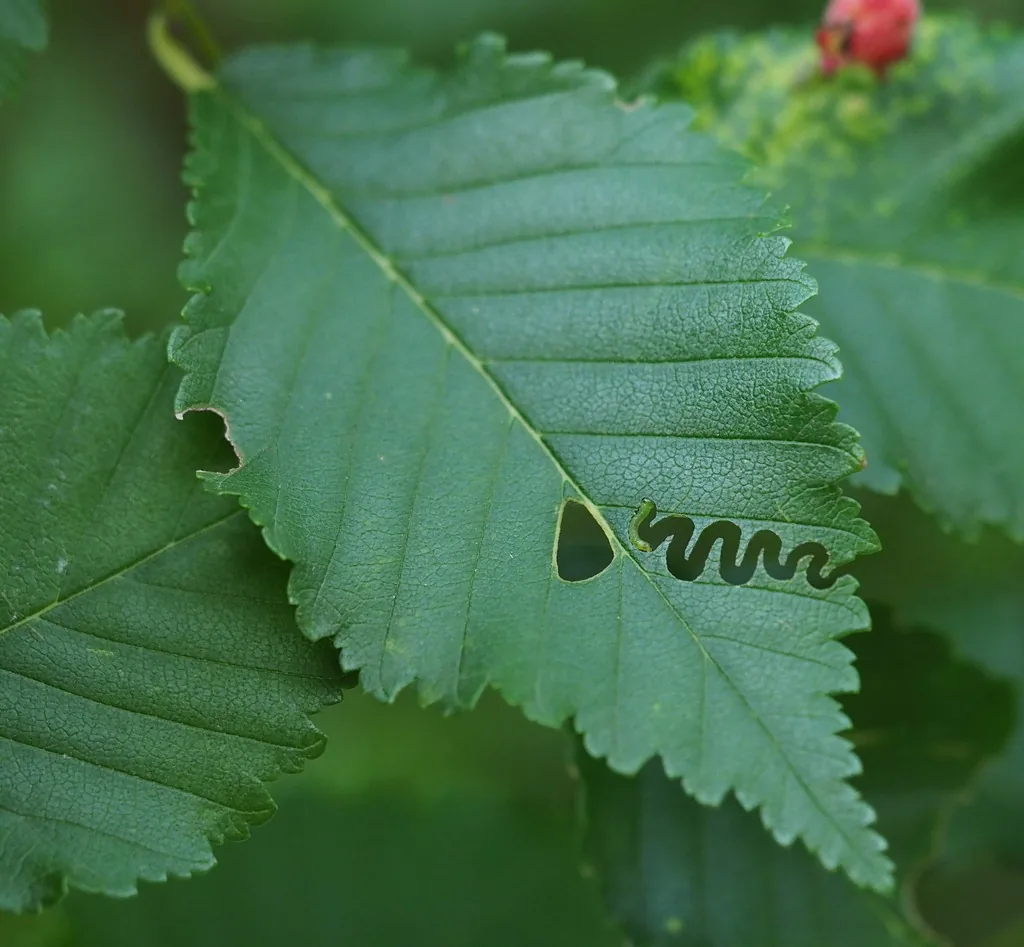
How to identify it
- Young larvae chew a distinctive zigzag pattern into elm leaves; older larvae eat broader areas.[1]
- Larvae turn green with a black head band and T-shaped black marks on two pairs of legs, reaching 10 to 11 mm.[1]
- Adults are small shiny black wasp-like flies, 7 to 8 mm, with smoky wings and yellow legs.[1]
Where it lives
It reached Québec in 2020 and Virginia in 2021; HGIC covers it for South Carolina elms.[1]
Biology and life cycle
No male has ever been found: females reproduce alone, each laying up to 60 eggs during a 1 to 6 day life.[1]
Larvae feed for 15 to 18 days; two to five generations a year have been seen in the US.[1]
Damage and signs
Health risk
It feeds on plants; Clemson HGIC mentions no risk to people.[1]
Control
Prevention
Monitor elms; if you suspect it, capture or photograph the insect and report it to Clemson Extension or Clemson DPI.[1]
Pesticides
Little is known about control; systemic insecticides show promise in ongoing research.[1]
Common questions
Sources
- Clemson Cooperative Extension, Home & Garden Information Center, “Elm Zigzag Sawfly (HGIC 2026).” hgic.clemson.edu/factsheet/elm-zigzag-sawfly/ (accessed 2026-10-06)
- iNaturalist, “Aproceros leucopoda taxon page (order and family).” www.inaturalist.org/taxa/497733 (accessed 2026-10-06)