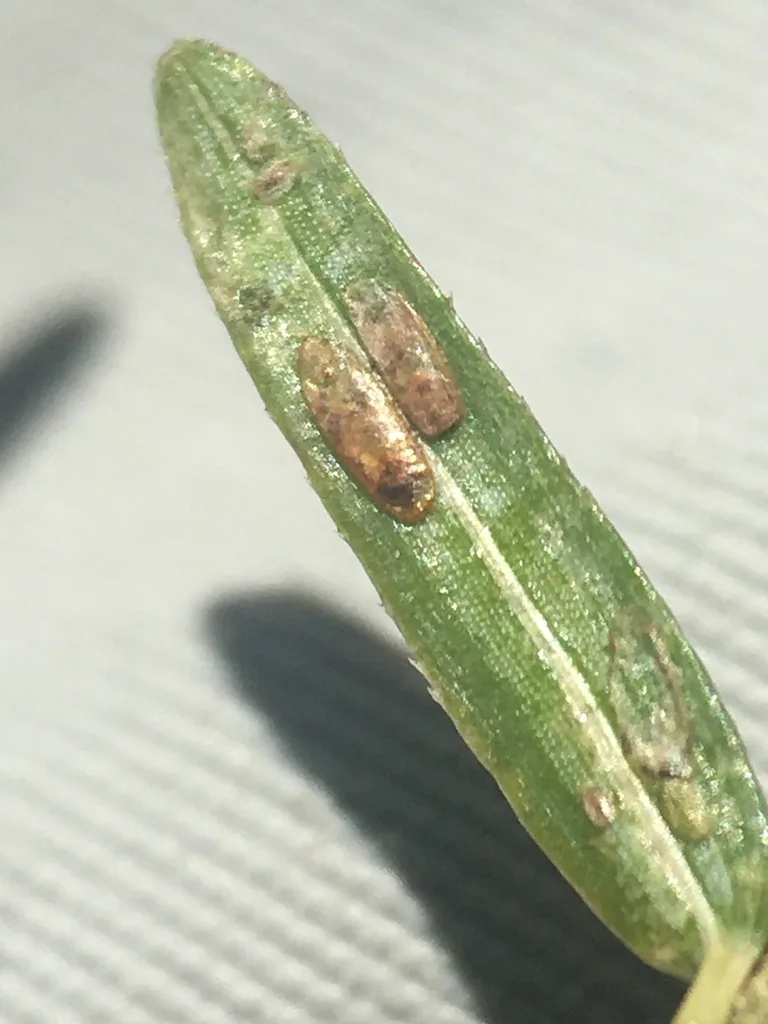
How to identify it
Where it lives
It's an invasive species best known on hemlocks and also feeds on firs, spruces, pines, cedars and yews.[1]
Biology and life cycle
It overwinters as fertilized females or eggs, and crawlers hatch over a long period starting around May.[1]
Because of that long hatch, all life stages can be on a tree at once.[1]
Damage and signs
- Needles show yellow spots or bands, then yellow entirely and drop; canopies thin and branches die back.[1]
Health risk
It feeds on trees; UK Extension mentions no risk to people.[1]
Control
Pesticides
Systemic dinotefuran works; imidacloprid won't. Crawlers can be treated with horticultural oil or contact insecticides, usually several times.[1]
Common questions
Sources
- University of Kentucky Entomology (ENTFACT), “Dealing with Elongate Hemlock Scale (ENTFACT-471).” entomology.mgcafe.uky.edu/ef471 (accessed 2026-10-06)
- iNaturalist, “Fiorinia externa taxon page (order and family).” www.inaturalist.org/taxa/447063 (accessed 2026-10-06)