How to identify it
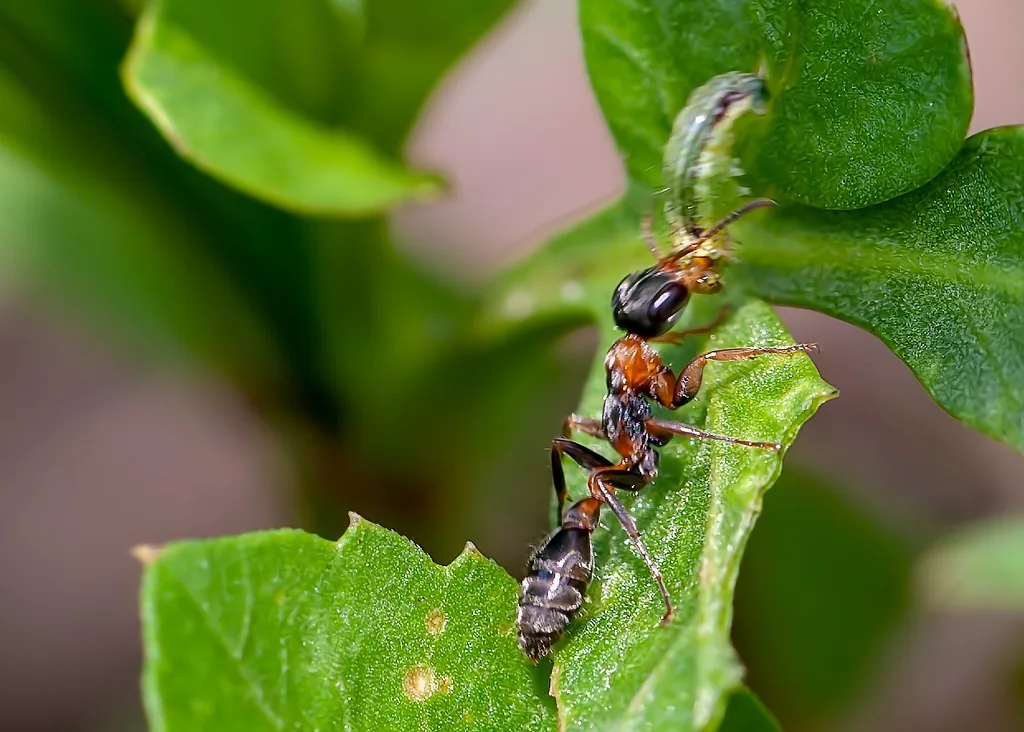
- Workers are large for an ant, about 8 to 10 mm (roughly 1/3 inch) long, with a slender, wasp-like body.[1][3]
- Most Florida and Southeast specimens are two-toned: a dark head and abdomen with an orange middle section, though some are all dark or all orange-brown.[1][3]
- The eyes are very large, taking up more than half the length of the head, and the waist has two long segments.[1][3]
- The body is covered in fine silvery hairs and longer erect hairs, and workers have a well-developed sting.[3][1]
- Workers usually forage alone on plants and buildings and often escape by dropping to the ground.[2]
Look-alikes
Where it lives
Native from Mexico and southern Texas south to Argentina. In the U.S. it is established in Texas, most of Florida since about 1960, southern Louisiana and Mississippi, and Hawaii, with records north to coastal South Carolina.[2][1][3]
Biology and life cycle
It nests in hollow twigs, small branches, plant stalks and grasses, often in tunnels left by wood-boring beetles, and in building crevices in urban areas.[1][2][3]
Colonies are small, with a single queen and only one small nest entrance.[1][3]
Nests may be high in trees, in shrubs, or in blades of grass, and the ant lives in both disturbed and undisturbed habitats.[1][2]
Workers do not lay scent trails; when a colony moves, workers carry nestmates to the new site.[1]
Damage and signs
Health risk
Workers and queens can give a painful sting. They are not aggressive and usually sting only when trapped under clothing, swatted, or defending the nest.[2][3][1]
Control
Prevention
Because it is usually met outdoors in small numbers, management is generally not necessary despite the painful sting.[1]
Avoid swatting workers on your skin or brushing against nests in shrubs and trees; stings mostly happen when ants are pinned, trapped or disturbed.[2][3]
Common questions
- Is this an ant or a wasp?
- It is an ant. Its long, slender body, big eyes and orange-and-black colors make it look wasp-like, but it has the two-segmented waist of an ant.[1][3]
- How bad is a twig ant sting?
- It is quite painful, but the ants are not aggressive and sting mainly when trapped under clothing or swatted.[2]
- Do I need to treat for twig ants?
- Usually not. They are encountered outdoors in small numbers and cause little damage, so UF/IFAS considers management unnecessary.[1]
Sources
- University of Florida/IFAS Extension, “Slender Twig Ant, Pseudomyrmex gracilis (Featured Creatures, EDIS IN752; Patricia L. Toth).” edis.ifas.ufl.edu/publication/IN752 (accessed 2026-10-06)
- Florida Entomological Society, “Worldwide Spread of the Graceful Twig Ant, Pseudomyrmex gracilis (James K. Wetterer). Florida Entomologist 93(4), 2010.” journals.flvc.org/flaent/article/download/76156/73814/76364 (accessed 2026-10-06)
- Mississippi Entomological Museum, Mississippi State University, “Pseudomyrmex gracilis (Joe A. MacGown, updated April 2016).” mem.org.msstate.edu/Researchtaxapages/Formicidaepages/genericpages/Pseudomyrmex.gracilis.htm (accessed 2026-10-06)
- iNaturalist, “Pseudomyrmex gracilis taxon page (order and family).” www.inaturalist.org/taxa/1418419 (accessed 2026-10-06)