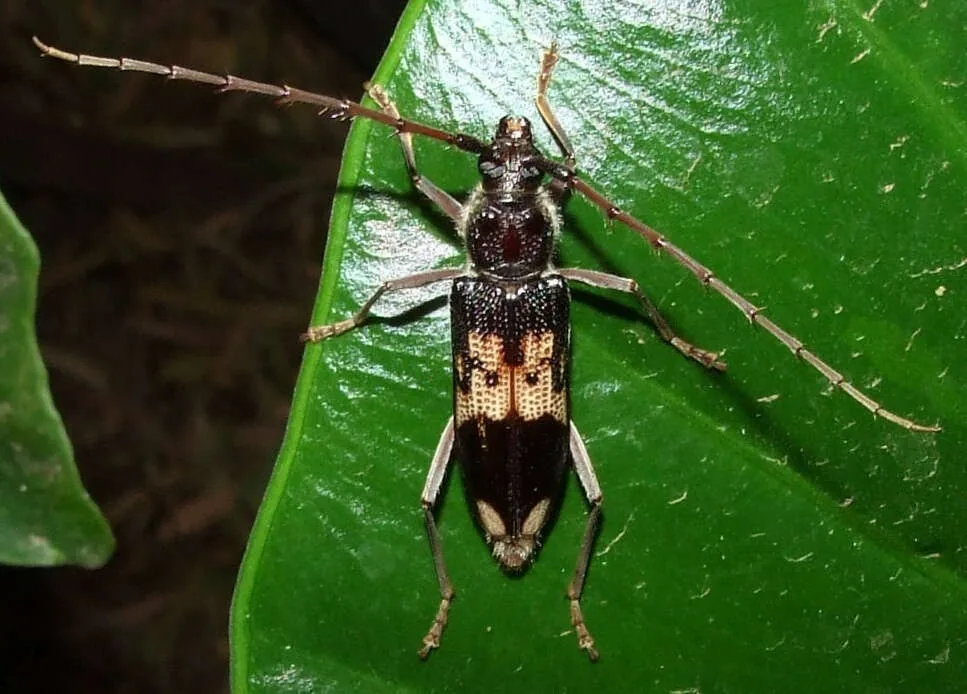
How to identify it
- Antennae are as long as or longer than the body; males' antennae carry prominent spines.[1]
- P. semipunctata has mostly dark brown wing covers with a cream band crossed by a zigzag line; P. recurva is mostly cream to yellow.[1]
- Holes in the bark and stains or oozing liquid on limbs and trunks are common signs.[1]
Where it lives
Native to Australia, P. semipunctata reached Southern California in the 1980s and now occurs statewide wherever eucalyptus grows; P. recurva was found in 1995.[1]
Biology and life cycle
Females lay groups of 3 to 30 eggs under loose bark, up to 300 eggs in a month or more of life.[1]
Eggs hatch in about one to two weeks, and larvae bore into the inner bark.[1]
Damage and signs
- Larvae feeding under the bark can kill stressed trees.[1]
Health risk
It attacks eucalyptus only; UC IPM mentions no risk to people.[1]
Control
Prevention
Reduce tree stress, especially drought; a well-kept susceptible tree can be safer than a neglected resistant one.[1]
Plant more resistant species such as lemon gum, red ironbark, river red gum or sugar gum, avoiding invasive blue gum.[1]
Sanitation
Handle cut eucalyptus wood properly, since fresh wood attracts the beetles.[1]
Biological control
Protect introduced natural enemies; pesticides generally aren't effective.[1]
Common questions
Sources
- University of California Statewide IPM Program, “Pest Notes: Eucalyptus Longhorned Borers (Publication 7425).” ipm.ucanr.edu/PMG/PESTNOTES/pn7425.html (accessed 2026-10-06)
- iNaturalist, “Phoracantha semipunctata taxon page (order and family).” www.inaturalist.org/taxa/201891 (accessed 2026-10-06)