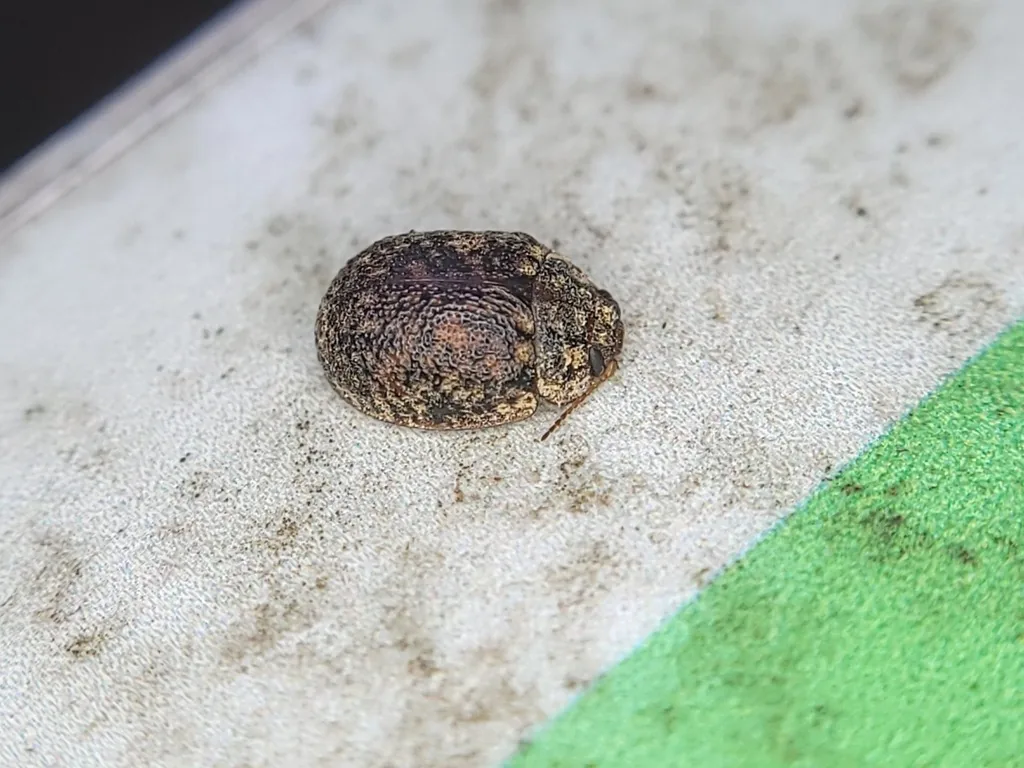
How to identify it
Where it lives
Trachymela sloanei was found in Riverside County in 1998 and now occurs in most of California where eucalyptus grows; Chrysophtharta m-fuscum was found in Orange County in 2003.[1]
Biology and life cycle
Beetles can strip most of a leaf's surface down to the midvein and occasionally feed on new shoot tips.[1]
Damage and signs
- Heavy infestations can strip most leaves, adding stress on top of other introduced eucalyptus pests.[1]
Health risk
It feeds on eucalyptus; UC IPM mentions no risk to people.[1]
Control
Prevention
Provide good growing conditions and care; no control is needed in many landscapes.[1]
Biological control
Avoid actions that harm natural enemies.[1]
Common questions
Sources
- University of California Statewide IPM Program, “Pest Notes: Eucalyptus Tortoise Beetles (Publication 74104).” ipm.ucanr.edu/PMG/PESTNOTES/pn74104.html (accessed 2026-10-06)
- iNaturalist, “Trachymela sloanei taxon page (order and family).” www.inaturalist.org/taxa/208608 (accessed 2026-10-06)