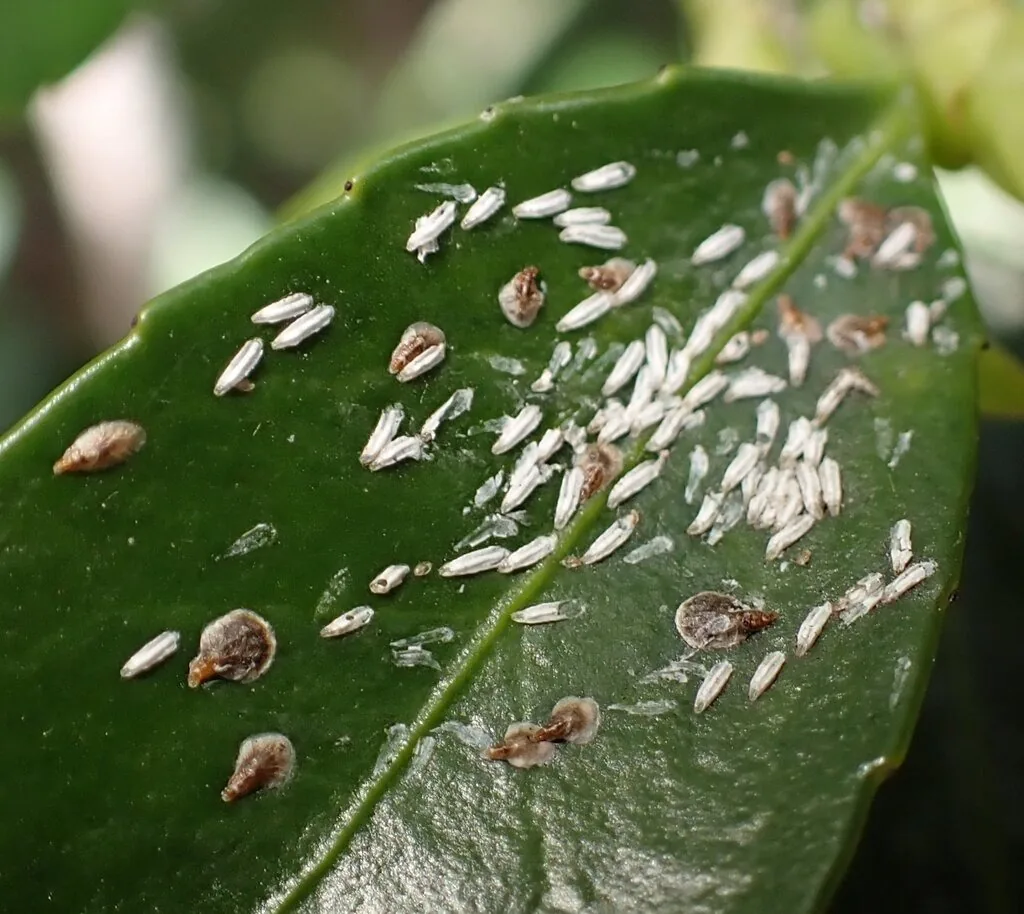
How to identify it
Look-alikes
| Look-alike | How to tell them apart |
|---|---|
| Other scale insects | Euonymus scale is an armored scale native to Japan and China, now established in the U.S. and Canada.[1] |
Where it lives
Native to Japan and China, it's established in the United States and Canada.[1]
Biology and life cycle
Fertilized females overwinter and lay eggs under their covers in late April and May; eggs hatch over two to three weeks.[1]
Development takes four to six weeks, and a second generation of crawlers appears from late July through August.[1]
Damage and signs
- Heavy infestations on twigs or leaves can defoliate plants, kill twigs or kill the whole plant.[1]
Health risk
It feeds on plants only; Penn State mentions no risk to people.[1]
Control
Traps and physical control
Prune and destroy heavily infested branches.[1]
Biological control
The lady beetle Chilocorus kuwanae was introduced in the eastern U.S. to help control it.[1]
Pesticides
Treat first-generation crawlers in late May through June and second-generation crawlers in late July through August, following the label.[1]
Common questions
Sources
- Penn State Extension, “Euonymus Scale.” extension.psu.edu/euonymus-scale (accessed 2026-10-06)
- iNaturalist, “Unaspis euonymi taxon page (order and family).” www.inaturalist.org/taxa/512010 (accessed 2026-10-06)