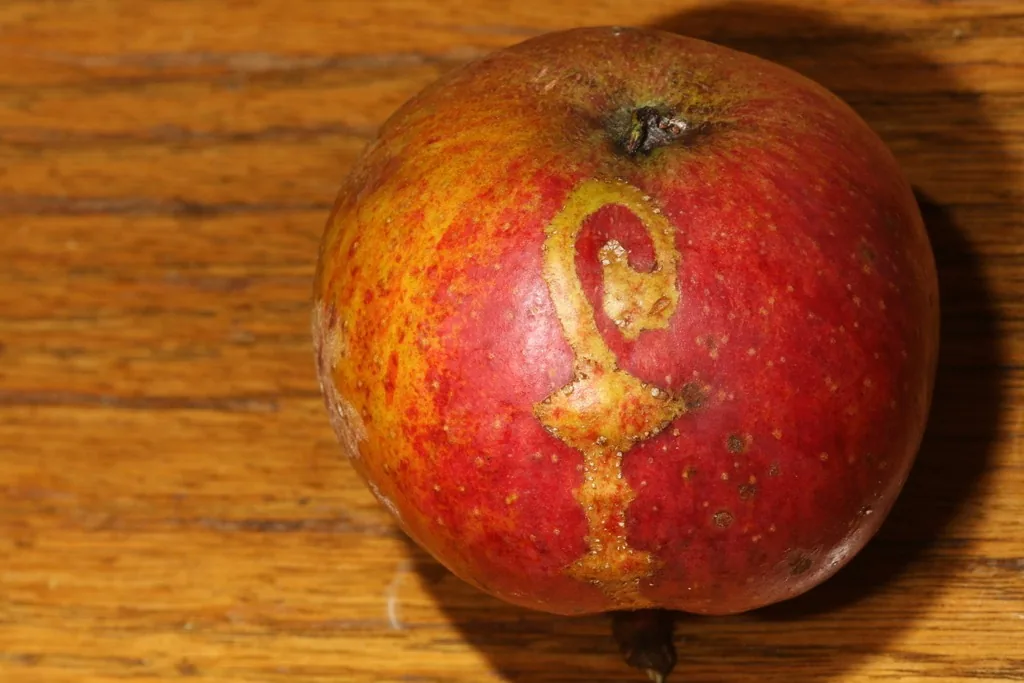
How to identify it
Look-alikes
| Look-alike | How to tell them apart |
|---|---|
| Caterpillars in apples | Sawfly larvae resemble caterpillars but have prolegs on each abdominal segment.[1] |
Where it lives
Penn State Extension covers it in Pennsylvania apple orchards and home fruit plantings.[1][2]
Biology and life cycle
There's one generation a year, and larvae overwinter in the soil.[1]
Adults emerge during late pink and early bloom and lay eggs on the calyx end of developing fruit.[1]
Young larvae tunnel just under the skin; second and later instars bore into the seed chamber and can move on to other fruit.[2]
Damage and signs
Health risk
It feeds on plants; Penn State Extension mentions no risk to people.[1]
Control
Prevention
Orchards hang white sticky traps on the south sides of trees, 5 to 6 feet up, at the pink stage to track adults.[2]
Biological control
No native natural enemy is reported to be effective in North America; Canada introduced the parasitic wasp Lathrolestes ensator with partial success.[2]
Pesticides
Where this sawfly has been a problem before, Penn State's best tactic is a spray as soon as pollination is complete.[1][2]
Common questions
Sources
- Penn State Extension, “European Apple Sawfly in the Home Fruit Planting.” extension.psu.edu/european-apple-sawfly-in-the-home-fruit-planting (accessed 2026-10-06)
- Penn State Extension, “Tree Fruit Insect Pest: European Apple Sawfly.” extension.psu.edu/tree-fruit-insect-pest-european-apple-sawfly (accessed 2026-10-06)
- iNaturalist, “Hoplocampa testudinea taxon page (order and family).” www.inaturalist.org/taxa/483616 (accessed 2026-10-06)