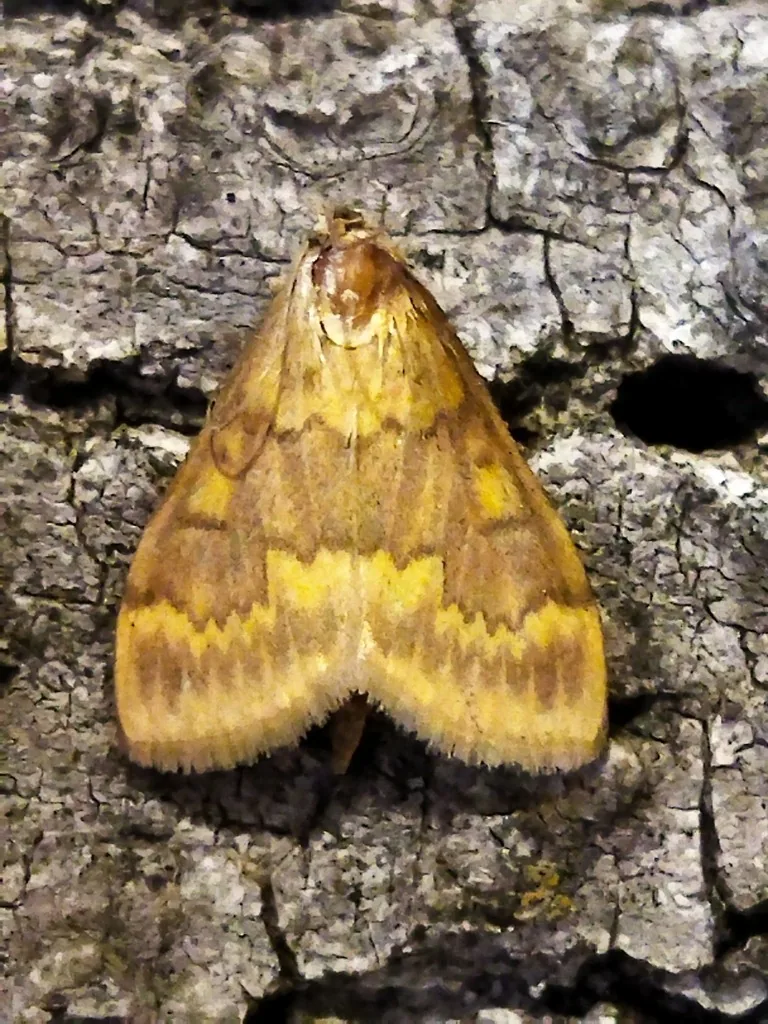
How to identify it
- Full-grown caterpillars are about 1 inch long, pale (whitish, pale yellow or pinkish gray) with a dark head and rows of small dark spots on each body segment.[1][2][3]
- Eggs are laid in flat clusters on the undersides of leaves, overlapping like fish scales; they are white at first and darken with age.[1][2][3]
- Adults are yellowish-brown, patterned moths; females have about a 1-inch wingspan, and males are smaller, slimmer and darker.[1][2]
- Signs of borers are pinhole entrance holes with sawdust-like frass and silk, and wilting or broken stems above them.[1][2]
Where it lives
NC State, Maryland and Illinois Extension all cover it as a garden pest; NC State reports four generations a year in North Carolina, while Illinois reports two to three.[1][2][3]
Biology and life cycle
Females lay up to 600 eggs in flat masses of 15 to 20, and the eggs hatch in about a week.[1][3]
Young caterpillars feed on leaf surfaces for a few days, then bore into the stalk to feed and eventually pupate inside.[1]
The caterpillars are cannibalistic, which is why only one or two borers are usually found in an infested pot of mums.[1]
Caterpillars overwinter inside plant stems; in Maryland, eggs are laid in May and June and again in July and August.[1][2][3]
Damage and signs
- Illinois Extension calls it a very important pest of peppers, sweet corn and tomatoes; it tunnels into pepper and tomato fruits, corn ears and stems.[3]
- In peppers, borers enter near the stem and feed on the seed core, and bell peppers are damaged more than hot peppers.[2][3]
- In sweet corn, young caterpillars feed in the leaf whorl and tassels, then bore into the stalk or the ear, where tunneling along the kernel rows lets in fungi.[2][3]
- Flowers attacked include chrysanthemums, asters, cosmos, dahlias, gladioli, hollyhocks, roses and zinnias.[1]
Health risk
Control
Sanitation
Destroy the stalks where caterpillars overwinter: cut corn, dahlia and mum stalks close to the soil and remove, shred or till them under, and clear nearby weeds.[1][2][3]
Traps and physical control
Split an infested stalk below the borer hole and kill the borer with a piece of wire or a nail, or cut out and destroy infested flower stems.[1][2]
Biological control
Bt, a microbial insecticide, can be sprayed when caterpillars first appear.[2]
Pesticides
Sprays only work before caterpillars bore in: Illinois advises treating whorl-stage sweet corn if more than 15 percent of plants show feeding, and NC State suggests a pyrethroid such as permethrin or bifenthrin for ornamentals in mid to late summer.[1][3]
Common questions
- Why do my peppers have a small hole with sawdust near the stem?
- European corn borer caterpillars enter peppers near the stem and leave a pinhole covered with frass.[2][3]
- Can I spray once the borers are inside the stalk?
- It is essentially too late then; cut out the infested stems or kill the borer with a wire.[1][2]
- How do I prevent corn borers next year?
- Remove or shred corn, dahlia and mum stalks and nearby weeds, because the caterpillars overwinter inside them.[1][2][3]
Sources
- NC State Extension, “European Corn Borer on Ornamentals.” content.ces.ncsu.edu/european-corn-borer (accessed 2026-10-15)
- University of Maryland Extension, “European Corn Borer on Vegetables.” extension.umd.edu/resource/european-corn-borer-vegetables (accessed 2026-10-15)
- University of Illinois Extension, “European Corn Borer.” extension.illinois.edu/insects/european-corn-borer (accessed 2026-10-15)
- iNaturalist, “Ostrinia nubilalis taxon page (order and family).” www.inaturalist.org/taxa/1523240 (accessed 2026-10-06)