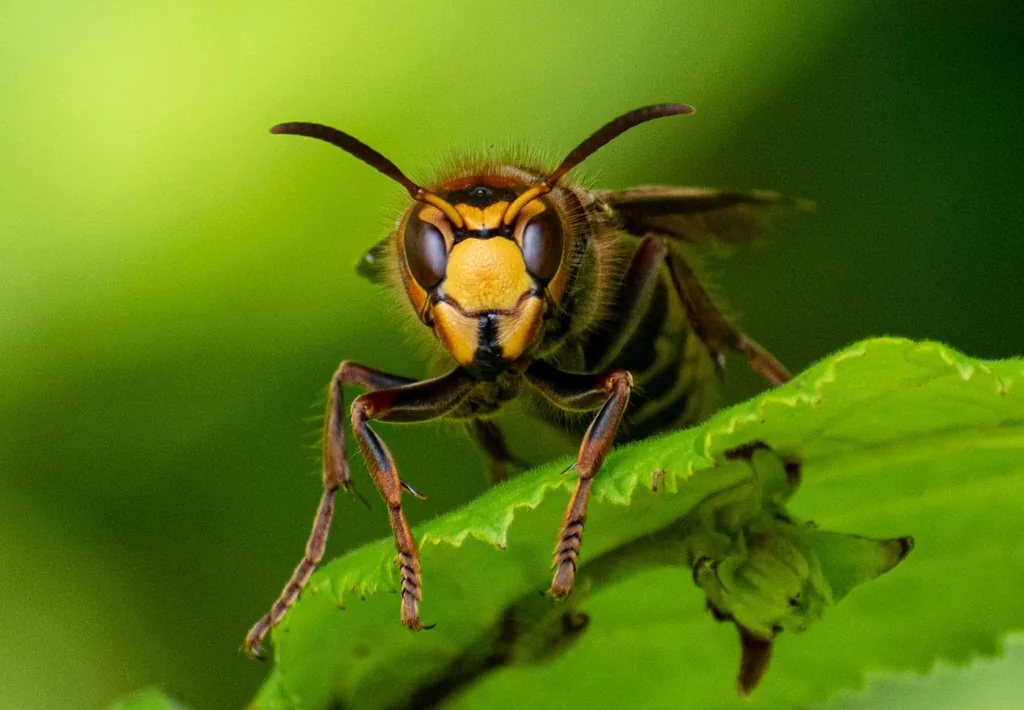
How to identify it
- Workers are up to about an inch long and queens reach about 1 1/2 inches, among the largest wasps where they occur.[1][2]
- Reddish-brown thorax and top of the head, a yellow face, and brownish wings.[2][1]
- The abdomen is mostly yellow toward the rear, with black bands that trail backward into teardrop shapes.[1][2]
- It is one of the few wasps that fly at night and often turns up at lit windows and porch lights.[1][2]
Look-alikes
| Look-alike | How to tell them apart |
|---|---|
| Northern giant hornet | Has an entirely yellow head, a mostly black thorax and a banded abdomen without teardrops; it was found only in Washington State and British Columbia and was declared eradicated in 2024.[1][2] |
| Cicada killer | A solitary wasp with a mostly black abdomen with yellow markings that nests in the ground, not in paper nests in hollow trees or walls.[1][2] |
| Bald-faced hornet | Despite its name, it belongs to the yellowjacket group and builds large, exposed paper nests in trees.[2][1] |
Where it lives
Native to Europe and Asia; established across the eastern United States and spreading westward, with records reaching Arkansas, Oklahoma and Kansas.[1][2]
Biology and life cycle
Nests are paper, built in protected, high cavities such as hollow trees, and sometimes in attics, barns and the wall voids of houses.[1][2]
Each nest lasts one season and peaks in mid-September, usually with 200 to 400 workers; only mated queens survive winter, and old nests aren't reused.[1][2]
Queens overwinter under bark, in leaf litter or in wall voids, and may wander into living areas in spring.[1][2]
Workers hunt grasshoppers, flies, caterpillars, yellowjackets and other insects, and turn to sugary foods such as fallen fruit in late summer and fall.[1][2]
Damage and signs
Health risk
Despite its size, the sting hurts about as much as a honey bee's, though it can sting more than once. Stings usually clear in a few hours unless you're allergic or stung many times; get immediate care if a reaction starts.[1]
Control
Prevention
Nests die out with hard frost, so waiting for cold weather is the simplest option when the nest isn't in a high-traffic spot.[1][2]
Keep them out
Never block the entrance of a nest in a wall void, or hornets may chew through drywall into the home; seal siding, window and pipe gaps to stop queens from moving in.[1][2]
Sanitation
Pick up fallen fruit, keep trash cans closed, and turn off porch lights or floodlights near a nest at night.[1][2]
Traps and physical control
Protect damaged shrubs with mesh netting until the hornets die off; no pesticide applied to the bushes will kill them.[1]
Pesticides
If a nest must go, treat its entrance at night with a wasp and hornet spray or insecticidal dust, wearing long sleeves and pants tucked into socks; they also fly at night.[1][2]
When to call a professional
Nests hidden in hollow trees can be up to 30 feet high, and hiring a professional may be needed to treat them safely.[1][2]
Common questions
- Is this a murder hornet?
- Almost certainly not. The European hornet is the species most often mistaken for the northern giant hornet, which was found only in the Pacific Northwest.[1][2]
- Why are hornets hitting my windows at night?
- European hornets fly at night and are attracted to light from windows and porch lights; turning off lights or drawing blinds helps.[2][1]
- Will hornets come back to the same nest next year?
- No. Overwintered queens build new nests each spring and don't reuse old ones.[1][2]
Sources
- Penn State Extension, “European Hornet (updated July 19, 2024).” extension.psu.edu/european-hornet (accessed 2026-10-06)
- Ohio State University Extension (Ohioline), “European Hornets and Look-Alikes (ENT-0102, February 2025).” ohioline.osu.edu/factsheet/ent-0102 (accessed 2026-10-06)
- iNaturalist, “Vespa crabro taxon page (order and family).” www.inaturalist.org/taxa/54327 (accessed 2026-10-06)