How to identify it
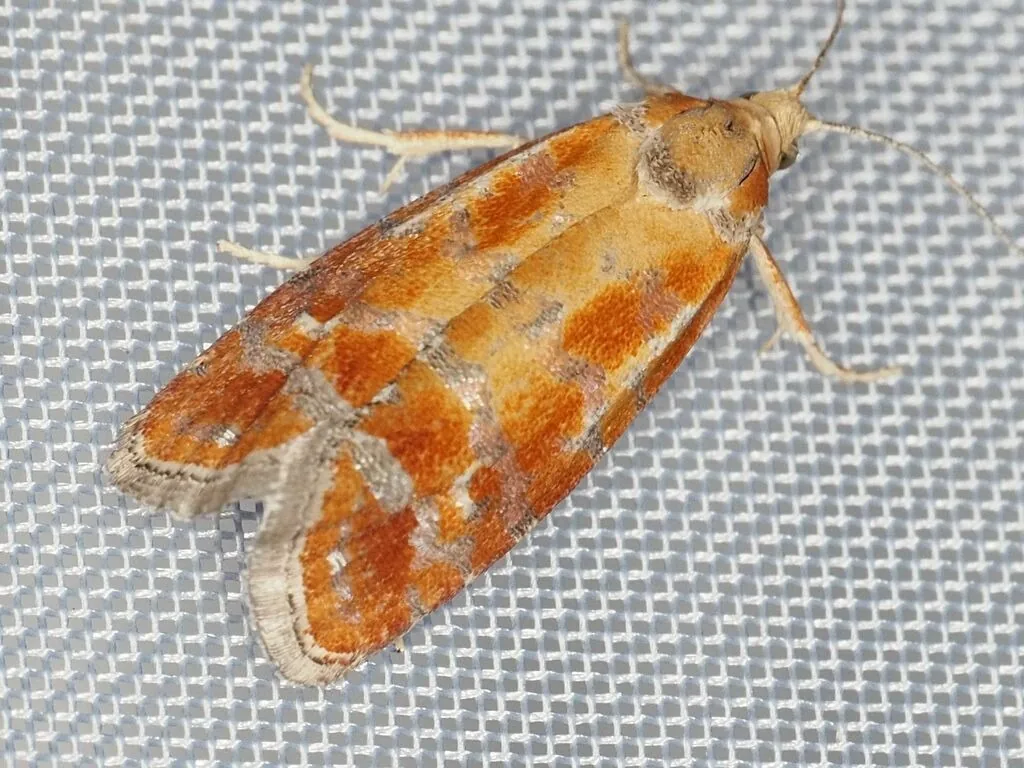
- Moths are orange-red with a wingspan of about 20 mm, wavy silver stripes on the forewings, dark gray hind wings and white legs.[1]
- Mature larvae are 12 to 15 mm long, light yellowish brown to brown, with black heads.[1]
- Larvae cover their entrance holes in buds and shoots with resin-coated webbing.[1]
Look-alikes
| Look-alike | How to tell them apart |
|---|---|
| Nantucket pine tip moth | Has two generations a year in Pennsylvania; the European pine shoot moth has one.[1] |
Where it lives
Accidentally introduced and first recorded in North America on Long Island, New York, in 1914, it occurs across the northeastern US and southern Canada, with infestations reported in the Pacific Northwest.[1]
Biology and life cycle
Larvae overwinter in silk-lined tunnels inside buds and start boring into buds and new shoots again in April.[1]
They pupate in the shoots at the end of May; moths emerge two to three weeks later and lay eggs from early to mid-June.[1]
Young larvae feed under resin-coated webs at the needle bases, then move into buds in midsummer and stay there through winter.[1]
Hosts include mugo, Scots, red, Austrian, Japanese red, Japanese black and eastern white pines.[1]
Overwintering larvae can't survive temperatures colder than about -20°F.[1]
Damage and signs
Health risk
It feeds on plants; Penn State Extension mentions no risk to people.[1]
Control
Traps and physical control
Prune out dead shoots as soon as you spot them.[1]
Biological control
Native and introduced parasitoids reduce populations by about 10 percent.[1]
Pesticides
Larvae are most vulnerable when small and active: early to mid-April as they leave winter sites, and early July right after egg hatch; cover the buds thoroughly.[1]
Common questions
Sources
- Penn State Extension, “European Pine Shoot Moth.” extension.psu.edu/european-pine-shoot-moth (accessed 2026-10-06)
- iNaturalist, “Rhyacionia buoliana taxon page (order and family).” www.inaturalist.org/taxa/209022 (accessed 2026-10-06)