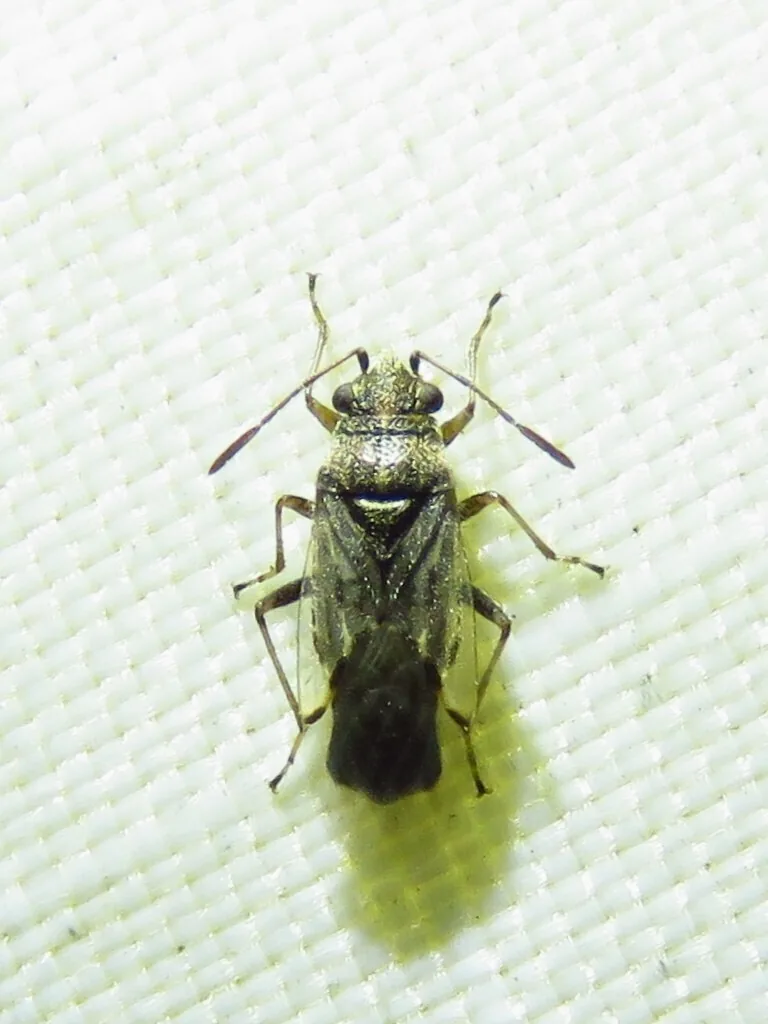
How to identify it
- Adults are slender, grayish brown and about 1/8 to 1/6 inch long.[1][3]
- When folded, the wing tips overlap and form a fairly clear X on the back.[1][3]
- Nymphs have no wings and look like coffee grounds from a distance; they are mottled gray-brown, often with reddish or orange marks on the abdomen.[1][2]
Look-alikes
| Look-alike | How to tell them apart |
|---|---|
| Chinch bugs (true chinch bugs) | True chinch bugs are lawn pests; the southern chinch bug adult is black with whitish wings, unlike the grayish false chinch bug.[1][2] |
| Bigeyed bugs | Wider, with larger eyes; they are beneficial predators of pest insects and mites, and never swarm the way false chinch bugs do.[1] |
Where it lives
A pest of the West, covered by extension services in California, Colorado and Utah; in California the worst plant damage is reported from the lower San Joaquin Valley.[1][2][3]
Biology and life cycle
They overwinter as nymphs and adults among winter annual weeds, especially mustards such as flixweed, often under debris.[1][2]
Eggs are laid in soil cracks or loose soil around plants; nymphs molt three times and become adults in about three weeks, with several generations a year.[1][2]
Problems are worst after wet, cool springs, when weeds grow thick and last longer, letting populations build.[1]
When their weed hosts dry out, are cut or are sprayed, the adults, which fly well, move into irrigated gardens, landscapes and buildings.[1][3]
Besides mustards, they feed on many plants, including potato, lettuce, kochia, quinoa and turfgrass.[2][3]
Damage and signs
- In most years they hurt only seedlings, which may wilt but rarely die; larger plants tolerate their feeding.[1]
- Thousands can mass on a single plant, and wilting and leaf dieback can follow, especially when plants are drought-stressed.[2]
- In rare cases, mainly in the lower San Joaquin Valley, swarms have killed young almond, pistachio, pomegranate and citrus trees.[1]
- They crawl under sliding patio screen doors and through other openings, but don't feed on or damage anything indoors.[1][2]
Health risk
False chinch bugs don't bite, and those trapped indoors eventually die.[2][3]
Control
Prevention
During a problem migration, Colorado State suggests briefly stopping irrigation right next to the building and offering cool, humid spots farther away so the bugs move on.[2][3]
Keep garden plants well watered so they can make up for sap lost to feeding.[1]
Keep them out
Keep window and patio door screens intact and seal exterior cracks and other entry points.[1][3]
Traps and physical control
Vacuum up any that get inside; small numbers need no control.[1][3]
Near weedy mustard fields, protect vegetable seedlings with row covers or caps until the spring migration ends.[1]
They move mostly in cool mornings and evenings, so running sprinklers then, or making a water moat around a garden, can reduce the invasion.[1]
Pesticides
Insecticides aren't recommended: perimeter sprays have very short residual, and Utah State notes the bugs resist chemical control. Migrations usually last a week or less.[1][2][3]
Common questions
- Why are thousands of tiny gray bugs on my house?
- In the West, these are often false chinch bugs migrating from drying weeds in nearby fields. They seek shelter and humidity, and the migration usually ends within about a week.[1][2]
- Should I spray for false chinch bugs?
- Extension services say no. Sprays have little effect and new bugs keep arriving; sealing openings and vacuuming work better.[1][2][3]
- Are false chinch bugs the same as chinch bugs?
- No. They are related seed bugs, but true chinch bugs are lawn pests, while false chinch bugs favor weedy mustards and become nuisance invaders.[1][2]
Sources
- University of California Statewide IPM Program, “Pest Notes: False Chinch Bug (UC ANR Publication 74153).” ipm.ucanr.edu/home-and-landscape/false-chinch-bug/ (accessed 2026-10-06)
- Colorado State University Extension, “False Chinch Bugs (Fact Sheet 5.603).” extension.colostate.edu/resource/false-chinch-bugs/ (accessed 2026-10-06)
- Utah State University Extension, “False Chinch Bug (Nuisance Pest IPM Notes).” extension.usu.edu/planthealth/ipm/notes_nuisance/false-chinch-bug (accessed 2026-10-06)
- iNaturalist, “Nysius raphanus taxon page (order and family).” www.inaturalist.org/taxa/261564 (accessed 2026-10-06)