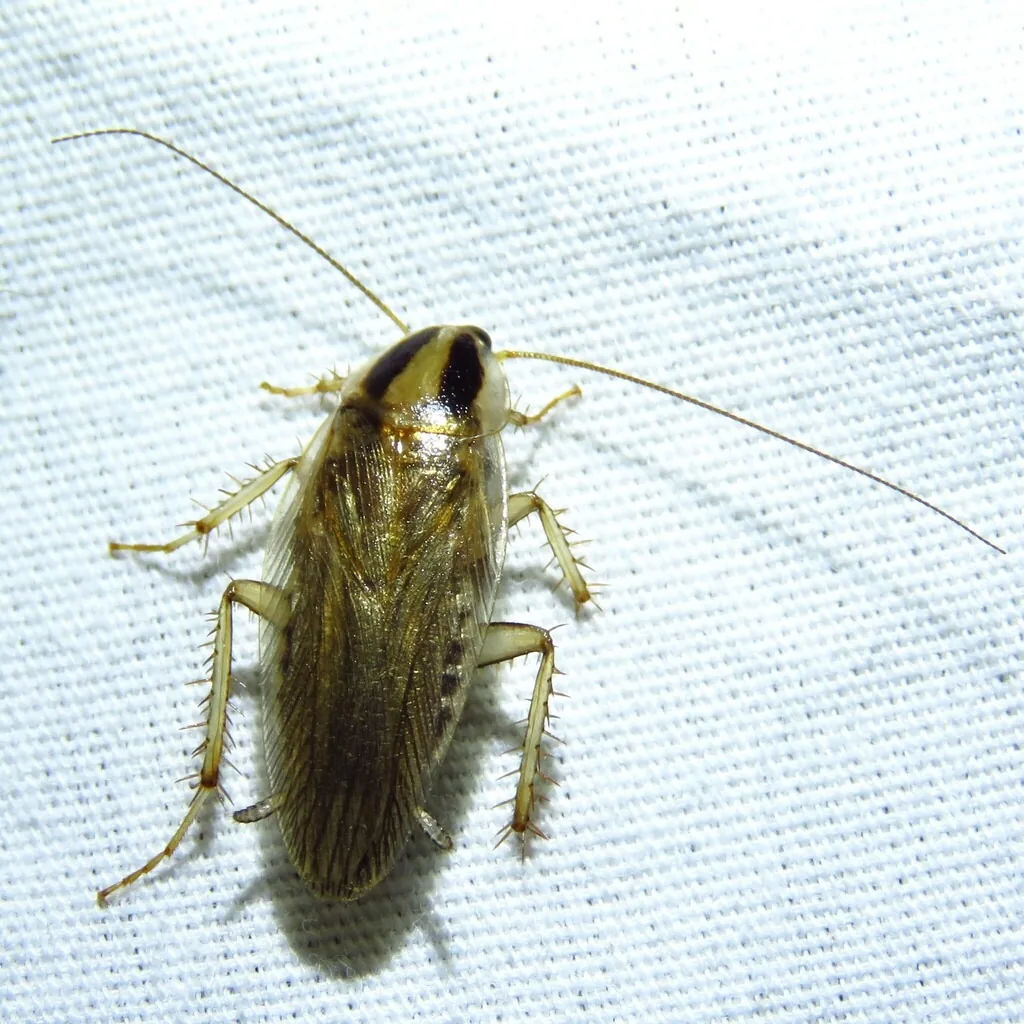
How to identify it
- Adults are about 3/8 to 1/2 inch long and light brown to tan with an olive-green tint.[1][2]
- Like the German cockroach, it has two dark lengthwise stripes on the shield behind the head.[1][2]
- The best field mark is a broad dark brown to black band on the face between the eyes, which German cockroaches lack.[1][2]
- Young nymphs are yellowish cream; older nymphs darken but stay lighter than German cockroach nymphs.[1]
Look-alikes
| Look-alike | How to tell them apart |
|---|---|
| German cockroach | Lives mainly indoors and hides by day, while the field cockroach lives outdoors, is more active in daylight, and has a dark stripe between the eyes.[3][2] |
| Asian cockroach | Also has two dark stripes behind the head, but the field cockroach adds a broad dark band across the face between the eyes.[1] |
Where it lives
Native to central and south Asia, it was first described from Arizona and California in 1935 and has spread along the southern U.S. border to Louisiana and, by 2018, Mobile, Alabama.[4][1]
Biology and life cycle
Females carry the egg case until it is about to hatch; each case usually holds 30 to 40 young.[2]
A female produces about five egg cases in her life, with later cases holding far fewer eggs than the first three.[1]
Development from egg to adult takes about 70 days, or roughly 3 months, through five to seven molts, and adults live about 100 to 150 days.[1][2]
It is more active in daylight than the German cockroach, gathers around lights, and flies when disturbed.[3]
Its spread across the southern states appears to follow major interstate highways.[4]
Damage and signs
Health risk
The field cockroach mostly lives outdoors. Indoors, cockroach shed skins and droppings can trigger allergies when the particles get into the air.[2][3]
Control
Prevention
Identify the species first; knowing which cockroach you have and where it hides tells you where to focus control.[2]
Keep them out
When roaches are coming in from outside, seal cracks and openings and add door sweeps and weather stripping to doors and windows.[2]
Sanitation
Trim shrubbery near the house, thin dense ground covers, and clear trash, lumber and firewood stacks that give outdoor roaches shelter.[2]
A strip of gravel 6 to 12 inches wide around the foundation keeps the area drier and less inviting to outdoor cockroaches.[2]
Pesticides
Outdoors, place baits or bait stations around the building perimeter, in meter boxes, wood piles and planters.[2]
Indoor insecticide treatment is warranted only for an established infestation, not for an occasional roach that wandered in.[2]
Common questions
- How can I tell a field cockroach from a German cockroach?
- Look at the face. Field cockroaches have a broad black band between the eyes and an olive tint, and they are usually found outdoors or near lights in daytime.[1][2][3]
- Will field cockroaches infest my kitchen?
- They live and breed outdoors in leaf litter and plant debris, and mostly come inside when it is hot or dry, looking for moisture.[2][1]
- Where are field cockroaches found?
- Mostly across the Southwest, especially southern California and desert areas, east to Louisiana and recently Alabama.[2][1][4]
Sources
- University of Florida, Department of Entomology and Nematology, “Field cockroach, Blattella vaga (Cockroach image gallery).” entnemdept.ufl.edu/projex/gallery/dl/cockroaches/text/field_cockroach.htm (accessed 2026-10-06)
- University of California Statewide IPM Program, “Pest Notes: Cockroaches, Publication 7467 (revised December 2019).” ipm.ucanr.edu/legacy_assets/PDF/PESTNOTES/pncockroaches.pdf (accessed 2026-10-06)
- Texas A&M AgriLife Extension Service, “German Cockroach (Field Guide to Common Texas Insects).” texasinsects.tamu.edu/blattodea/german-cockroach/ (accessed 2026-10-06)
- Florida Entomological Society (Jeon, Balusu, Zhang, Fadamiro and Appel, Auburn University), “First record of Blattella vaga (Blattodea: Ectobiidae) from southern Alabama. Florida Entomologist 101(1), 2018.” journals.flvc.org/flaent/article/view/105203 (accessed 2026-10-06)
- iNaturalist, “Blattella vaga taxon page (order and family).” www.inaturalist.org/taxa/466559 (accessed 2026-10-06)