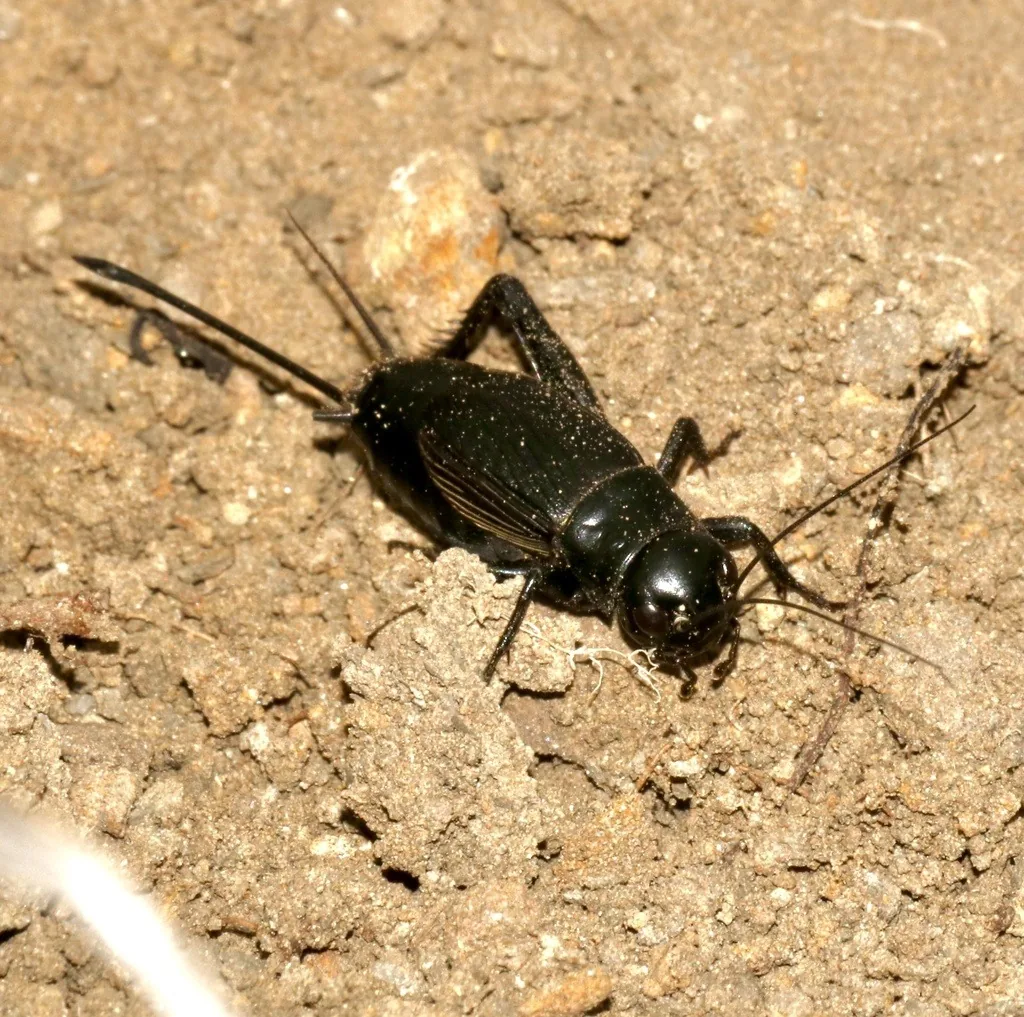
How to identify it
- Usually black, sometimes shades of brown, and about 1/2 to 1 1/4 inches long.[1][2]
- The brownish hind wings stick out past the front wings like pointed coattails.[1]
- Antennae longer than the body, big jumping hind legs with short spines, and two feelers at the tail end; females also carry a long, sword-like egg-laying tube.[2][3]
Look-alikes
| Look-alike | How to tell them apart |
|---|---|
| House cricket | Light yellowish brown with three dark bands across the head, about 3/4 inch long, and able to breed indoors.[3][1] |
| Camel cricket | Wingless and humpbacked, so it can't chirp, and it isn't attracted to lights.[1] |
Where it lives
Field crickets live in fields, pastures, meadows and yards, and they are among the most common house-invading crickets in Missouri.[2][1]
Biology and life cycle
Females lay eggs in moist soil; nymphs hatch in 15 to 25 days and look like small, wingless adults.[3][2]
Nymphs reach adulthood in about 12 weeks, and southern areas can have up to three generations a year.[3]
Winter is passed as eggs in cold climates and also as nymphs in warmer areas.[3]
Adult males chirp by rubbing their wings together to attract females and mark territory.[3][2]
They hide by day in mulch, tall grass, weeds and rock or wood piles, and come out at night.[2]
Damage and signs
- Indoors they chew cotton, linen, wool, silk and fur, especially items soiled with food or perspiration.[1][2]
- Because they lay eggs in soil, field crickets rarely build up large numbers inside and are usually only occasional invaders.[2]
- Outdoors, large numbers can damage garden plants and sometimes field crops.[3][1]
Health risk
The main problems are chirping indoors, which many people find annoying, and chewing damage to fabrics, especially soiled items.[2][1]
Control
Prevention
Limit outdoor lighting or switch to yellow or sodium vapor bulbs, which attract fewer crickets.[2][1]
Keep them out
Repair foundation cracks and poorly fitting doors, windows and vents, and keep screens in good condition.[1][2]
Sanitation
Mow tall grass, weed beds near the house, keep heavy mulch back from the foundation, and move rock, board and firewood piles away.[2][1]
Traps and physical control
Vacuum crickets indoors and discard the bag outside; sticky traps near entry points also help.[2][1]
Pesticides
Indoors, use cricket baits or labeled crack-and-crevice treatments rather than spraying open surfaces; outdoors, a bait band between habitat and the house works better than sprays on bare concrete.[1][2]
Common questions
- Why do crickets come inside in the fall?
- Field crickets move toward buildings as nights cool and are drawn to lights; they get in through gaps around doors, windows and foundations.[1]
- Will field crickets infest my house?
- Rarely. They usually lay eggs outdoors in soil, so indoor numbers stay low compared with house crickets, which can breed inside.[2][3]
Sources
- University of Missouri Extension, “Crickets (Publication G7366, reviewed August 2025).” extension.missouri.edu/publications/g7366 (accessed 2026-10-06)
- Clemson Cooperative Extension, Home & Garden Information Center, “House and Field Crickets (HGIC 2425).” hgic.clemson.edu/factsheet/house-and-field-crickets/ (accessed 2026-10-06)
- Texas A&M AgriLife Extension, “Field Cricket (Field Guide to Common Texas Insects).” texasinsects.tamu.edu/field-cricket/ (accessed 2026-10-06)
- iNaturalist, “Gryllus pennsylvanicus taxon page (order and family).” www.inaturalist.org/taxa/122193 (accessed 2026-10-06)