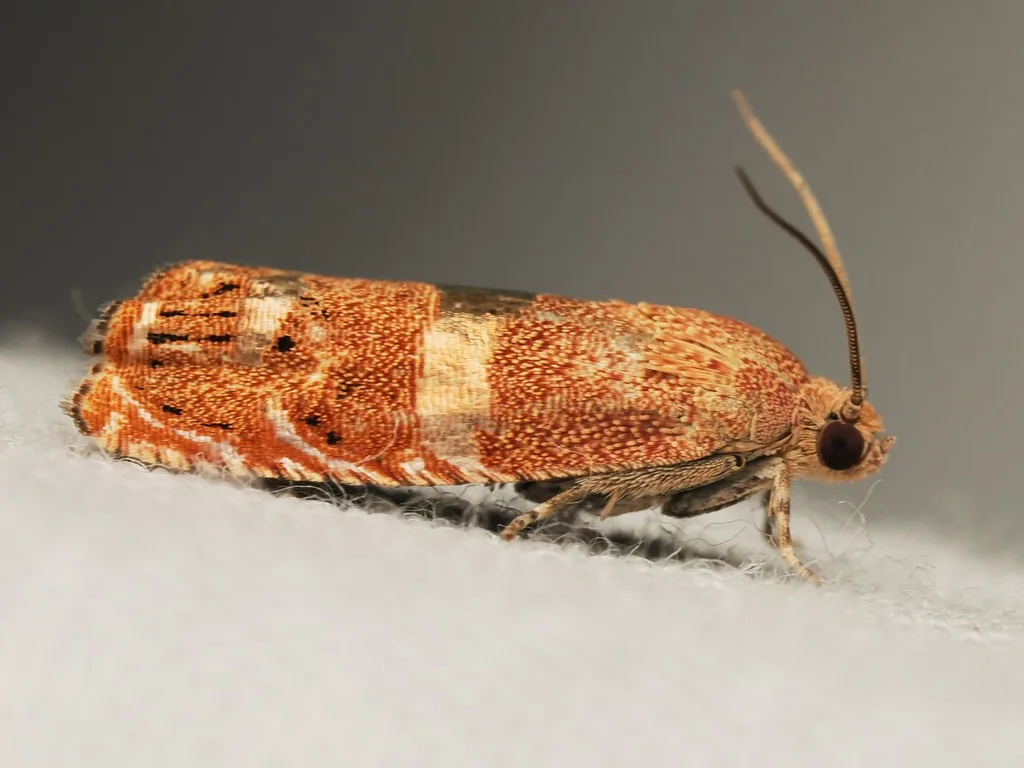
How to identify it
Look-alikes
| Look-alike | How to tell them apart |
|---|---|
| Codling moth | A close relative; filbertworm adults are gray to reddish with golden bands across each forewing.[1] |
Where it lives
It's found with many wild and cultivated fruits and nuts in North America and is common in acorns and chinkapin in the Pacific Northwest; in California it can hit pomegranates.[1]
Biology and life cycle
Mature larvae overwinter in silk cocoons under leaves and debris, up to 2 inches deep in soil, or in bark cracks.[1]
Moths fly from late May through October, and there are two generations a year.[1]
Females lay eggs on the upper surface of leaves.[1]
Damage and signs
- Early feeding on young nut clusters can make nuts abort, and later larvae infest nuts and destroy the kernel.[1]
Health risk
It feeds on plants; the PNW Insect Management Handbook mentions no risk to people.[1]
Control
Prevention
Hazelnut varieties differ; those with thicker shells at the basal scar, such as 'Lewis', 'Jefferson', 'Dorris' and 'Barcelona', are less susceptible.[1]
Sanitation
The first nuts to drop are more often infested; removing them, and fallen acorns from nearby oaks, can reduce pressure.[1]
Biological control
Predators, parasitic wasps such as Trichogramma minutum, and bats kill eggs, larvae and moths.[1]
Pesticides
Home-use options listed include spinosad, carbaryl, esfenvalerate and neem-based products; pheromone traps help time sprays.[1]
Common questions
Sources
- Pacific Northwest Pest Management Handbooks (OSU, WSU, University of Idaho), “Hazelnut: Filbertworm (Insect Management Handbook).” pnwhandbooks.org/insect/nut/hazelnut/hazelnut-filbertworm (accessed 2026-10-06)
- iNaturalist, “Cydia latiferreana taxon page (order and family).” www.inaturalist.org/taxa/148907 (accessed 2026-10-06)