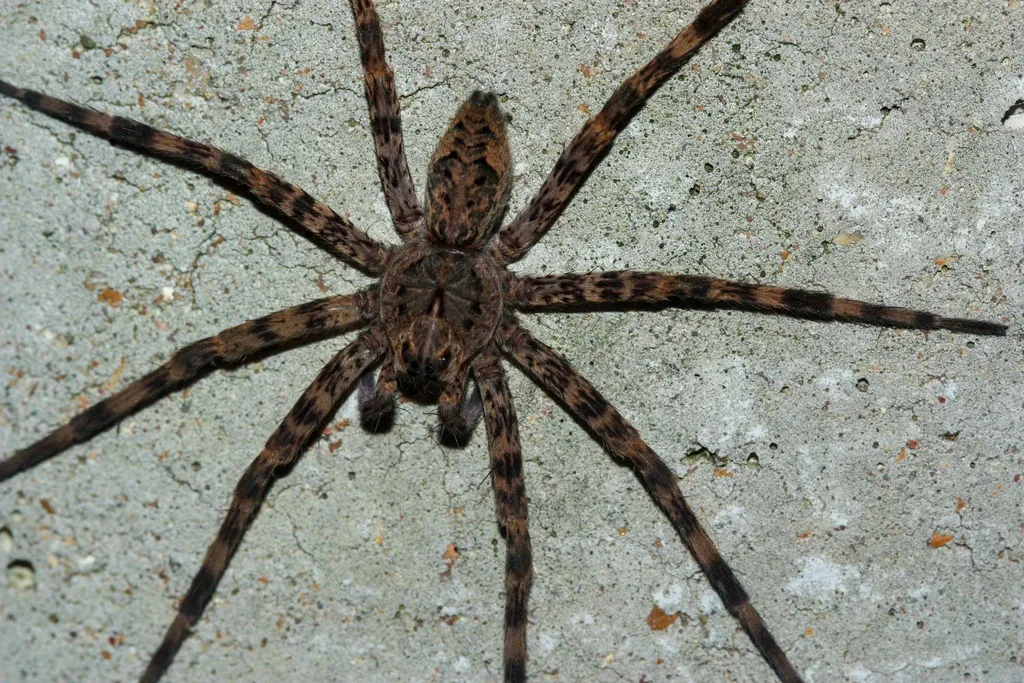
How to identify it
- Dark fishing spider females are about 5/8 to 1 inch long, with a leg span that can top 3 inches; males are roughly half that size.[1][3]
- The body is brownish gray to dark brown with black and lighter brown markings, and the legs are banded light and dark.[1][3]
- Fishing spiders don't spin webs to catch prey; they stalk or ambush it, mostly at night, often resting head-down on tree trunks by day.[3]
- With a hand lens, you can see that in the front four eyes, the outer two sit higher than the inner two.[2]
Look-alikes
| Look-alike | How to tell them apart |
|---|---|
| Wolf spider | Wolf spiders have the front four eyes in a straight row facing forward, and females carry their young on their backs instead of guarding them in a leaf nursery.[2] |
| Striped fishing spider | A close relative that looks very similar but has white W-shaped marks near the rear of the abdomen and lives mostly right at the water's edge.[1][3] |
Where it lives
The dark fishing spider ranges from New England and Canada south to Florida and Texas. Other Dolomedes species live along ponds, streams and wetlands across the same region.[1][3]
Biology and life cycle
Despite the name, the dark fishing spider is more of a tree-dwelling spider and is often found far from water in wooded settings.[1][3]
Fishing spiders mostly eat insects, but species living near water also catch small fish, tadpoles and frogs, and can stay underwater for a short time when chased.[2][3]
Spiders spend the winter not quite mature under stones, loose bark, tree cavities or in buildings, then mature in spring; adults are seen from early May through September.[1]
Females carry the egg sac in their jaws, then tie leaves into a nursery web where they guard 1,000 or more spiderlings.[1][2]
Females often eat males after mating, and sometimes before.[3]
Damage and signs
Health risk
Bites are rare because these spiders are shy and run away. A bite is painful, about like a bee or wasp sting, and is not dangerous unless a person is unusually sensitive to spider venom.[1][3][2]
Control
Traps and physical control
A fishing spider that wanders into a garage or basement can be coaxed into a jar or other container and released outside.[2]
Pesticides
They are not household pests, so spraying is not needed; a stray spider can be swatted or treated with a common household aerosol if it causes real distress.[2]
Common questions
- Are fishing spiders dangerous?
- No. Their venom is not dangerously toxic to people, they rarely bite even when handled, and a bite usually feels like a bee sting.[1][2][3]
- Why is there a fishing spider in my house if I don't live near water?
- The dark fishing spider is a woodland species that often lives well away from water. It commonly wanders into homes in wooded areas.[1][3]
- Can fishing spiders really catch fish?
- Yes. They can walk on water and dive, and species near ponds and streams catch minnows and tadpoles, though insects make up most of their diet.[2][3]
Sources
- Penn State Extension, “Fishing Spider (updated January 19, 2026).” extension.psu.edu/fishing-spider (accessed 2026-10-06)
- NC State Extension, “Fishing Spiders and Wolf Spiders (PDIC Factsheet, reviewed June 15, 2022).” content.ces.ncsu.edu/fishing-spiders-and-wolf-spiders (accessed 2026-10-06)
- Mississippi State University Extension Service, “Dark Fishing Spider (Bug's Eye View, Vol. 8, No. 25).” extension.msstate.edu/newsletters/bugs-eye-view/2022/dark-fishing-spider-vol-8-no-25 (accessed 2026-10-06)
- iNaturalist, “Dolomedes tenebrosus taxon page (order and family).” www.inaturalist.org/taxa/82117 (accessed 2026-10-06)