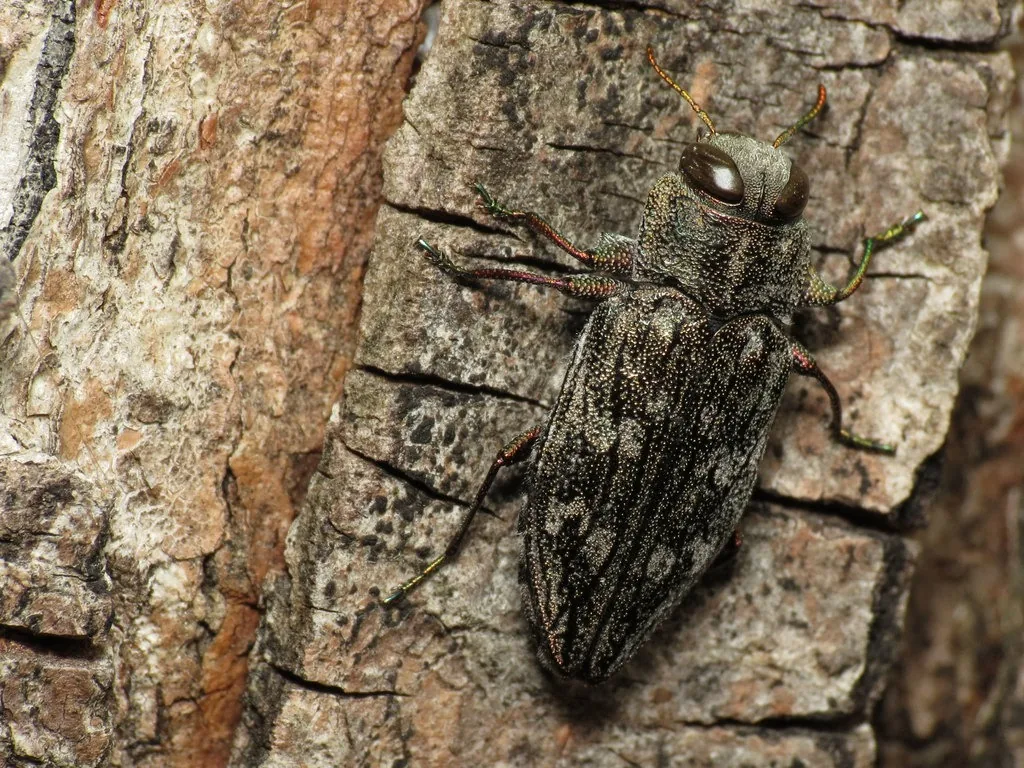
How to identify it
Where it lives
HGIC covers it on apple trees in South Carolina.[1]
Biology and life cycle
Adults are present from late spring to November, and there's one generation a year.[1]
First attacks are usually on the sunny side of the tree.[1]
Damage and signs
- Trees stressed by recent planting or drought are attacked; galleries can girdle and kill the tree.[1]
Health risk
It feeds on plants; Clemson HGIC mentions no risk to people.[1]
Control
Prevention
Keep trees healthy and vigorous, watering weekly during heat and drought; vigorous trees can drown larvae in sap.[1]
Common questions
Sources
- Clemson Cooperative Extension, Home & Garden Information Center, “Apple & Crabapple Insects (HGIC 2001).” hgic.clemson.edu/factsheet/apple-crabapple-insects/ (accessed 2026-10-06)
- iNaturalist, “Chrysobothris femorata taxon page (order and family).” www.inaturalist.org/taxa/1308752 (accessed 2026-10-06)