How to identify it
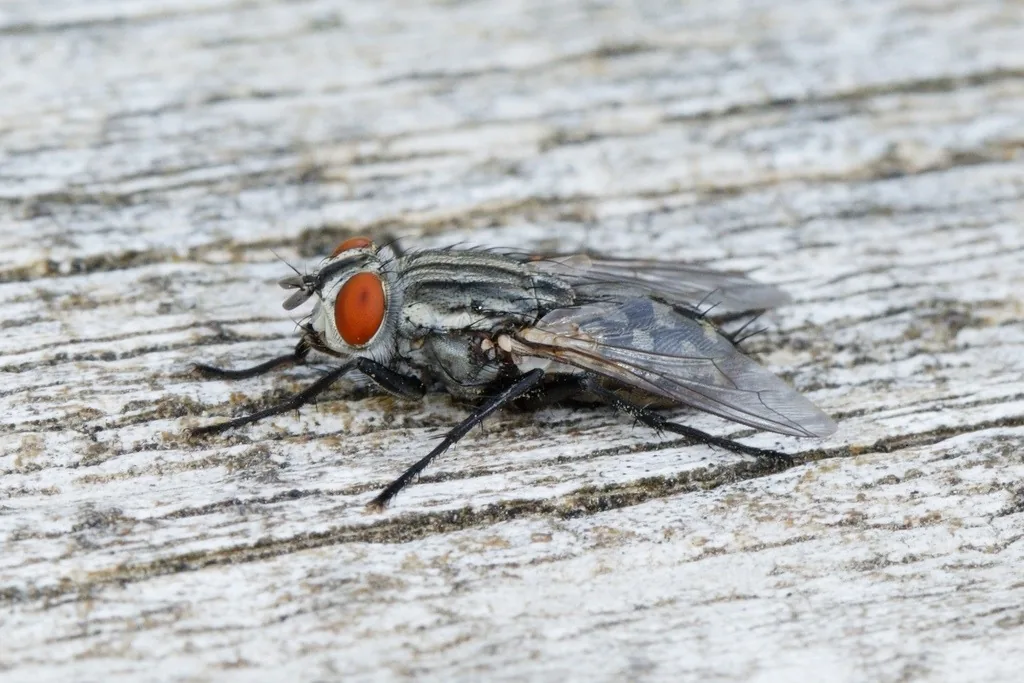
- Adults are big flies, about 3/8 to 5/8 inch long, noticeably larger than a house fly.[4][1]
- The body is gray with three black stripes running lengthwise on the thorax and a black-and-gray checkerboard pattern on the abdomen.[1][2]
- In some species, such as the red-tailed flesh fly, the tip of the abdomen is red or pink.[4][3]
- Larvae are creamy, legless maggots that taper to a pointed head end.[4]
Look-alikes
Where it lives
Flesh flies are a large, widespread group. They are mainly outdoor insects that turn up indoors in summer, and in the South the red-tailed flesh fly stays active all year.[1][3]
Biology and life cycle
Females don't lay eggs. The eggs hatch inside the female, and she deposits live maggots on a food source.[3]
Larvae feed mostly on animal carcasses, garbage, excrement and decaying plant material; some flesh flies instead parasitize other insects.[2][3]
Full-grown maggots wander away from the carcass to find a protected crack, where they pupate and later emerge as adults.[4]
Indoors, adults usually appear one to two weeks after maggots, and new flies may keep emerging for one to three weeks before they stop.[4]
Damage and signs
- They are a nuisance rather than a structural pest. Many big flies suddenly appearing indoors usually means an animal died somewhere inside the building.[1][2]
- Their arrival often follows a dead-animal odor; by the time adults emerge, the maggots may have mostly consumed the carcass and the smell may be fading.[3]
Health risk
Flesh flies don't bite. Because they develop in waste and decaying matter, they can carry disease-causing bacteria on their bodies and spread them by contact.[1][2]
Control
Keep them out
Flesh flies indoors point to a home that lets wildlife in. Seal openings with sturdy wire or sheet metal, cap the chimney, and screen roof vents and turbines.[4]
Keep exterior doors closed, repair window screens, and add caulk, weather stripping and door sweeps to keep flies outside.[2]
Sanitation
Find and remove the dead animal or other breeding material if you can reach it; if new food sources keep appearing, the flies will keep coming.[4][3]
Keep trash cans and dumpsters clean with lids closed, and place dumpsters at least 50 feet from the building.[2]
Traps and physical control
Destroy any wandering maggots and swat adult flies. When the carcass is out of reach, this is often the only practical response, and the flies die out on their own.[4][3]
Properly placed light traps can catch flies that do get indoors.[2]
Common questions
- Why are big gray flies suddenly in my house?
- Usually a mouse, rat, bird or other small animal has died in a wall void or attic, and the flesh flies developed in the carcass.[1][3]
- Will flesh flies go away on their own?
- Often, yes. Once the carcass is used up and the adults can't find another place to deposit larvae, the problem ends as the flies die off.[3]
- Do flesh flies bite?
- No. Flesh flies do not bite people.[1]
Sources
- University of Minnesota Extension, “Flesh flies (What insect is this? Insects found indoors).” apps.extension.umn.edu/garden/diagnose/insect/indoor/flies/medium/flesh-flies.html (accessed 2026-10-06)
- Utah State University Extension, Plant Health, “Flesh Flies, Sarcophaga spp. (IPM Notes: Nuisance Pests).” extension.usu.edu/planthealth/ipm/notes_nuisance/flesh-flies (accessed 2026-10-06)
- Mississippi State University Extension Service, “Red-tailed Flesh Fly (Bug's Eye View, Vol. 8, No. 5, 2022).” extension.msstate.edu/newsletters/bugs-eye-view/2022/red-tailed-flesh-fly-vol-8-no-5 (accessed 2026-10-06)
- Texas A&M AgriLife Extension, “ENTO-050: Indoor Flies and Their Control.” agrilifeextension.tamu.edu/library/insects/indoor-flies-and-their-control/ (accessed 2026-10-06)
- iNaturalist, “Sarcophaga taxon page (order and family).” www.inaturalist.org/taxa/120489 (accessed 2026-10-06)