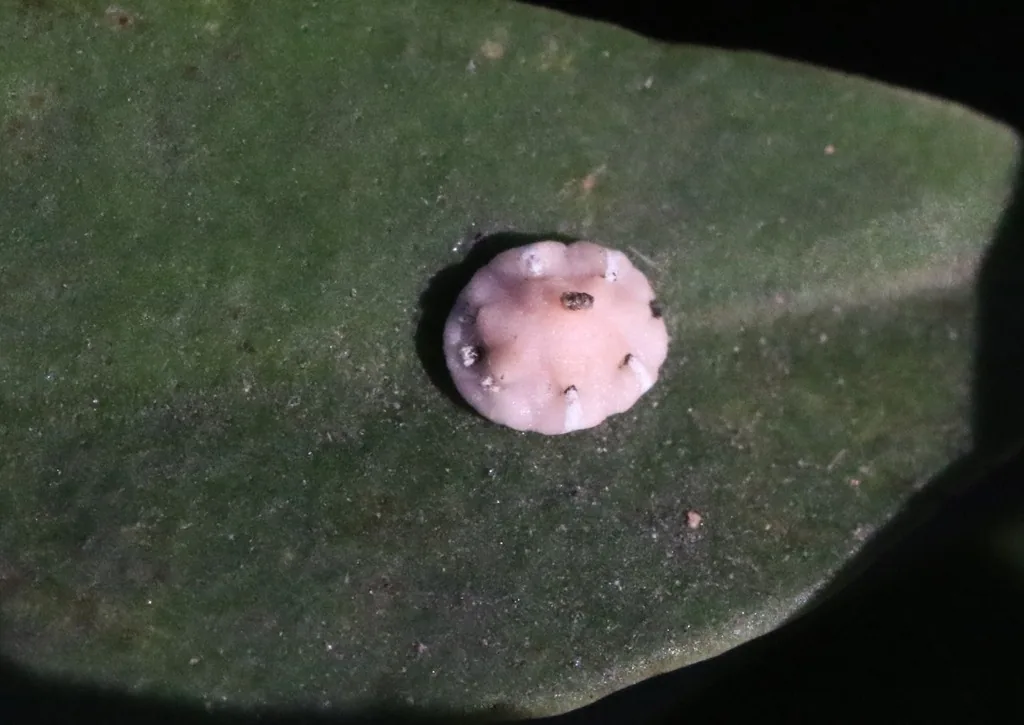
How to identify it
Look-alikes
| Look-alike | How to tell them apart |
|---|---|
| Other scale insects | Soft scales like this one produce sticky honeydew and sooty mold.[1] |
Where it lives
Native to the northern Neotropics, it now occurs worldwide; in Florida it infests citrus, avocado, crape myrtle, holly, Indian hawthorn and many others.[1]
Biology and life cycle
Florida has three generations a year, in April–May, July–August and October–November; two are common elsewhere.[1]
Crawlers hatch after two to three weeks under the female, disperse and settle.[1]
Damage and signs
- Heavy infestations discolor leaves, cause leaf drop and branch dieback, and can kill plants; honeydew grows sooty mold.[1]
Health risk
It feeds on plants only; UF/IFAS mentions no risk to people.[1]
Control
Prevention
Buy only pest-free plants and site them where light and soil suit them.[1]
Traps and physical control
Prune off and destroy infested plant parts.[1]
Biological control
Three parasitic wasps attack it in parts of the U.S.[1]
Common questions
Sources
- University of Florida IFAS Extension (Featured Creatures), “Florida Wax Scale, Ceroplastes floridensis (EENY-510).” edis.ifas.ufl.edu/publication/IN913 (accessed 2026-10-06)
- iNaturalist, “Ceroplastes floridensis taxon page (order and family).” www.inaturalist.org/taxa/330197 (accessed 2026-10-06)