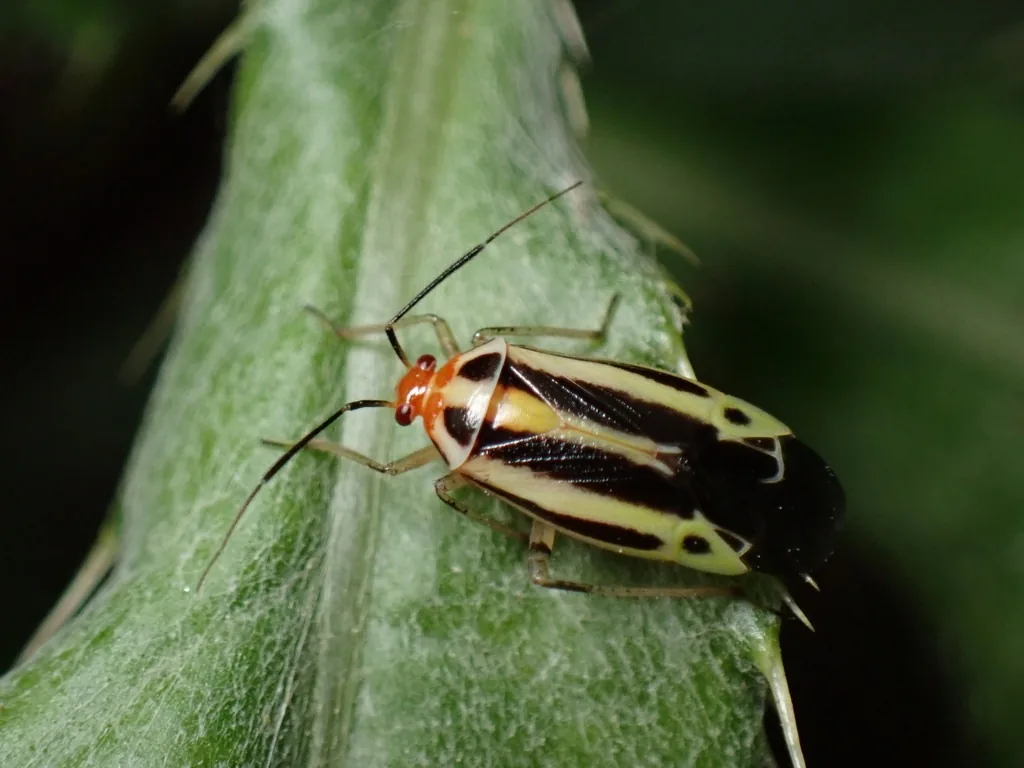
How to identify it
- Adults are 1/4 to 1/3 inch, greenish yellow with four black stripes down the wings, an orange-brown head and yellow-green legs.[1]
- Young nymphs are bright red with black wing pads; older ones are reddish orange with a light stripe on each wing pad.[1]
- Feeding makes dark, round, sunken spots 1/16 to 1/8 inch wide that may turn clear and drop out.[1]
Look-alikes
| Look-alike | How to tell them apart |
|---|---|
| Leaf spot diseases | Disease spots vary in size and have discolored edges; plant bug spots are uniform.[1] |
Where it lives
It feeds on about 250 plant species, especially mint, basil, chrysanthemum, shasta daisy, azalea, dogwood, viburnum, currant and peppers.[1]
Biology and life cycle
Eggs hatch in late spring as leaves emerge; nymphs feed about four weeks before becoming adults.[1]
Females lay banana-shaped eggs in slits in stems, adults feed until early July, and there's one generation a year.[1]
Damage and signs
- Moderate to heavy feeding can brown leaves, wilt new growth and ruin herbs.[1]
Health risk
It feeds on plants; Minnesota Extension mentions no risk to people.[1]
Control
Prevention
Small to moderate numbers don't seriously harm plants; check in late May and early June.[1]
Sanitation
Cut down host plants in fall to remove eggs laid in the stems.[1]
Pesticides
Insecticidal soap (best on nymphs) or pyrethrins work on contact and are low risk to beneficials; repeat as needed.[1]
Common questions
Sources
- University of Minnesota Extension, “Fourlined plant bugs (Yard and garden insects).” extension.umn.edu/garden-and-home/yard-and-garden/yard-and-garden-insects/four-lined-plant-bugs (accessed 2026-10-06)
- iNaturalist, “Poecilocapsus lineatus taxon page (order and family).” www.inaturalist.org/taxa/126211 (accessed 2026-10-06)