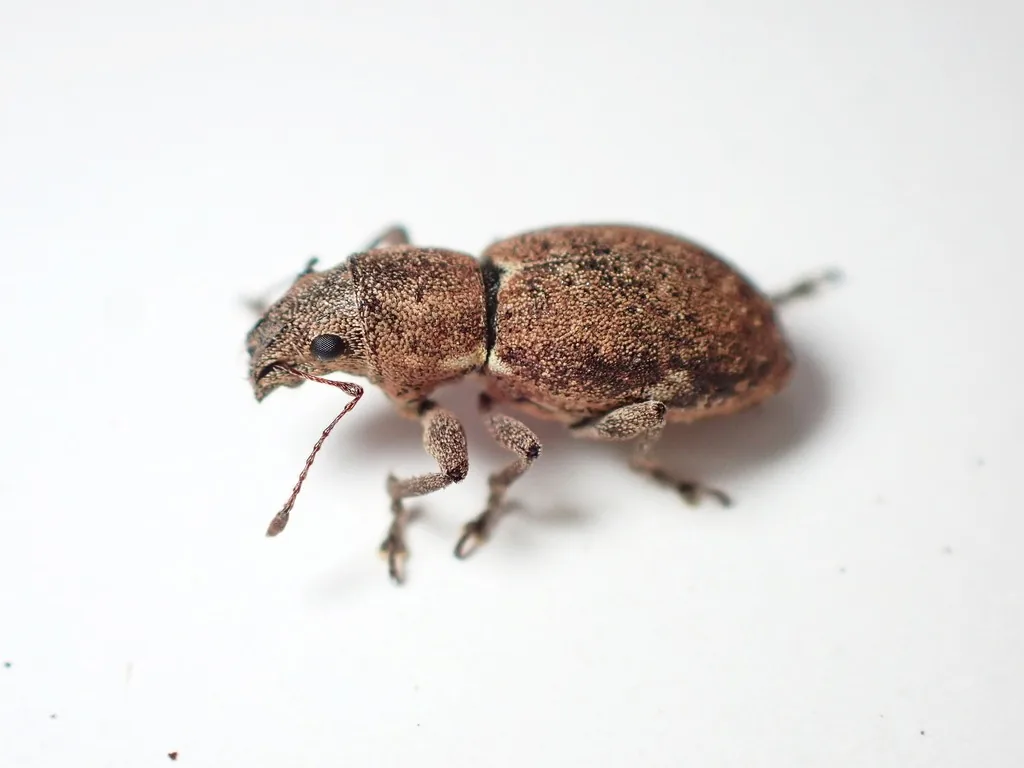
How to identify it
Look-alikes
| Look-alike | How to tell them apart |
|---|---|
| Cribrate weevil and vegetable weevil | These two common California snout beetles look similar; the shape and angle of the head tell the Fuller rose beetle apart.[1] |
Where it lives
Hosts include acacia, avocado, box elder, citrus, oak, photinia, Prunus and Pyrus species, Rhaphiolepis and rose.[1]
Biology and life cycle
All Fuller rose beetles are females that lay eggs without mating.[1]
Larvae drop to the soil and feed on roots for about 6 to 10 months, then pupate in the soil.[1]
Adults emerge mostly in summer and fall, feed at night, hide in litter by day and can't fly.[1]
There is one generation a year.[1]
Damage and signs
Health risk
It feeds only on plants; UC IPM mentions no effect on people.[1]
Control
Prevention
Feeding on healthy woody plants can generally be ignored; UC IPM recommends no insecticides for this weevil in gardens.[1]
Keep them out
Trim branches that touch the ground or other plants, and put a 6-inch sticky band over a trunk wrap so the flightless adults can't climb up.[1]
Biological control
A tiny wasp, Fidiobia citri, often parasitizes up to half the eggs in each egg mass; parasitized eggs turn gold, then black.[1]
Common questions
Sources
- University of California Statewide IPM Program, “Fuller Rose Beetle (Pests in Gardens and Landscapes).” ipm.ucanr.edu/PMG/GARDEN/PLANTS/INVERT/fullerrosebeetle.html (accessed 2026-10-06)
- iNaturalist, “Pantomorus cervinus taxon page (order and family).” www.inaturalist.org/taxa/318474 (accessed 2026-10-06)