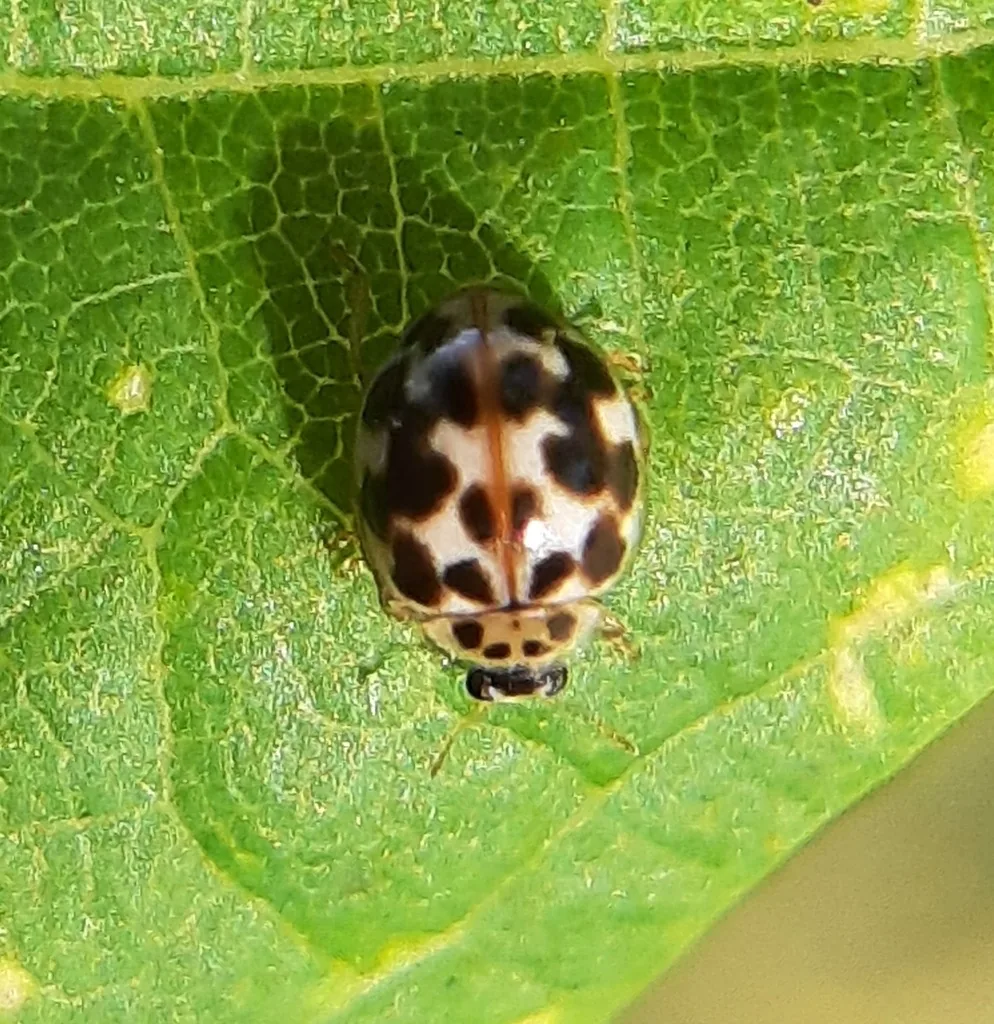
How to identify it
- Psyllobora vigintimaculata adults are 1/8 to 1/6 inch long, round and domed.[1]
- The thorax and wing covers are cream, pale gray or yellowish with four or five spots on the thorax and usually eight or nine on each wing cover.[1]
- In many individuals the spots run together, and some have orange marks.[1]
- Larvae are pale gray to whitish with dark markings that get bolder as they grow.[1]
Where it lives
P. vigintimaculata ranges through the contiguous United States, western Canada and Alaska and on into Central and northern South America.[1]
Biology and life cycle
Females lay small egg groups mostly under leaves where powdery mildew grows.[1]
Egg to reproductive adult takes three to four weeks, with multiple generations a year.[1]
In California, adults can be active from at least February to mid-December.[1]
Damage and signs
Health risk
They feed only on powdery mildew, and UC IPM describes no risk to people.[1]
Control
Prevention
Treat the beetles as a sign of powdery mildew, not as a pest; their numbers rise as mildew spreads.[1]
Biological control
Flowering plants, ant control and avoiding persistent, broad-spectrum insecticides help keep these beetles around.[1]
Common questions
- Why are lady beetles on my mildewed squash?
- They may be Psyllobora, which eat powdery mildew and become more common as mildew increases.[1]
- Will they eat my aphids?
- No. Psyllobora species won't feed on insects.[1]
- Are the whitish spotted larvae a pest?
- No. They're Psyllobora larvae grazing on powdery mildew.[1]
Sources
- University of California Statewide IPM Program, “Fungus-Feeding Psyllobora Lady Beetles (Natural Enemies Gallery).” ipm.ucanr.edu/natural-enemies/fungus-feeding-psyllobora-lady-beetles/ (accessed 2026-10-06)
- iNaturalist, “Psyllobora vigintimaculata taxon page (order and family).” www.inaturalist.org/taxa/118967 (accessed 2026-10-06)