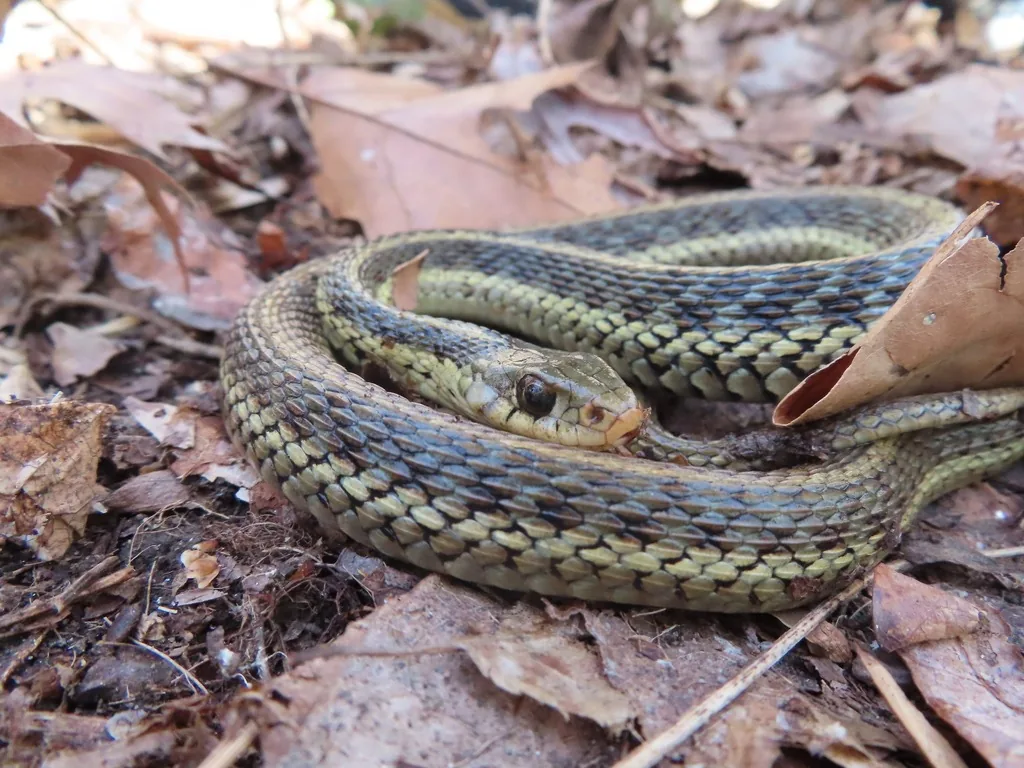
How to identify it
- A slender snake, usually 18 to 26 inches long as an adult, with three thin light stripes: one down the back and one along each side.[2][1]
- Stripes are usually yellow, green, brown, blue or white over a black, brown, olive or gray body, often with dark checkered spots between them.[2][1]
- Narrow black bars mark the edges of the upper lip scales.[1][2]
- The eyes are large, with round pupils, and there is no pit between the eye and nostril.[2][3]
- Some individuals lack stripes, and in red-sided gartersnakes red skin shows between the side scales.[2][1]
Look-alikes
| Look-alike | How to tell them apart |
|---|---|
| Ribbonsnakes | Ribbonsnakes are close striped relatives; Missouri's orange-striped ribbonsnake has plain, unmarked upper lip scales instead of black bars.[1][2] |
| Plains gartersnake | Plains gartersnakes have boldly marked black bars on the upper lip scales, rather than narrow ones.[1] |
| Copperhead | Copperheads are venomous pit vipers with a heat-sensing pit on each side of the face and vertical pupils; gartersnakes have round pupils, no pits and lengthwise stripes.[3][2] |
Where it lives
The common gartersnake is widespread across the eastern half of the United States and reaches farther north than most snakes, well into Canada and southeastern Alaska.[1]
Biology and life cycle
They live in many habitats but favor damp spots near ponds, marshes, creeks and ditches, and they shelter under boards, rocks and other objects near buildings.[1][2]
They are active mainly by day, from March into early November, and may come out on mild winter days.[1]
They eat earthworms, frogs, toads, salamanders and tadpoles, plus slugs, snails, insects and small fish; they swallow prey alive rather than constricting it.[1][2]
Females give birth to live young in mid to late summer, usually about two dozen but sometimes many more.[1][2]
In winter they shelter in animal burrows, mole tunnels, rock crevices, old wells, cisterns and building foundations.[1]
Damage and signs
Health risk
Gartersnakes are not dangerous to people or pets. They may bite in self-defense if grabbed; a bite from a nonvenomous snake should be cleaned and treated like any minor wound.[2][1][5]
Control
Prevention
Leave the snake alone; when not cornered, gartersnakes flee for cover, and nearly all bites happen when people handle or harass them.[2][5]
Keep them out
Snakes don't gnaw their way in, so the same sealing that keeps out mice works: close gaps of 1/8 inch or more around doors, windows, pipes and foundations.[6]
A fence of 1/4-inch galvanized hardware cloth, 36 inches tall, buried 4 to 6 inches and slanted outward keeps most snakes out of a small area such as a play yard.[6]
Sanitation
Keep grass mowed and remove boards, rocks, brush and debris lying near the house that shelter snakes and their prey.[6]
Traps and physical control
To move a snake out of a basement, ICWDM suggests piling damp towels or burlap where it was seen, covering with a dry one, and checking after a couple of days.[6]
When to call a professional
If a snake is indoors and you're not comfortable moving it, call a wildlife control operator or your state wildlife agency.[6][3]
Why gartersnakes are worth keeping around
Snakes don't harm landscapes or gardens, and they help reduce insect and rodent populations.[5]
ICWDM notes that spending money to control nonvenomous snakes is seldom justified.[6]
Snakes are protected as nongame wildlife in most states and should never be killed indiscriminately; check your state's rules.[3]
What doesn't work
Several snake repellents are sold, but none has research showing it works well in real-world use.[6]
No toxicants are registered for snake control, and fumigating burrows isn't practical because most snakes don't dig them.[6]
Common questions
- Are garter snakes poisonous?
- No. Gartersnakes are nonvenomous and harmless, though they may bite and smear a foul-smelling musk if picked up.[1][2]
- Why are garter snakes in my yard?
- They follow food and shelter: earthworms, slugs and frogs in damp spots, plus cover under boards, rocks, mulch and debris near buildings.[1][4]
- Why do I see so many garter snakes in early spring?
- Gartersnakes tolerate cold better than most snakes, so they emerge early, and they mate soon after leaving their winter shelters.[1]
Sources
- Missouri Department of Conservation, “Eastern Gartersnake and Red-Sided Gartersnake (Field Guide).” mdc.mo.gov/discover-nature/field-guide/eastern-gartersnake-red-sided-gartersnake (accessed 2026-10-06)
- Florida Museum of Natural History, University of Florida, “Common Gartersnake (Florida Snake ID Guide).” www.floridamuseum.ufl.edu/florida-snake-id/snake/common-gartersnake/ (accessed 2026-10-06)
- Internet Center for Wildlife Damage Management, “Snakes: Identification.” icwdm.org/species/reptiles/snakes/ (accessed 2026-10-06). Run by university wildlife damage specialists (maintained at the University of Wisconsin-Stevens Point); species modules are based on Prevention and Control of Wildlife Damage (University of Nebraska Cooperative Extension, 1994).
- Internet Center for Wildlife Damage Management, “Snake Biology.” icwdm.org/species/reptiles/snakes/snake-biology/ (accessed 2026-10-06). Run by university wildlife damage specialists (maintained at the University of Wisconsin-Stevens Point); species modules are based on Prevention and Control of Wildlife Damage (University of Nebraska Cooperative Extension, 1994).
- Internet Center for Wildlife Damage Management, “Snake Damage Identification.” icwdm.org/species/reptiles/snakes/snake-damage-identification/ (accessed 2026-10-06). Run by university wildlife damage specialists (maintained at the University of Wisconsin-Stevens Point); species modules are based on Prevention and Control of Wildlife Damage (University of Nebraska Cooperative Extension, 1994).
- Internet Center for Wildlife Damage Management, “Snake Damage Prevention and Control Methods.” icwdm.org/species/reptiles/snakes/snake-damage-prevention-and-control-methods/ (accessed 2026-10-06). Run by university wildlife damage specialists (maintained at the University of Wisconsin-Stevens Point); species modules are based on Prevention and Control of Wildlife Damage (University of Nebraska Cooperative Extension, 1994).
- iNaturalist, “Thamnophis sirtalis taxon page (order and family).” www.inaturalist.org/taxa/28362 (accessed 2026-10-06)