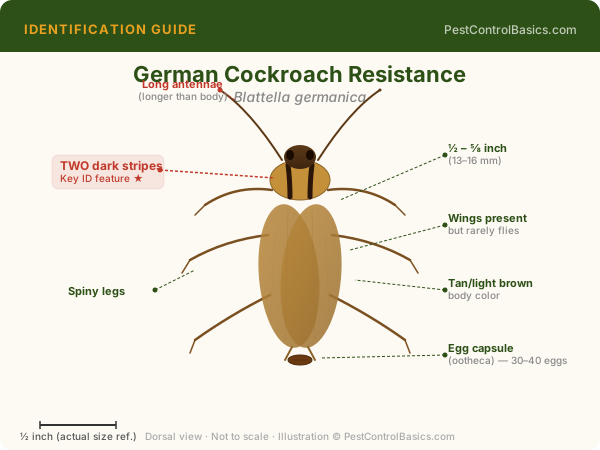
Urban German cockroach populations have survived every insecticide class thrown at them. Here's what's resistant, what still works, and why gel bait remains the gold standard.
Original illustration by PestControlBasics.com. Use anatomical labels above to confirm your identification.
🔬
PestControlBasics Editorial Team
Reviewed by Derek Giordano · Updated 2026
🔍 Identification
Documented resistance in US urban populations: pyrethroids (bifenthrin, cypermethrin, permethrin) — widespread; organophosphates (chlorpyrifos, malathion) — widespread; carbamates (propoxur) — widespread; some populations showing reduced susceptibility to fipronil and imidacloprid. The primary mechanism is metabolic detoxification enzymes that neutralize insecticides before they reach target sites. Behavioral resistance (avoidance of treated surfaces) is also documented.
🧬 Biology & Behavior
The products with lowest current resistance rates: indoxacarb (Advion) — metabolic activation in cockroach gut makes it uniquely difficult to develop resistance to; abamectin (Vendetta) — different mode of action; dinotefuran (Alpine WSG) — some resistance developing but less than imidacloprid. CimeXa (amorphous silica) — mechanical mode of action, CANNOT develop resistance. This is why the professional standard remains gel bait + CimeXa dust — both remain effective against resistant populations.
⚠️ Damage & Health Risk
Treatment failure from resistant populations; continued infestation despite aggressive spray programs; increasing treatment costs as less effective products are applied repeatedly.
🔧 DIY Treatment
Advion gel bait (indoxacarb) — most effective product against resistant populations. CimeXa in wall voids — mechanical, resistance-proof. Rotate: alternate Advion with Vendetta (abamectin gel) to prevent resistance development to indoxacarb.
👷 When to Call a Pro
For severe resistant infestations in commercial settings: professional application of Phantom (chlorfenapyr) provides non-cross-resistant option; combine with Advion for comprehensive control.
❓ FAQ
My spray doesn't seem to kill cockroaches anymore — why?
Pyrethroid resistance in German cockroaches is now extremely widespread in US urban environments — particularly in apartment buildings that have received years of spray treatments. The cockroaches you're seeing may be surviving because their populations have evolved detoxification enzymes. Switch from spray to Advion gel bait — it works through a completely different mechanism that resistant cockroaches haven't defeated.
Why does gel bait work even on resistant cockroaches?
Indoxacarb (Advion) is a pro-insecticide — it's only activated into its toxic form by enzymes specifically present in the cockroach gut. The same metabolic detoxification enzymes that degrade pyrethroids actually help activate indoxacarb. Cockroaches that are resistant to pyrethroids may actually be MORE susceptible to indoxacarb. This is why gel bait outperforms spray in resistant populations.
DG
Derek Giordano
Certified Pest Control Operator · Former Business Owner
Derek ran his own pest control company in Florida for several years, servicing thousands of regular customers. All content is based on hands-on field experience and current EPA & university extension guidelines.
Prevention strategies that actually reduce German Cockroach Resistance pressure
Most pest pressure traces back to one or two environmental conditions that are easier to fix than the infestation itself is to spray. For German Cockroach Resistance, the highest-leverage changes typically involve moisture management, food access, and exclusion at structural entry points. Reducing standing water within 20 feet of the foundation eliminates more pest problems than any single chemical application, and the effect persists year over year rather than requiring a rebuy every quarter.
Exclusion work is unglamorous but durable. A common entry-point audit covers door sweeps, weep holes, utility penetrations, dryer vents, soffit gaps, and the base of siding. Most homes have between five and fifteen openings larger than the minimum required for the target pest to enter, and sealing even half of them measurably reduces indoor sightings within one season. Stainless steel mesh, copper wool, and exterior-grade sealant cover most situations; expanding foam alone is not sufficient because rodents and some insects chew through it.
Storage practices matter too. Pantry pests, fabric pests, and overwintering insects all exploit cardboard, paper, and natural-fiber storage in basements and garages. Switching to sealed plastic bins for seasonal storage removes a significant amount of harborage that is otherwise impossible to spray effectively.
When to escalate German Cockroach Resistance control beyond DIY
Most German Cockroach Resistance situations are within the range of a careful homeowner, but a handful of scenarios genuinely warrant a licensed applicator. Multi-unit buildings are at the top of that list — shared walls, plumbing, and ductwork mean a localized treatment in one unit often just relocates the population to a neighbor. Any infestation that involves wall voids, attic insulation, or sub-slab plumbing is also harder to reach with consumer products and benefits from professional equipment and labeled product concentrations.
Health-sensitive situations are the second escalation trigger. Pregnancy, infants, immunocompromised residents, and pets with known sensitivities all narrow the available product list considerably. A licensed professional can apply restricted-use products and reduced-risk reformulations that achieve control with lower household exposure than over-the-counter alternatives. The cost difference is usually less than two seasons of DIY spending once the time investment is factored in.
The third escalation point is recurrence. If the same pest returns within six weeks of an apparently successful treatment, the source is usually structural or environmental rather than chemical, and a professional inspection often finds the cause faster than a second round of self-treatment.
Confirming a German Cockroach Resistance infestation in the field
Misidentification is the most common reason home treatment fails for German Cockroach Resistance. Look-alike species often respond to completely different active ingredients, so a 30-second confirmation step before any spraying or baiting saves the most time over a season. The practical workflow begins with where you found the specimen — kitchen, bathroom, garden, attic — because habitat narrows the candidate list faster than morphology alone.
Specific cues for German Cockroach Resistance include body proportions, leg count, antenna shape, and any wing structure if present. Adults are usually the easiest stage to identify, but most real-world infestations show juveniles or evidence (frass, shed skins, webbing, damage patterns) more often than adults themselves. Photograph the specimen against a ruler or coin for scale, then compare against a regional reference rather than a global one — range maps from state Extension services beat generic online identification sites.
When two species look genuinely similar, the deciding factor is often where they congregate at dusk versus dawn, or whether they leave a visible trail. A test of three common DIY treatments — one bait, one residual spray, one mechanical barrier — applied in different areas can also confirm identity by which works.
Why timing changes everything with German Cockroach Resistance
The same product applied two weeks apart can produce a complete kill or near-zero effect depending on where the German Cockroach Resistance population sits in its life cycle. Egg-stage pests are nearly immune to contact sprays, so a perfectly applied treatment during a major hatch event will leave the next generation completely unaffected. The professional standard is two applications spaced 10 to 14 days apart for most household pests — the first kills the active adults, the second catches anything that emerges from eggs in the interim.
Temperature also drives treatment success. Most residual sprays lose efficacy above 90°F or below 50°F, and pyrethroid products in particular can repel rather than kill when applied during high heat. The best window is early morning when surface temperatures are still moderate and target pests are moving but not yet at peak activity. Indoor treatment is less weather-dependent but still benefits from being applied when household air movement is low — running ceiling fans during application redistributes droplets away from the intended surface.
Seasonal pressure for German Cockroach Resistance usually has two or three predictable peaks per year. A treatment calendar built around those peaks costs less and works better than reactive spraying after a problem is already established.
Published: Jan 1, 2025 · Updated: Apr 7, 2026
Why aerosol sprays often make cockroach problems worse
Aerosol cockroach sprays remain among the best-selling pest control products despite being among the worst choices for actual cockroach control. The mechanism of harm is twofold. First, aerosols are repellent: they drive surviving cockroaches deeper into harborage or into adjacent untreated areas, sometimes expanding the problem across a building. Second, aerosols are contaminating: bait acceptance drops significantly on surfaces with aerosol residue, so a homeowner who has been spraying and then switches to bait often gets poor results from the bait that would have worked on a clean substrate. Professional German cockroach programs specifically avoid aerosols for these reasons, relying on baits, dusts in voids, growth regulators, and targeted residuals applied via crack-and-crevice rather than space sprays. Homeowners who have been treating with aerosols and not getting results should typically stop spraying, wait a week or two for surfaces to ventilate, then switch to bait — counterintuitively, doing less initially produces better long-term results.
Reading product labels: the parts that matter and the parts that don't
Pesticide product labels are legal documents with specific use directions, but the parts that matter most for residential decisions aren't always the parts that get attention. The active ingredient and its concentration are essential — they determine what category of pest the product targets and how it compares to alternatives. The 'Directions for Use' section is binding (using a product against label instructions is technically a federal violation and may void product liability), but most homeowners skim it. The 'Precautionary Statements' section tells you exposure risks and required PPE. The 'First Aid' section matters in an emergency. What matters less in practice: marketing copy on the front of the package, brand-specific claims about superiority (federal regulations sharply limit what these can say), and 'natural' or 'organic' labeling (which can be technically accurate while still describing a product with meaningful exposure considerations — pyrethrin from chrysanthemums is 'natural' but still a neurotoxin in concentration). Reading labels critically — focusing on active ingredient, concentration, target pest list, application method, and precautions — gives a clearer picture than retail-shelf comparison ever does.
Cockroach control in slab-on-grade construction: specific challenges
Homes on slab-on-grade foundations present specific cockroach control challenges that don't apply to crawlspace or basement homes. Plumbing and electrical penetrations through the slab provide protected harborage routes between exterior and interior that can't be sealed conventionally because the openings are often inside walls. American cockroaches in particular travel slab penetrations from sewer lines into kitchens and bathrooms, appearing as occasional intruders rather than established populations. The diagnostic clue is sightings concentrated in plumbing-adjacent areas — beneath sinks, around toilets, near the washer-dryer hookups — without harborage signs in those areas. Treatment in this context emphasizes exterior perimeter treatment to reduce inbound pressure, perimeter bait stations around the foundation, and indoor bait placement in plumbing-access areas. Repairing damaged sewer lines and venting issues addresses the underlying access route. For chronic problems, professionals can apply approved formulations to the slab perimeter and seal individual penetrations with appropriate non-shrink grout or copper mesh.
Pyrethroid resistance in German cockroaches: a real and growing problem
German cockroach populations in many regions now carry significant resistance to commonly used pyrethroid insecticides, and the resistance is heritable rather than situational. A population that didn't respond well to a pyrethroid treatment last year is not going to respond better to the same active this year, and using the same chemistry repeatedly accelerates the problem. This is the practical reason that contemporary cockroach control programs have shifted toward gel baits with non-pyrethroid actives like indoxacarb, fipronil, dinotefuran, or hydramethylnon, and away from spray-and-flush approaches that select heavily for resistance. The shift also explains why some over-the-counter aerosol products that worked in the 1990s now produce frustrating results — the chemistry is the same but the populations have changed. The right move when a treatment doesn't perform is to switch chemistry class, not to apply more of the same product, and to incorporate non-chemical control like sanitation, exclusion, and trapping to reduce the population by means that resistance can't undo. Households that find themselves repeatedly treating with the same product and getting diminishing returns are watching resistance evolve in their own kitchens, and the only way out is a chemistry change.
How regional pest pressure should shape what you buy
The retail pest control aisle is largely undifferentiated by region, but pest pressure is enormously regional, and the disconnect leads to predictable purchasing mistakes. A homeowner in the Gulf Coast facing year-round subterranean termite pressure and large peridomestic cockroach populations has dramatically different needs from a homeowner in the upper Midwest facing rodent invasion in October and bed bugs in apartments. The product mix that makes sense for each is different, the level of investment that's justified is different, and the cadence of application is different. Generic shopping advice and product reviews tend to wash out these regional patterns by averaging across users. The better approach is to identify the two or three pests that actually drive pressure in your specific area, then build a product and treatment plan around those rather than around the broad category. Local cooperative extension publications, state agricultural department pest fact sheets, and regional pest control company blog content tend to be more useful sources of guidance than national review sites, precisely because they're calibrated to the conditions you're actually treating.
Ootheca management: why egg cases need separate handling
A cockroach egg case is a hardened protein structure designed specifically to protect developing nymphs from desiccation, predators, and many insecticides. Spray and bait treatments that kill adults very effectively often leave intact ootheca behind, and those ootheca hatch on their own schedule weeks after treatment. This is the predictable pattern behind the complaint that a successful initial treatment seemed to come back from nowhere a month later — it didn't come back from nowhere, it hatched from cases that survived. Effective programs anticipate this by scheduling follow-up treatment to catch the hatch, using insect growth regulators that disrupt nymph development even when adults aren't present, and physically removing visible ootheca during inspection. German cockroach ootheca are carried by the female until close to hatch, which gives bait programs a window of opportunity if adults are killed before deposition; American and Oriental species deposit ootheca much earlier, which means the cases are typically already separated from adults by the time treatment happens. Knowing which species you're dealing with shapes how you handle this problem.
🗺️ US Distribution — German Cockroach Resistance
Common Occasional Not Present
States Present
51
Occasional
0
Primary Region
All 50 states (indoor pest)
📊 Source: University extension services, USDA, CDC vector data, and published entomological surveys.