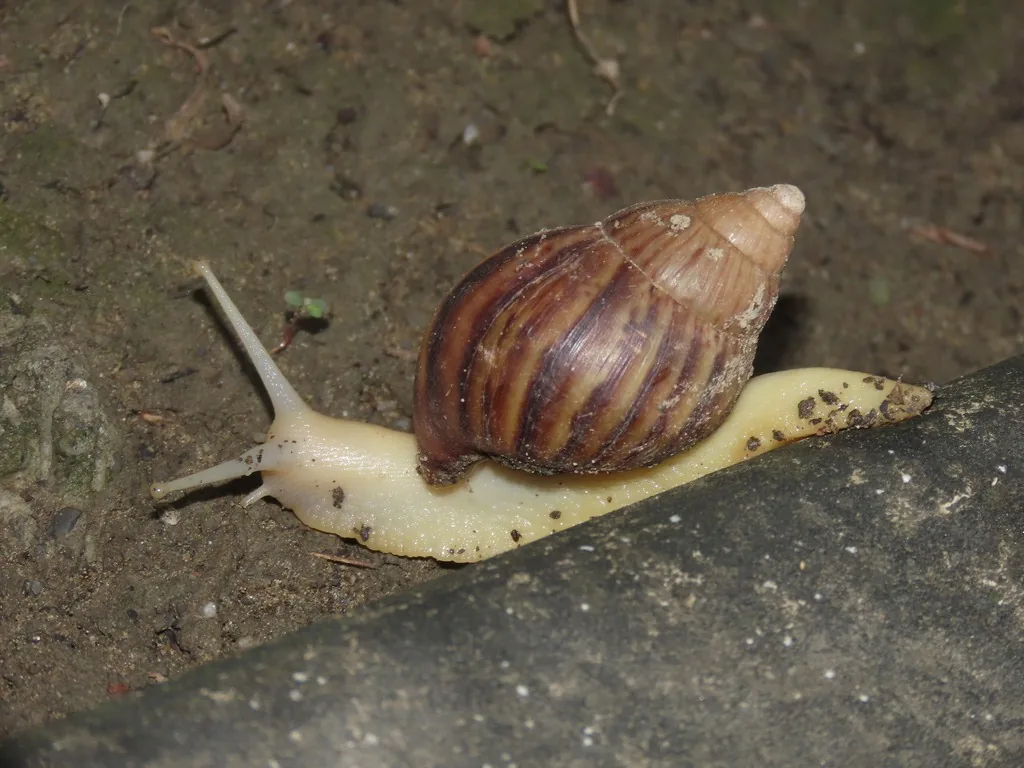
How to identify it
- It can grow to nearly 8 inches long and 5 inches across, making it one of the largest land snails in the world.[1][3]
- The shell is cone-shaped, tapering to a distinct point at one end, and usually light brown with darker brown stripes running lengthwise.[1][3]
- A mature shell has seven to nine whorls.[3]
- Body color varies: FDACS reports dark-shelled snails with grayish-brown flesh as well as lighter snails with milky white flesh, sometimes called albino GALS.[2]
Look-alikes
| Look-alike | How to tell them apart |
|---|---|
| Garden snails | A snail approaching 8 inches with a tall, pointed, cone-shaped shell fits the giant African land snail; if you aren't sure, email a photo to the FDACS helpline instead of handling it.[1][2] |
Where it lives
Native to East Africa and spread through Southeast Asia, Pacific islands, Brazil and the Caribbean. Florida has eradicated it three times, most recently in 2026 in Lee County, and quarantines are in place in Broward and Pasco counties.[1][2]
Biology and life cycle
It rests by day in shaded, humid spots and comes out at night or in wet weather to feed, traveling up to 50 feet in a night and leaving a slime trail.[1]
Each snail has both male and female organs; after mating, it can lay 100 to 500 eggs and produce clutches every two to three months without mating again.[3]
The hard-shelled eggs, about 1/5 inch across, are laid in soil, and hatchlings stay underground for one to two weeks before surfacing.[1]
In dry weather it seals its shell opening and can rest inactive for months, often in moist soil.[1]
It is active at roughly 48 to 90 degrees F and may be able to survive as far north as 40 degrees latitude.[1]
Damage and signs
Health risk
It can carry rat lungworm, a parasite that can cause meningitis. People get infected by eating raw or undercooked snails or produce with snail parts on it, so wear gloves and wash produce well.[4][2][1]
Control
Prevention
Never handle these snails without gloves, and never release, share or keep one; they are illegal to import or possess in the U.S. without a permit.[2][3]
Inside a Florida quarantine area, moving plants, soil, yard waste, compost or building materials out of the area requires a compliance agreement.[2]
Sanitation
For snails in general, removing mulch, dense ground cover, wood and stones and cutting back irrigation takes away the moist shelter they need.[1]
Traps and physical control
Boards, saucers or unglazed pots in shade make refuges you can check by day; UF/IFAS notes banana and papaya attract them.[1]
Pesticides
Molluscicide baits include iron phosphate, metaldehyde and boric acid; iron phosphate is much safer around pets and wildlife, and baits should be scattered thinly, not piled.[1][2]
When to call a professional
Report suspected snails to your state agriculture department or USDA APHIS; in Florida, call the FDACS Division of Plant Industry helpline at 1-888-397-1517 or email DPIHelpline@FDACS.gov.[3][2]
Common questions
- What should I do if I find a giant African land snail?
- Don't touch it with bare hands, don't move or release it, and contact your state agriculture department or USDA; in Florida, email a photo to the FDACS helpline.[3][2]
- Can I keep one as a pet?
- No. Giant African land snails are prohibited in the United States without a permit, and FDACS notes that lighter-colored snails are sought after in the illegal pet trade.[2][3]
- Can touching a giant African land snail make you sick?
- Handling a live snail and then touching your eyes, nose or mouth is a risk, so wear gloves and wash your hands.[3][4]
Sources
- University of Florida IFAS Extension (EDIS), “Giant African Land Snail in Florida, Featured Creatures (EDIS publication IN904).” edis.ifas.ufl.edu/publication/IN904 (accessed 2026-10-06)
- Florida Department of Agriculture and Consumer Services, Division of Plant Industry, “Giant African Land Snail.” www.fdacs.gov/Agriculture-Industry/Pests-and-Diseases/Plant-Pests-and-Diseases/Giant-African-Land-Snail (accessed 2026-10-06)
- USDA Animal and Plant Health Inspection Service, “Pest Alert: Giant African Snails, APHIS 81-35-009 (revised May 2018).” www.aphis.usda.gov/sites/default/files/alert-gas.pdf (accessed 2026-10-06)
- Centers for Disease Control and Prevention, “About Rat Lungworm Disease (June 24, 2024).” www.cdc.gov/angiostrongylus/about/index.html (accessed 2026-10-06)
- iNaturalist, “Lissachatina fulica taxon page (order and family).” www.inaturalist.org/taxa/502885 (accessed 2026-10-06)