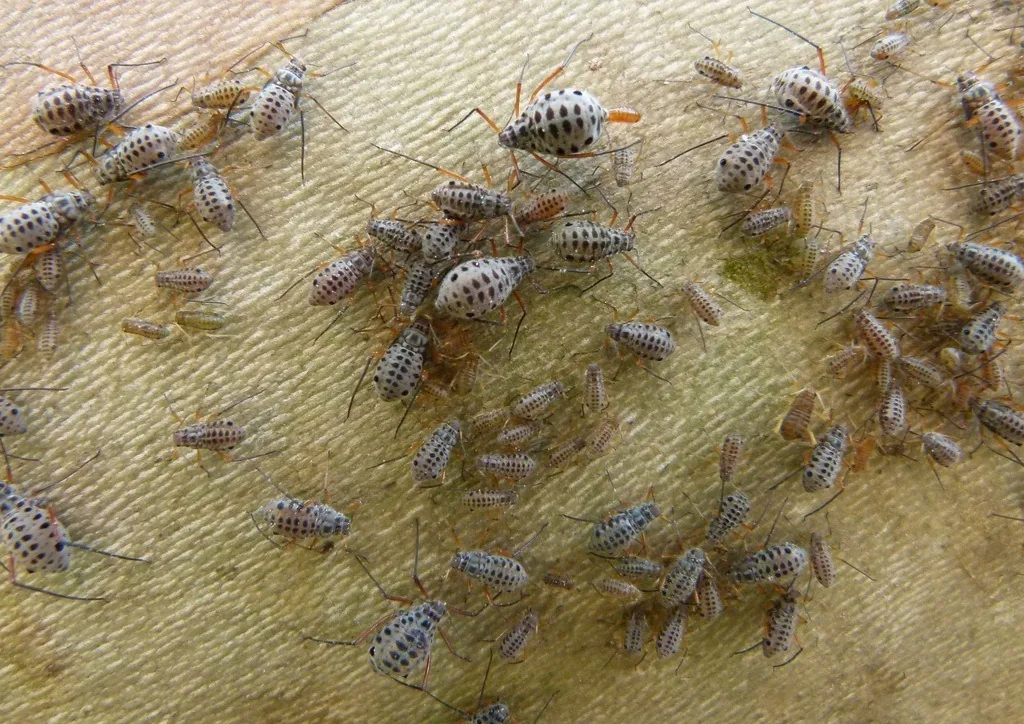
How to identify it
- Aphids are about 1/4 inch long with long legs, light gray to grayish black, with four rows of black spots down the back.[1][2]
- They cluster on the bark of one- to three-year-old stems rather than on leaves, and leave an iodine-colored stain when crushed.[2]
- Winged adults have translucent gray wings.[1]
Where it lives
NC State and Iowa State both report it; populations peak and are most noticed in late summer.[1][2]
Biology and life cycle
During the growing season females give birth to females without mating, so numbers can rise quickly.[1]
In fall, males and egg-laying females appear, and the eggs overwinter on twigs, turning shiny black.[1]
They insert their mouthparts through the bark into the sap-carrying tissue and excrete the excess sugar as honeydew.[1][2]
Damage and signs
- Hosts include basswood, birch, elm, hickory, maple, oak, pecan, sycamore, walnut, wax myrtle and willow.[1][2]
- Heavy honeydew grows sooty mold that can blacken plants; heavy infestations may cause stunting or twig dieback, though healthy trees often tolerate large populations.[1][2]
- Aphids may wander from infested trees onto sidewalks, decks and patios.[2]
Health risk
Control
Biological control
Parasitic wasps, lady beetles, syrphid fly maggots, lacewings and an aphid-killing fungus often reduce populations rapidly.[1]
Pesticides
Control in late summer or fall is usually not warranted; treat early-summer populations on young or stressed plants, and horticultural oils work well.[1][2]
Common questions
- What are the big gray bugs clustered on my tree branches?
- In late summer they are often giant bark aphids, the largest aphid, feeding through the bark.[1][2]
- Why is everything under my tree sticky and black?
- Honeydew from the aphids, with sooty mold growing on it.[1]
- Should I spray giant bark aphids?
- Usually not in late summer or fall; natural enemies often knock them back quickly.[1][2]
Sources
- NC State Extension, “Giant Bark Aphid (PDIC Factsheet).” content.ces.ncsu.edu/giant-bark-aphid (accessed 2026-10-15)
- Iowa State University Extension and Outreach (Yard and Garden), “Giant Bark Aphid.” yardandgarden.extension.iastate.edu/encyclopedia/giant-bark-aphid (accessed 2026-10-15)
- iNaturalist, “Longistigma caryae taxon page (order and family).” www.inaturalist.org/taxa/332640 (accessed 2026-10-06)