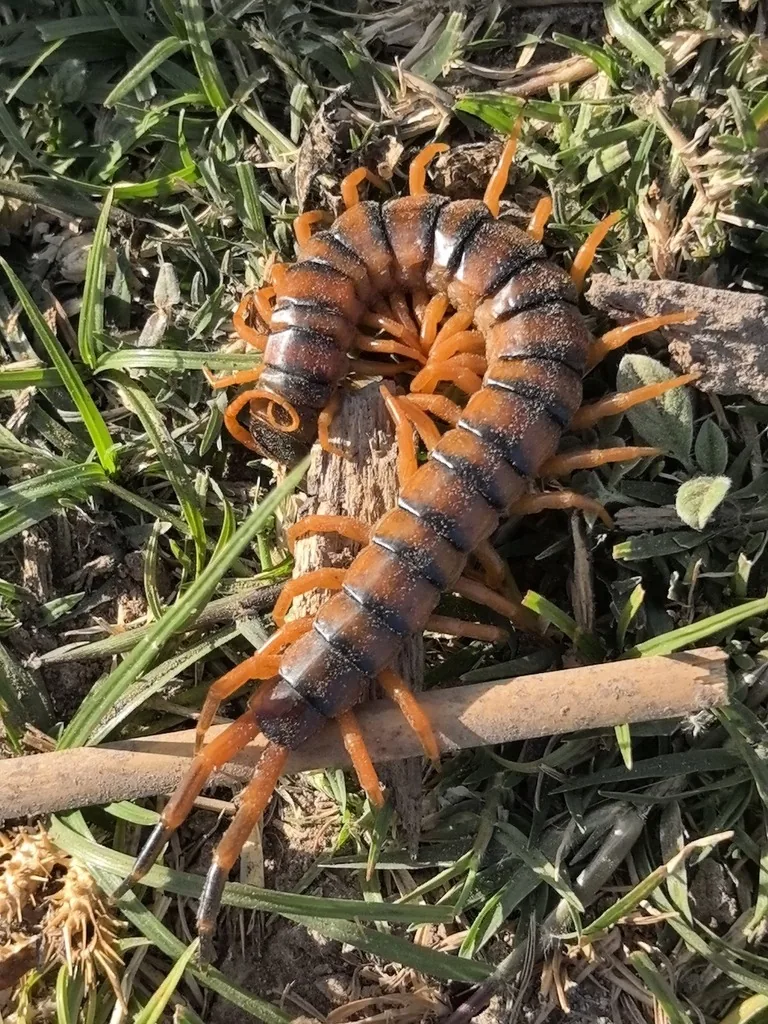
How to identify it
- Adults usually run about 6 to 6 1/2 inches long and can reach about 8 inches, far bigger than any other centipede most people will see.[1][2][3]
- A long, flattened body with 21 pairs of legs, one pair per body segment; the last pair points backward like a pair of tails.[2][3]
- Color varies by region: Arizona animals are often reddish-yellow with dark bluish-black bands, while those farther east have a black body, yellow legs and a rusty red head.[1][2][3]
- The rear legs look like stingers but are grasping legs used to seize prey or pinch; the bite comes from fang-like claws just behind the head.[1][2]
Look-alikes
| Look-alike | How to tell them apart |
|---|---|
| House centipede | Much smaller, with fewer legs that, like its antennae, are very long for its body; it usually turns up in damp spots such as showers and bathtubs.[1] |
| Millipedes | Millipedes have two pairs of legs on most body segments, while centipedes have only one pair per segment.[1][3] |
Where it lives
Found across much of the Southwest and south-central U.S., including Arizona, New Mexico, Texas, Oklahoma, Kansas, Louisiana, Arkansas and southern Missouri, and into northern Mexico.[3][1][2]
Biology and life cycle
It is a predator of insects and other arthropods and will also take small frogs, lizards, snakes and newborn mice.[1][2][3]
It hides by day under rocks, logs, wood piles and leaf litter, often in moist spots or below lights where prey insects gather.[1][2]
Females lay eggs in cavities in rotting wood, then curl around the egg mass and guard the young after they hatch.[2][3]
Young hatch with the full number of legs, start out nearly colorless, and gain adult coloring over time.[2][3]
Damage and signs
Health risk
The bite causes sharp pain and swelling usually no worse than a wasp or bee sting in healthy adults. Infants, older adults, people in poor health or anyone with allergic symptoms such as trouble breathing should get medical care.[2][1]
Control
Prevention
Wear gloves and work carefully when moving firewood, rocks or wood piles, though its fangs may be able to pierce leather gloves.[1][2]
Keep them out
Keep window screens and door weather stripping in good repair and caulk visible cracks so centipedes can't slip inside.[1]
Sanitation
If centipedes keep turning up indoors, look for and manage the cockroaches and crickets they come in to hunt.[1]
Traps and physical control
To remove one found indoors, grab it with kitchen tongs or heavy gloves, drop it into a large lidded jar, and release it outside.[1]
Pesticides
Some sources recommend insecticides for centipedes in and around the home; removing the ones that wander in is another good option.[1]
If you are bitten
Most bites cause intense local pain and swelling that eases over several hours.[2][3]
Seek medical attention if swelling gets worse, breathing becomes difficult, or other symptoms develop.[2]
Watch the wound, since secondary infection is an added risk with centipede bites.[1]
Common questions
- Is the giant desert centipede deadly?
- No credible reports show it kills healthy people; most authorities say a bite causes intense pain and swelling similar to a wasp or scorpion sting.[2]
- Are the back legs stingers?
- No. The last pair of legs grasps prey and can pinch, but the venom is delivered by fang-like claws just behind the head.[1][2]
- Will a centipede chase or attack me?
- No. Reported attacks are most likely centipedes trying to escape by running under a shoe or up a pant leg, not attacking.[1]
Sources
- University of Arizona Cooperative Extension, Yavapai County, “Backyard Gardener #53: Centipedes (January 15, 2023).” extension.arizona.edu/sites/extension.arizona.edu/files/barnesm/Centipedes.pdf (accessed 2026-10-06)
- Missouri Department of Conservation, “Giant Redheaded Centipede (Field Guide).” mdc.mo.gov/discover-nature/field-guide/giant-redheaded-centipede (accessed 2026-10-06)
- University of Arkansas Arthropod Museum, “Giant Redheaded Centipede, Scolopendra heros.” arthropod.uark.edu/giant-redheaded-centipede/ (accessed 2026-10-06)
- iNaturalist, “Scolopendra heros taxon page (order and family).” www.inaturalist.org/taxa/146601 (accessed 2026-10-06)