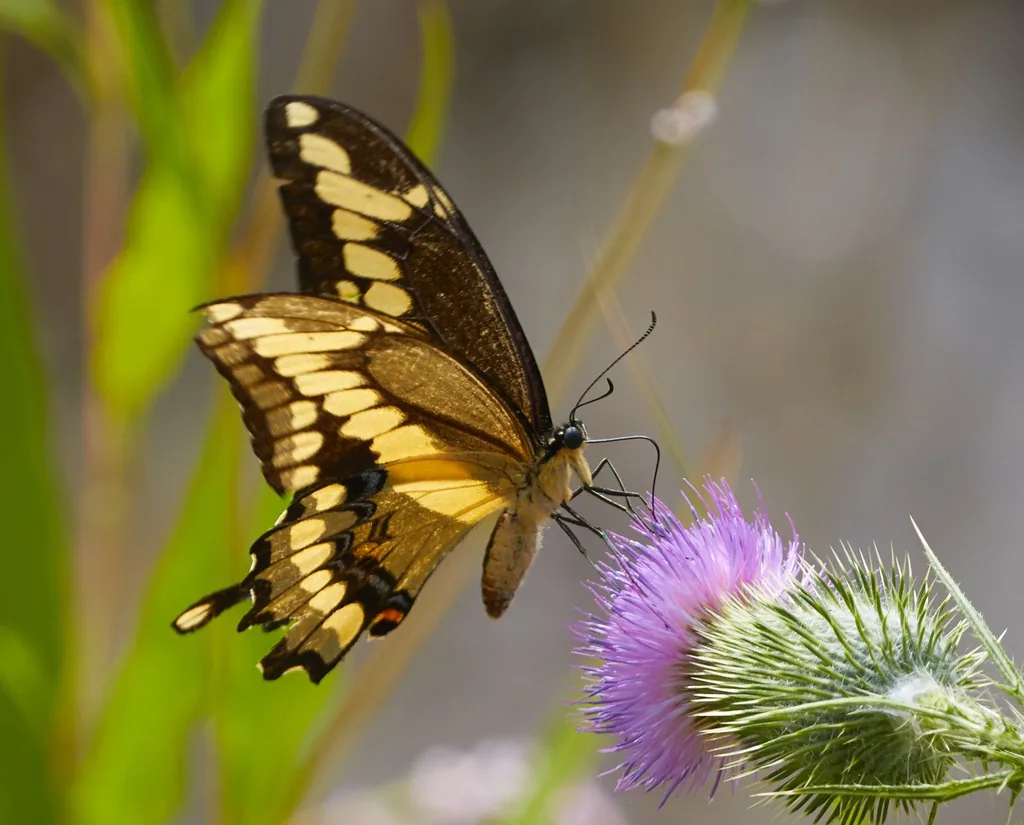
How to identify it
- Caterpillars mimic bird droppings, especially young ones resting on upper leaf surfaces.[1]
- When disturbed, larvae push out a forked organ (osmeterium) that may resemble a snake's tongue.[1]
- Adults are large black butterflies with a diagonal yellow bar across the forewings and mostly yellow undersides.[1]
Where it lives
It ranges from southern New England and the Great Lakes south to Florida and west to the Rockies.[1]
Biology and life cycle
Larvae go through five instars, feeding mostly at night, and pupate on twigs or nearby fences.[1]
Damage and signs
- A few orangedogs can quickly defoliate small or young citrus.[1]
Health risk
It feeds on citrus leaves; UF/IFAS mentions no risk to people.[1]
Control
Traps and physical control
On small trees, remove caterpillars by hand; large trees tolerate them.[1]
Biological control
Tachinid flies and parasitic wasps attack the pupae.[1]
Common questions
Sources
- University of Florida IFAS Extension (Featured Creatures), “Giant Swallowtail, Orangedog, Papilio cresphontes (EENY-008).” edis.ifas.ufl.edu/publication/IN134 (accessed 2026-10-06)
- iNaturalist, “Heraclides cresphontes taxon page (order and family).” www.inaturalist.org/taxa/85024 (accessed 2026-10-06)