Pest profile

Giant Woolly Bear

Hypercompe scribonia · Lepidoptera: Erebidae[2]

The giant woolly bear is a large, stiff-haired black caterpillar that grows into the white, black-spotted giant leopard moth.[1]

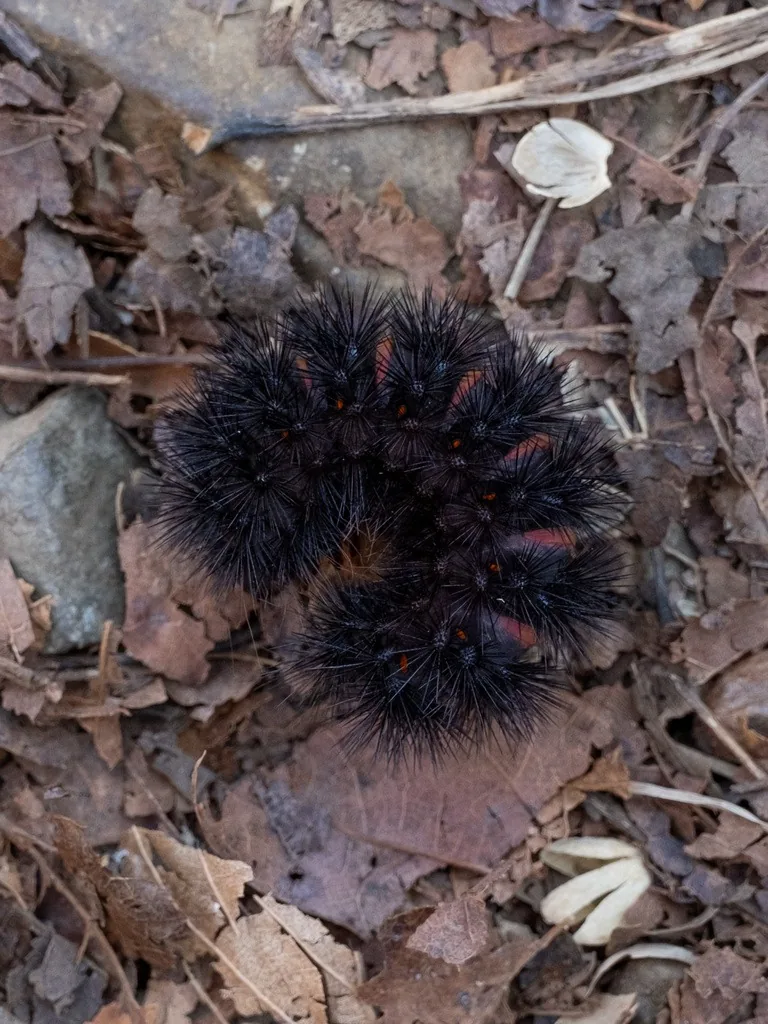
Giant woolly bear, a black caterpillar covered in stiff black bristles, curled on the ground
Giant woolly bear, a black caterpillar covered in stiff black bristles, curled on the ground. (c) Alex Abair, some rights reserved (CC BY) — via iNaturalist, CC BY 4.0

How to identify it

  • Full-grown caterpillars are about 3 inches long and covered with stiff black setae.[1]
  • Early instars have orange and dark brown segments with orange lines along the body.[1]

Where it lives

The giant leopard moth occurs from southern Ontario south to Florida and west to Minnesota and Texas.[1]

US map: public records from 36 states since 1990 (GBIF).

Biology and life cycle

Eggs are nearly spherical, about 0.8 mm across.[1]

Damage and signs

  • The giant leopard moth isn't economically important.[1]

Health risk

Tiger moth larvae like this one lack stinging spines and don't bite.[1]

Control

Prevention

Control measures are neither recommended nor required.[1]

Common questions

What's the big black fuzzy caterpillar?
Possibly a giant woolly bear, the larva of the giant leopard moth.[1]
What does it become?
A white moth with black spots, the giant leopard moth.[1]

Sources

  1. University of Florida IFAS Extension (Featured Creatures), “Giant Woolly Bear, Giant Leopard Moth, Hypercompe scribonia (EENY-599).” edis.ifas.ufl.edu/publication/IN1043 (accessed 2026-10-06)
  2. iNaturalist, “Hypercompe scribonia taxon page (order and family).” www.inaturalist.org/taxa/63028 (accessed 2026-10-06)

Updated 2026-10-14. Built from sourced records. Spot an error? Tell us.