How to identify it
- The largest lizard native to the United States, reaching about 20 inches long and up to two pounds.[2]
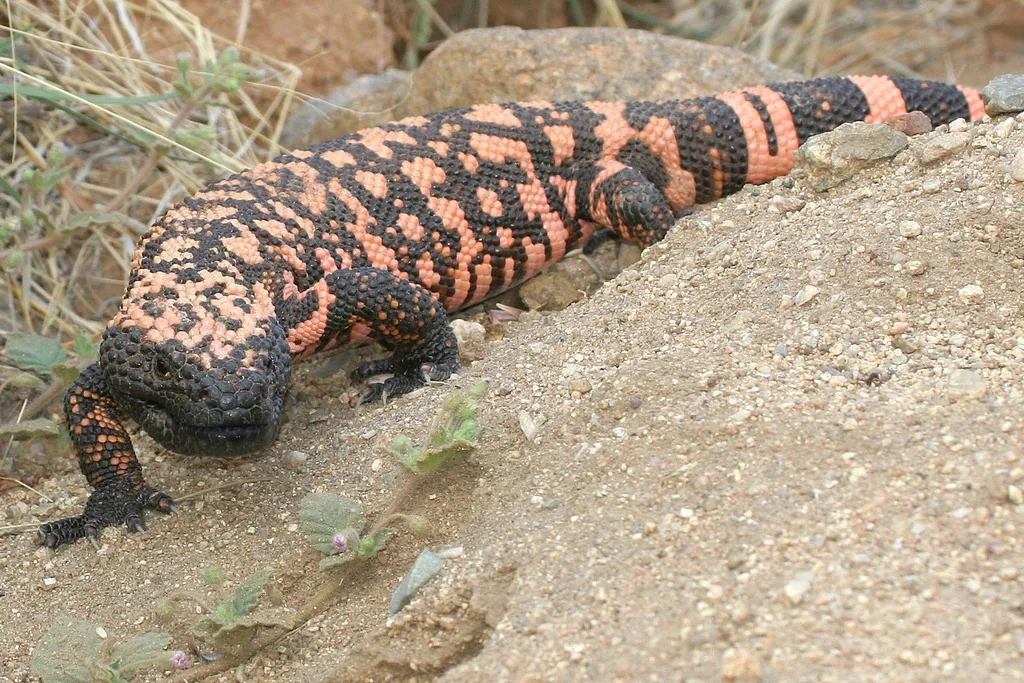
- Bright pink, salmon or coral and black skin, usually in a netlike (reticulated) pattern.[1][2][3]
- The skin looks beaded because small bony disks called osteoderms sit under the scales.[1][2]
- A large head with small, beady eyes, bulges along the lower jaw where the venom glands sit, and a short, fat tail.[1][2]
Where it lives
Found mainly in western and southern Arizona south into Sonora, Mexico, and also in extreme southeastern California, southern Nevada, extreme southwestern Utah and southwestern New Mexico.[1]
Biology and life cycle
Most common in desert foothills with saguaros and palo verde, it also uses washes and, in Utah, rocky bluffs and sandy canyons around St. George.[1][2]
It spends over 95 percent of its time hidden in burrows, either dug by other animals or by itself.[2][1]
It is active mainly by day from March through November and hibernates over winter; in Utah, activity peaks in April and May.[1][2]
It eats newborn rodents and rabbits, plus ground-nesting birds, lizards and eggs; a young Gila monster may eat half its body weight at once.[1]
Females lay about five eggs, sometimes up to 12, in late summer; the eggs overwinter and hatch the next spring.[1]
Damage and signs
Health risk
The bite is extremely painful, and the lizard may hang on for minutes. Swelling, nausea, vomiting, weakness and sweating can follow; serious reactions occur, but no human death has been documented in decades.[3][1][2]
Control
Prevention
Do not approach, pick up or carry a Gila monster. Move away slowly; left alone, it will likely move on within a couple of hours.[2]
Keep children and pets away while it is in the yard, and watch from a distance; it is shy and uses its venom as a defensive weapon.[2][3][1]
When to call a professional
If one is on residential property and won't leave, contact your state wildlife agency; Utah residents can call the Division of Wildlife Resources.[2]
Legal protection
In 1952 the Gila monster became the first venomous animal in North America given legal protection; it is illegal to collect, kill or sell one in Arizona.[1]
Arizona law protects Gila monsters from being captured or held in any manner.[3]
In Utah they are protected by state and federal laws that prohibit collecting them from the wild, even though the species is not federally endangered.[2]
If someone is bitten
Remove the lizard as quickly as possible; the poison center suggests prying the jaws open with a strong stick while the lizard keeps a foothold on the ground.[3]
Rinse the wound with plenty of water, keep the limb still at heart level, and call Poison Control at 1-800-222-1222.[3]
Do not use ice, a tourniquet or any attempt to suck out venom; get medical care right away.[2][3]
There is no antivenom; doctors check the wound for broken-off teeth, update tetanus shots and watch for infection.[3]
Common questions
- Is a Gila monster dangerous?
- Its bite is venomous and very painful but rarely life-threatening. Bites almost always happen when people handle or harass the lizard.[1][3][2]
- Can I kill or relocate a Gila monster in my yard?
- No. It is illegal to kill or collect one in Arizona, and Utah prohibits picking up or carrying one; leave it alone or call your state wildlife agency.[1][2]
- When are Gila monsters most likely to be seen?
- Mostly in spring; in Utah, daytime activity peaks in April and May, with some activity on warm summer nights through August.[2]
Sources
- Arizona-Sonora Desert Museum, “Gila Monster (Heloderma suspectum), from A Natural History of the Sonoran Desert.” desertmuseum.org/books/nhsd_gila.php (accessed 2026-10-06)
- Utah Division of Wildlife Resources, “Gila Monsters in Utah (brochure).” wildlife.utah.gov/pdf/gila_monster_brochure.pdf (accessed 2026-10-06)
- Arizona Poison and Drug Information Center, University of Arizona College of Pharmacy, “Gila Monster (venomous creatures).” azpoison.com/venom/gila-monster (accessed 2026-10-06). Regional poison control center operated by the University of Arizona.
- iNaturalist, “Heloderma suspectum taxon page (order and family).” www.inaturalist.org/taxa/35003 (accessed 2026-10-06)