How to identify it
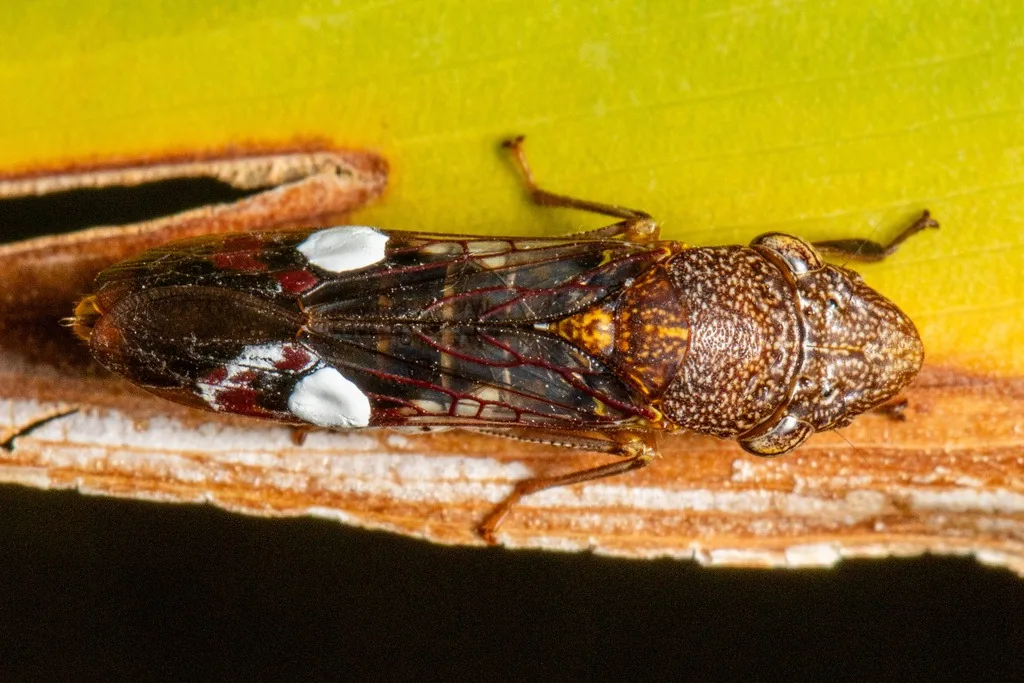
- Adults are large leafhoppers about 1/2 inch long, dark brown to black from above and the side, with a whitish or yellow abdomen.[1]
- The head is brown to black with many ivory to yellowish spots.[1]
- Females carry chalky white spots on their wings shortly before laying eggs.[1]
- Nymphs are smaller, wingless and olive-gray with bulging eyes.[1]
Look-alikes
| Look-alike | How to tell them apart |
|---|---|
| Smoke-tree sharpshooter | This native desert relative has wavy light lines on its head instead of spots.[1] |
Where it lives
Native to the southeastern U.S., it reached Southern California around the late 1980s and is established there and in parts of the San Joaquin Valley.[1]
Biology and life cycle
Females lay masses of 8 to 12 eggs under the skin of the lower leaf surface, leaving brown scars after hatching.[1]
In Southern California and the San Joaquin Valley there are typically two generations a year; adults overwinter on citrus and other evergreen plants.[1]
It feeds on hundreds of plant species, including citrus, avocado, crape myrtle, grape, photinia, pittosporum and some roses.[1]
Damage and signs
Health risk
It feeds only on plant xylem; UC IPM describes no risk to people.[1]
Control
Prevention
Help slow its spread by not moving host plants out of infested areas.[1]
Biological control
Home management relies on natural enemies, so avoid broad-spectrum insecticides that kill them.[1]
When to call a professional
If you find one where it isn't established in California, call the CDFA pest hotline at 1-800-491-1899 or your county agricultural commissioner.[1]
Common questions
- Why are my car and patio covered with white spots under a tree?
- Large glassy-winged sharpshooter populations excrete liquid that dries white on leaves, fruit and cars.[1]
- Where do I look for them?
- Check about 6 inches to a foot back from new shoot tips; they hide by circling to the far side of the twig.[1]
Sources
- University of California Statewide IPM Program, “Pest Notes: Glassy-winged Sharpshooter (Publication 7492).” ipm.ucanr.edu/PMG/PESTNOTES/pn7492.html (accessed 2026-10-06)
- iNaturalist, “Homalodisca vitripennis taxon page (order and family).” www.inaturalist.org/taxa/199381 (accessed 2026-10-06)