How to identify it
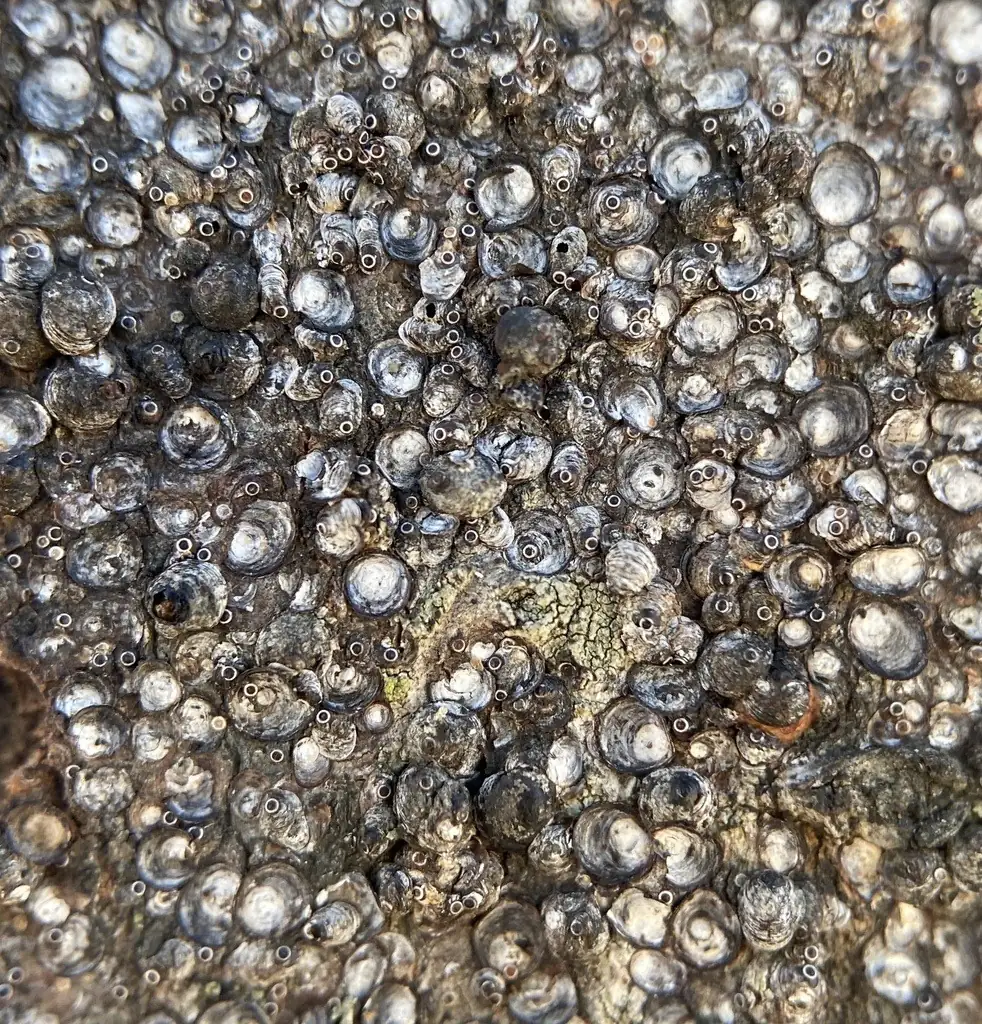
- Female covers are round, gray to brown with a darker or paler center ring, convex, and about 2 to 3 mm (1/8 inch) across; they blend in with the bark.[1][2]
- Under the cover the female is pink, legless and wingless; male covers are smaller and oval, and crawlers are orange.[1][2]
- Heavily infested bark looks darkened and bumpy, warty up close or grainy from a distance, unlike the smooth bark of young maples.[1][2]
Look-alikes
| Look-alike | How to tell them apart |
|---|---|
| Other armored scales | Dead scale covers stay on the bark for years, so check that covers are alive before treating.[1][2] |
Where it lives
It occurs across the Southeast, north to Maryland, south to Florida and west to Texas, and is more abundant on city trees than in natural areas.[1]
Biology and life cycle
There is one generation a year.[1][2]
In North Carolina, crawlers emerge for 6 to 8 weeks starting in early May; in Maryland, the time to look for crawlers is mid-July to late August.[1][2]
Crawlers settle, insert their mouthparts and start building a cover; males emerge in August to mate.[1]
Damage and signs
- Red maple is the main host; sugar maple, elm, tulip poplar, hackberry, sweetgum, mulberry, hollies, catalpa, sycamore and grape are also attacked.[1][2]
- Scales feed on bark tissue, robbing the tree of nutrients and energy and possibly injecting toxins in their saliva.[1]
- Moderate infestations cause stunting and twig dieback; heavy or prolonged ones kill branches or whole trees.[1][2]
Health risk
Control
Prevention
Plant red maples away from large paved areas (NC State suggests avoiding sites with more than 60% impervious surface) and water to reduce drought stress.[1][2]
Avoid excess nitrogen fertilizer, which can increase scale numbers.[1][2]
Traps and physical control
Before treating, confirm scales are alive: flip a cover to look for a pink female or scrape them for pink or yellow juice; dry, flaky covers are dead.[1]
Biological control
Parasitic wasps in Encarsia, Signiphora and Ablerus attack it, with help from lacewings, lady beetles and predatory midges.[1]
Pesticides
When warranted, Maryland Extension recommends dormant oil combined with systemic or growth-regulating insecticides timed to crawlers, and having a certified arborist evaluate mature trees.[2]
Common questions
- Why is my red maple dying back with bumpy gray bark?
- Gloomy scale may cover the bark in overlapping round covers, causing dieback; it is worst on trees near pavement.[1][2]
- How do I know if the scales are alive?
- Flip covers to look for pink females or scrape them for pink or yellow juice; dead covers are dry and flaky.[1]
- When should gloomy scale be treated?
- Treatments target the crawlers, which appear in early May in North Carolina and mid-July to late August in Maryland.[1][2]
Sources
- NC State Extension, “Gloomy Scale, Melanaspis tenebricosa (Entomology Insect Notes).” content.ces.ncsu.edu/gloomy-scale-1 (accessed 2026-10-15)
- University of Maryland Extension, “Gloomy Scale.” extension.umd.edu/resource/gloomy-scale (accessed 2026-10-15)
- iNaturalist, “Melanaspis tenebricosa taxon page (order and family).” www.inaturalist.org/taxa/48083 (accessed 2026-10-06)