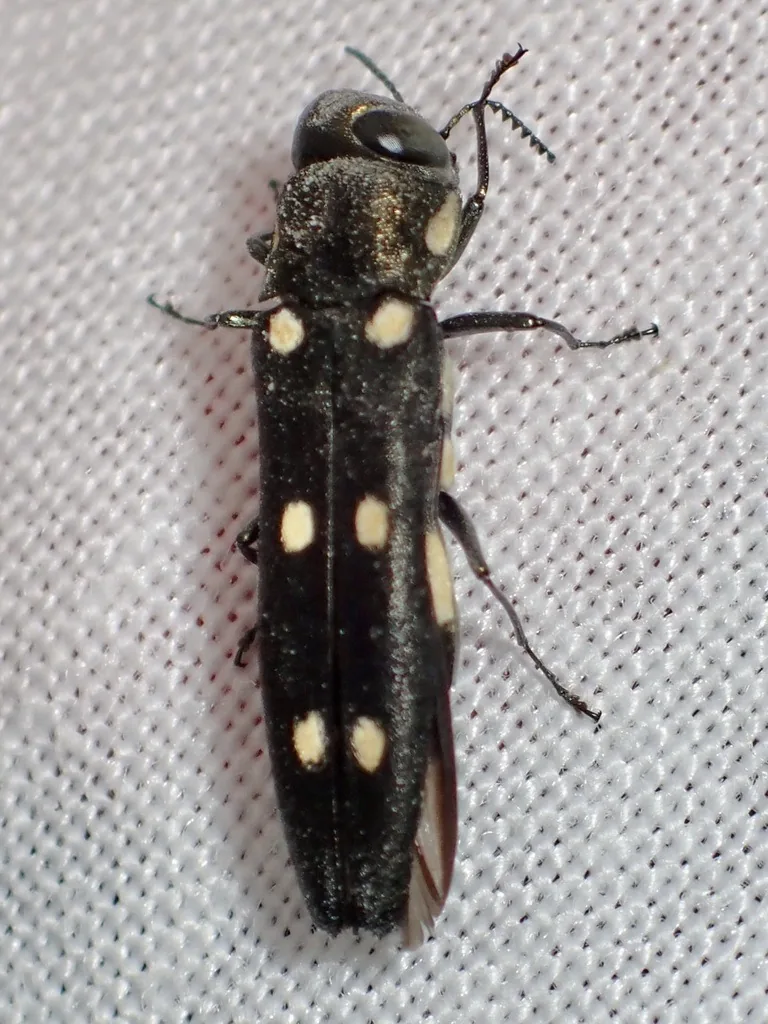
How to identify it
- Adults are bullet-shaped beetles about 10 mm long, black or iridescent green, with six gold spots on the wing covers and two on the thorax.[1]
- Signs on trees are crown thinning, dark bark staining, woodpecker damage to bark, and D-shaped exit holes.[1]
- Larvae are white and legless with two pincer-like spines at the tail, found only by cutting deep into bark.[1]
Where it lives
Introduced to San Diego County in the late 1990s or early 2000s and found in Riverside County in 2012, it's expected to spread to other parts of California.[1]
Biology and life cycle
It attacks only oaks, mainly the red oak group: coast live oak and California black oak, plus canyon live oak.[1]
It prefers mature trees; oaks 18 inches or more in trunk diameter are the most likely to die.[1]
Larvae feed under the bark at the wood surface, girdling the cambium.[1]
Damage and signs
- Years of repeated larval feeding cause decline and eventually kill trees.[1]
Health risk
It attacks oaks only; UC IPM mentions no risk to people.[1]
Control
Prevention
Don't move oak firewood; human transport is how it reached California.[1]
When to call a professional
Owners of high-value red oaks near infested areas should have a management plan for monitoring, removal, wood disposal and possible preventive treatment.[1]
Carbaryl products are restricted-use in California and need a licensed applicator.[1]
Common questions
Sources
- University of California Statewide IPM Program, “Pest Notes: Goldspotted Oak Borer (Publication 74163).” ipm.ucanr.edu/PMG/PESTNOTES/pn74163.html (accessed 2026-10-06)
- iNaturalist, “Agrilus auroguttatus taxon page (order and family).” www.inaturalist.org/taxa/1223427 (accessed 2026-10-06)