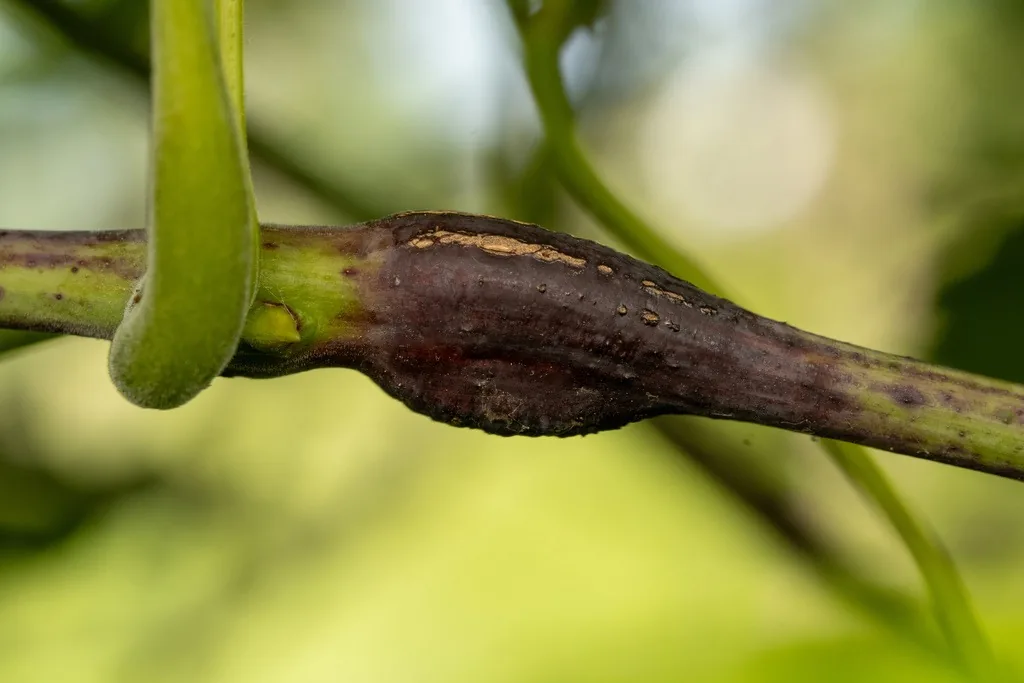
How to identify it
Look-alikes
| Look-alike | How to tell them apart |
|---|---|
| Grape cane girdler | A close relative that rings canes with punctures so the tips break off; it prefers Virginia creeper.[1] |
Where it lives
It's a common grape pest in Kentucky, with galls usually along vineyard borders near wooded, trashy areas or at row ends.[1]
Biology and life cycle
In May and June the female lays an egg in holes she chews just above a node when canes are 10 to 20 inches long.[1]
The larva feeds inside the swelling, pupates there, and adults emerge in August and overwinter in trashy borders.[1]
Damage and signs
- Most galls sit beyond the fruit clusters and usually cause no serious yield loss; galled canes can still bear the next year.[1]
Health risk
It feeds on plants; UK Extension mentions no risk to people.[1]
Control
Sanitation
If galls will be pruned out, do it by mid-July, before adults leave the galls.[1]
Pesticides
Insecticides usually aren't needed because the injury doesn't reduce yield.[1]
Common questions
Sources
- University of Kentucky Entomology (ENTFACT), “Grape Cane Gallmaker and Grape Cane Girdler (ENTFACT-223).” entomology.mgcafe.uky.edu/ef223 (accessed 2026-10-06)
- iNaturalist, “Ampeloglypter sesostris taxon page (order and family).” www.inaturalist.org/taxa/497178 (accessed 2026-10-06)