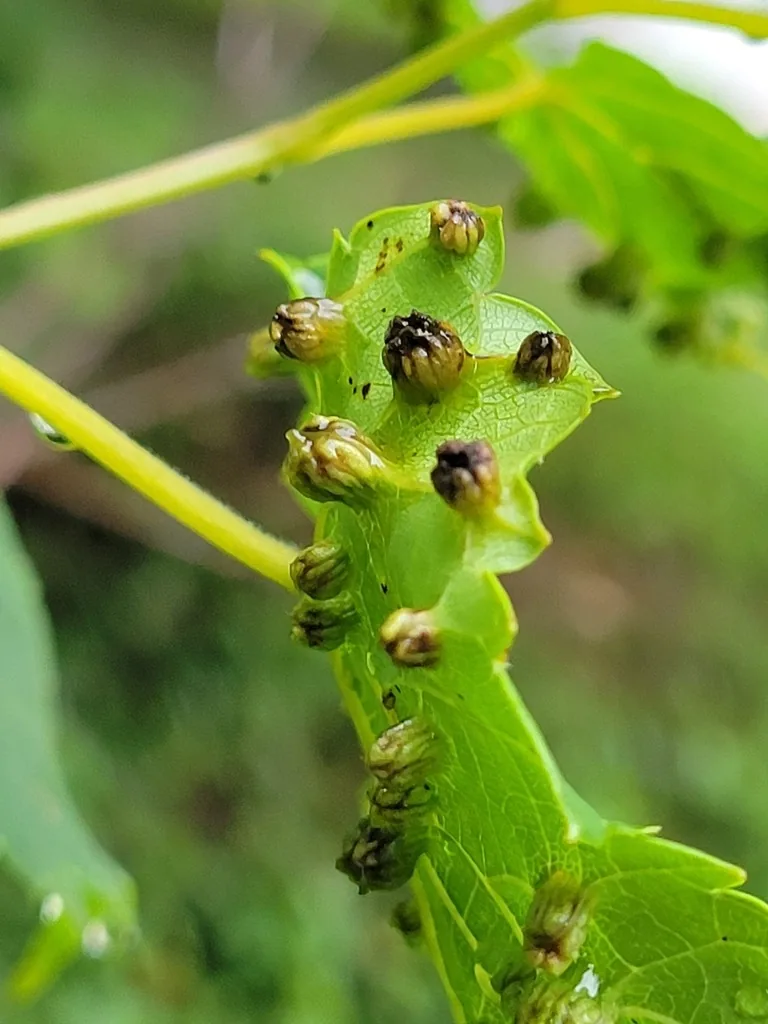
How to identify it
- They're oval to pear-shaped and 1/25 inch or less, bright yellow on healthy roots, visible with a 10X hand lens.[1]
- Infested root tips swell, turn yellowish and bend into clubbed shapes.[1]
- Leaf-galling forms, common in the eastern U.S., raise warty green swellings on leaves, sometimes dozens per leaf.[1]
Where it lives
Leaf-galling forms are abundant in the eastern United States. In California, root feeders do the most harm in heavy clay soils of cooler regions such as Napa, Sonoma and Mendocino.[1]
Biology and life cycle
Young nymphs overwinter on roots and start feeding when soil passes 60 degrees F; females lay up to 300 eggs.[1]
Crawlers spread through soil cracks, on wind, and on boots, tools and cuttings.[1]
There are 3 to 5 generations a year, more in warm regions.[1]
Damage and signs
Health risk
It feeds on grapevines only; UC IPM mentions no risk to people.[1]
Control
Prevention
Plant grapes on phylloxera-resistant rootstocks, or in sandy soil, the only completely effective methods.[1]
Sanitation
Clean boots, tools and equipment that touch infested vines, and don't move cuttings from infested plants.[1]
Pesticides
Insecticides are believed to be of little use on home-grown vines.[1]
Common questions
Sources
- University of California Statewide IPM Program, “Grape Phylloxera (Pests in Gardens and Landscapes).” ipm.ucanr.edu/PMG/GARDEN/FRUIT/PESTS/grapephylloxera.html (accessed 2026-10-06)
- iNaturalist, “Daktulosphaira vitifoliae taxon page (order and family).” www.inaturalist.org/taxa/324587 (accessed 2026-10-06)