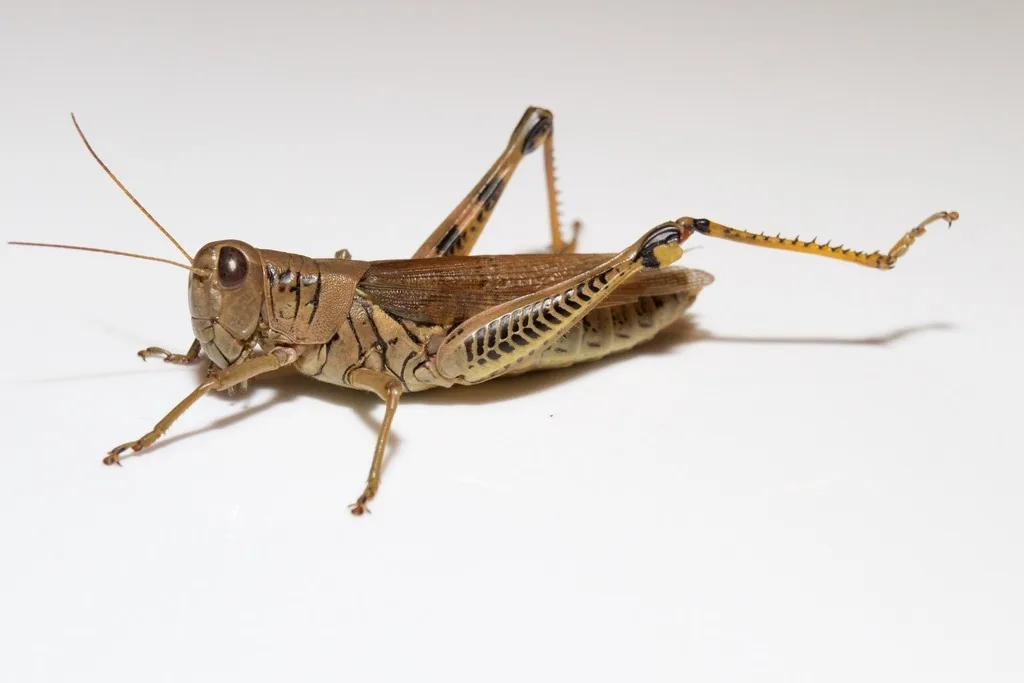
How to identify it
- Grasshoppers have a robust body, relatively short antennae, and hind legs with greatly enlarged thighs (femurs) built for jumping.[1]
- Most are winged and many fly well, although a few species are flightless.[1]
- The differential grasshopper is brown to olive green and yellow, up to about 1 3/4 inches long, with black chevron markings on the hind thighs.[3][4]
- Some differential grasshoppers are entirely black throughout their lives.[3][4]
- Nymphs look like small wingless adults, with wing pads that grow at each molt.[3]
Look-alikes
| Look-alike | How to tell them apart |
|---|---|
| Crickets | Crickets belong to the same insect order but have long antennae instead of the grasshopper's short ones.[1] |
| Katydids and Mormon crickets | Also have long antennae; the Mormon cricket of western rangelands is a longhorned grasshopper related to katydids, not a true grasshopper.[1][2] |
Where it lives
Many species occur across North America; the differential grasshopper ranges widely, with the largest populations in cropland between the Rocky Mountains and the Mississippi River.[4][2][1]
Biology and life cycle
In late summer and fall, females lay pods of eggs in the top inch or two of dry, undisturbed soil along roadsides, ditch banks, fencerows and pastures, rarely in tilled gardens.[1][2][3]
Most species spend winter as eggs, which hatch in spring as the soil warms.[1][2][3]
Nymphs molt five or six times over several weeks; there is usually one generation a year.[1][2][3]
Adults live two to three months or longer and die out with frost or when food runs out.[1][2]
Severe outbreaks usually come every 8 to 10 years, after warm, moist springs grow plenty of food in uncultivated areas.[1]
Damage and signs
- They chew large sections of leaves and flowers and can eat entire plants.[1][3]
- Favorites include lettuce, beans, sweet corn, carrots, onions and some annual flowers; squash, peas and tomato foliage tend to be avoided.[1][2]
- Garden damage is usually limited to a few weeks in early summer after range weeds dry up, but in outbreak years it lasts much longer.[1][2]
- Nymphs can build up unnoticed in tall weeds, then fly in as adults and suddenly damage landscape and vegetable plants.[3]
Health risk
Grasshoppers are medically harmless.[3]
Control
Prevention
Keep a border of tall grass or lush plants around the garden as a trap crop, and don't mow it or let it dry out, or the grasshoppers will move in.[1]
Keep them out
Cones, screened boxes and row covers give some protection; hungry grasshoppers chew through cloth or plastic, so metal window screening works better.[1]
Traps and physical control
When numbers are low, handpick and squash them.[1]
Biological control
Birds, blister beetles, robber flies, parasitic flies and diseases kill many grasshoppers; chickens and guinea hens eat them too but may damage plants.[1][2]
Nosema locustae baits infect young nymphs only, act slowly, and work best in long-term programs on breeding sites rather than in invaded gardens.[1][2]
Pesticides
Treat young nymphs at egg-laying and breeding sites early in the season; once adults migrate into gardens, sprays have limited effect.[2][1]
Carbaryl baits around garden borders before grasshoppers arrive are less hazardous to bees than sprays, but need reapplying after rain or irrigation.[1][2]
Sprays such as carbaryl or pyrethroids are very toxic to bees, natural enemies and aquatic life; reserve them for serious situations and follow the label.[1]
Common questions
- Why are there so many grasshoppers this year?
- Populations swing from year to year with weather; warm, moist springs that produce lots of food in uncultivated areas can let numbers build to outbreak levels.[1][2]
- Should I spray grasshoppers already in my garden?
- Once they have invaded, insecticides aren't very effective and must be reapplied every few days; physical barriers and handpicking are often the practical options.[1]
- What are the stiff dead grasshoppers clinging to plant stems?
- They were likely killed by a fungal disease that makes infected grasshoppers climb and cling to plants shortly before they die.[2]
Sources
- University of California Statewide IPM Program, “Pest Notes: Grasshoppers, Publication 74103.” ipm.ucanr.edu/home-and-landscape/grasshoppers/ (accessed 2026-10-06)
- Colorado State University Extension, “Grasshopper Control in Gardens and Small Acreages (Fact Sheet 5.536).” extension.colostate.edu/resource/grasshopper-control-in-gardens-and-small-acreages/ (accessed 2026-10-06)
- Texas A&M AgriLife Extension, Department of Entomology, “Differential Grasshopper (Field Guide to Common Texas Insects).” texasinsects.tamu.edu/differential-grasshopper/ (accessed 2026-10-06)
- University of Wyoming, Department of Entomology, “Differential Grasshopper, Melanoplus differentialis (Grasshoppers of Wyoming and the West field guide).” www.uwyo.edu/entomology/grasshoppers/field-guide/medi.html (accessed 2026-10-06)
- iNaturalist, “Melanoplus differentialis taxon page (order and family).” www.inaturalist.org/taxa/63518 (accessed 2026-10-06)